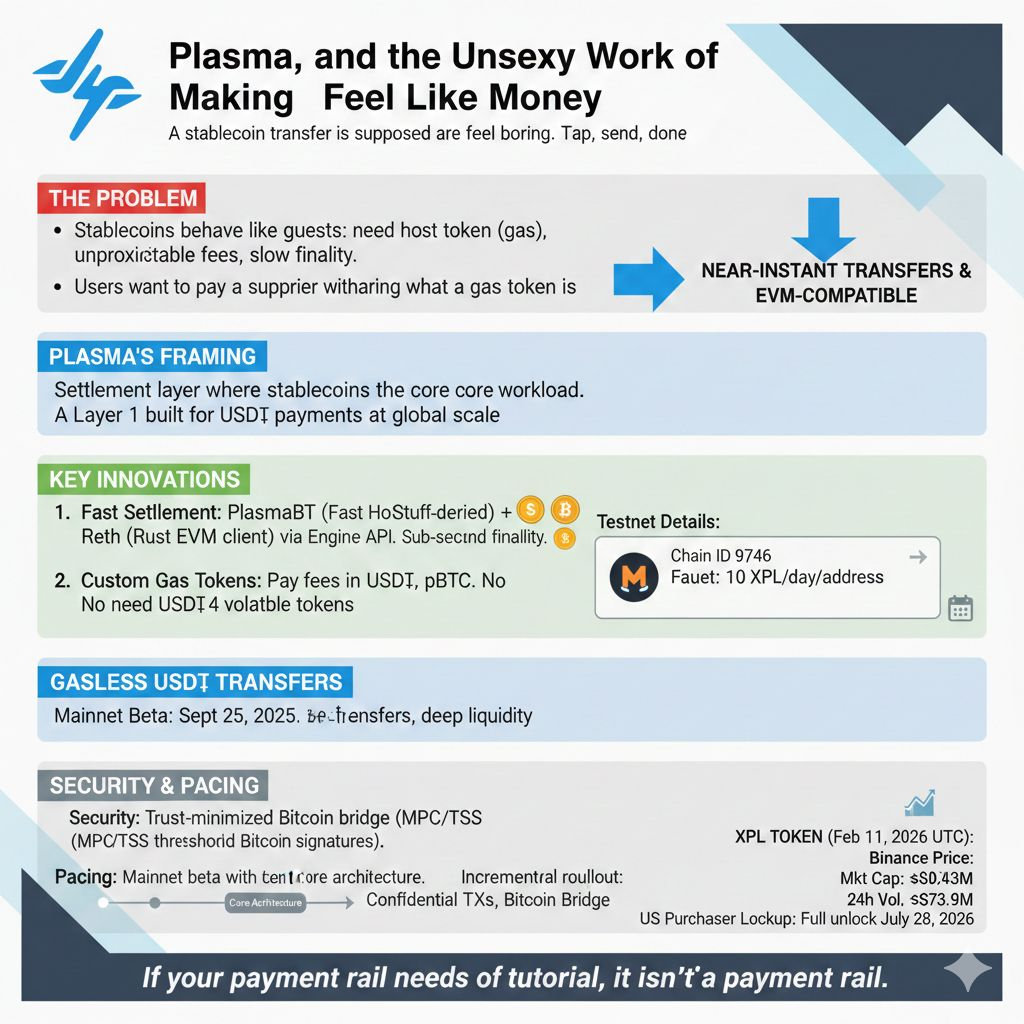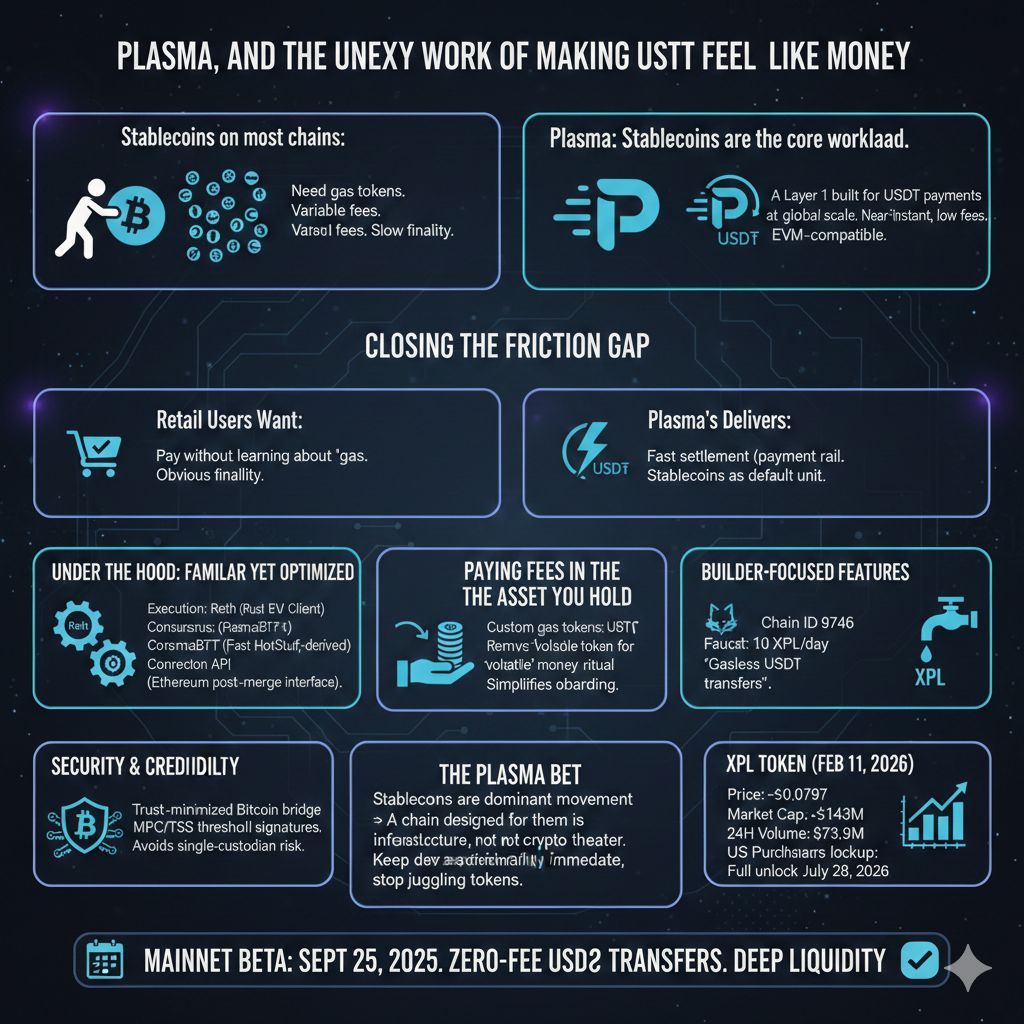
A stablecoin transfer is supposed to feel boring. Tap, send, done. But on most chains, stablecoins still behave like guests at someone else’s party: they move only if you also carry the host’s token for gas, accept whatever fee spikes show up, and wait long enough to feel “sure” the payment won’t get reorganized.That’s why Plasma’s framing matters. It isn’t trying to be the chain for everything. It’s trying to be the settlement layer where stablecoins aren’t an app category — they’re the core workload. The homepage language is blunt about it: a Layer 1 built for USD₮ payments at global scale, aiming for near-instant transfers and low fees while staying EVM-compatible.The design choices get more interesting when you look at where the friction actually lives in real usage. Retail users in high-adoption markets don’t wake up wanting “blockspace.” They want to pay a supplier without learning what a gas token is. Merchants don’t want a payment that’s technically final in a few minutes; they want it to be obviously final while a customer is still standing there. That’s the gap Plasma is trying to close with two linked decisions: make settlement fast enough to feel like a payment rail, and make stablecoins the default unit the system is optimized around.Under the hood, Plasma is basically saying: keep the developer surface area familiar, then change the chain behavior where it counts. Execution is built on Reth (a Rust Ethereum execution client), and consensus is PlasmaBFT (a Fast HotStuff-derived BFT design) — with the docs explicitly describing how Reth and PlasmaBFT connect via the Engine API, i.e., the same interface Ethereum uses post-merge. That’s a fancy way of saying builders don’t need a new mental model to deploy contracts, but the chain can still chase sub-second finality and predictable throughput for payment-style flows.Here’s the part that quietly changes behavior: paying fees in the asset people actually hold. Plasma supports “custom gas tokens,” with initial support including USD₮ and BTC bridged as pBTC. That matters because it removes the weird “I need a volatile token to move my non-volatile money” ritual. It also changes the onboarding slope for apps: wallets and payment flows can keep the user inside stablecoin reality instead of forcing a detour into exchange screens.And then there’s the small, practical stuff that tells you the team expects builders, not just headlines. On the testnet, you can literally add the network to MetaMask with Chain ID 9746, and the faucet drips 10 XPL per day per address. That’s not a marketing feature — it’s the kind of detail that makes it easy to actually test a checkout flow or a payroll contract without ceremony.
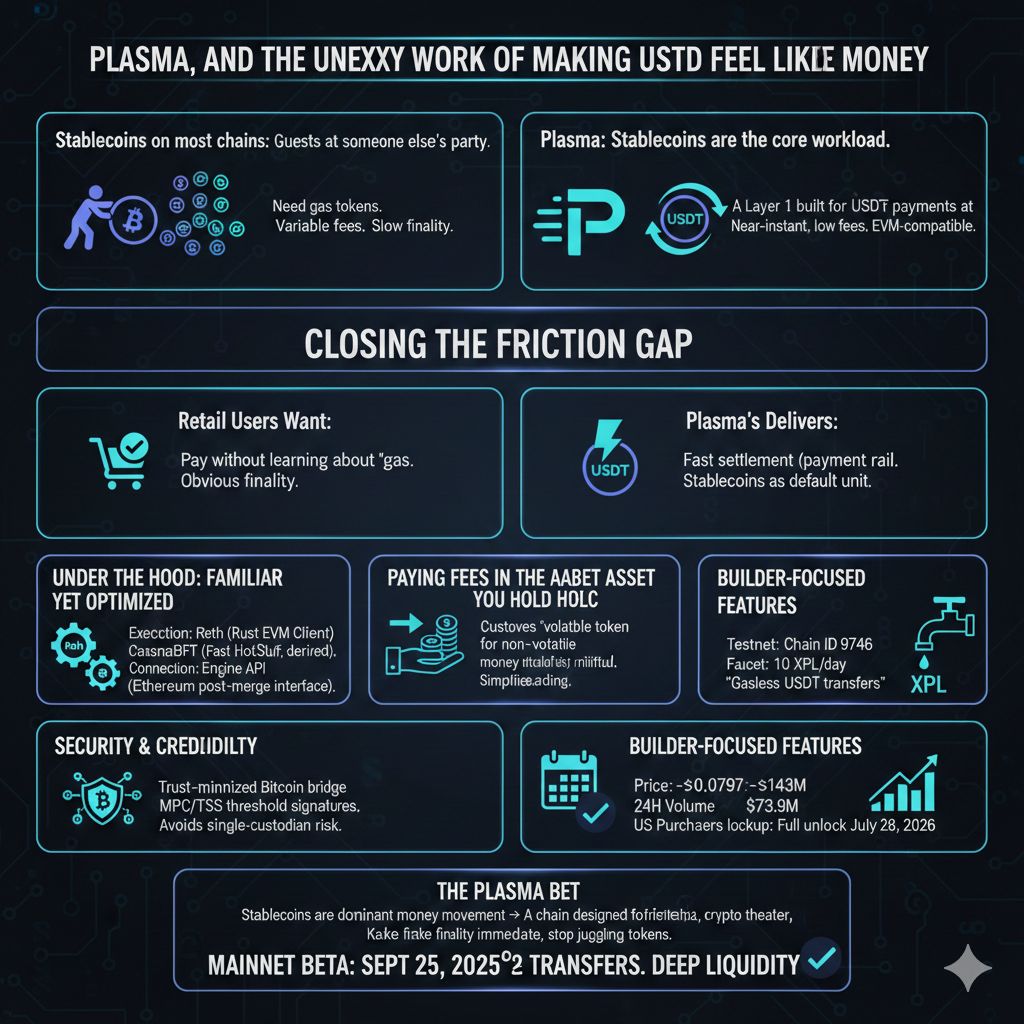 Plasma’s “gasless USDT transfers” pitch sits in that same category: reduce user friction where it most often kills adoption. The mainnet beta announcement explicitly positioned the launch (September 25, 2025) around zero-fee USD₮ transfers and deep liquidity from day one, aiming to make the chain useful immediately rather than “promising utility later.”Because, bluntly: if your payment rail needs a tutorial, it isn’t a payment rail.Security is where Plasma leans into a different kind of credibility. Instead of pretending payments are only a speed problem, it ties the story to neutrality and censorship resistance via a Bitcoin bridge model. The docs describe a trust-minimized bridge where verifiers confirm burns and then produce threshold signatures (MPC/TSS style) so no single verifier holds the full key needed to release BTC. That’s not the same as “trustless in the absolute sense,” but it is a clear attempt to avoid the classic “one custodian controls the wrapped asset” failure mode.It’s also not presented as “everything is live, right now.” Plasma’s own chain page says the mainnet beta launches with the core architecture (PlasmaBFT + modified Reth execution), while other features (like confidential transactions and the Bitcoin bridge) roll out incrementally as the network matures. That kind of pacing is healthy. People will still argue about it.If you care about the token because it’s part of the chain’s mechanics, XPL is already trading. On Binance’s price page, as of Feb 11, 2026 (UTC), XPL was around $0.0797, with a listed market cap around $143M and $73.9M 24-hour volume (numbers move, obviously).And token distribution has real-world constraints: Plasma’s docs note that US purchasers face a lockup schedule, with full unlock referenced for July 28, 2026, which is a reminder that “payments infrastructure” lives under regulatory gravity, not just code.The more subtle question is what happens when a chain is built around a single economic center of gravity: stablecoins. That can be a strength — predictable fees, clear UX, obvious product-market fit — and also a constraint, because it forces the ecosystem to take issuer realities seriously (listing decisions, compliance pressure, liquidity plumbing). Plasma’s bet is that the upside wins: if stablecoins are already the dominant on-chain money movement, then a chain designed around them will look less like crypto theater and more like infrastructure.That’s the real pitch hiding behind the acronyms: keep the developer experience familiar, make finality feel immediate, and stop asking normal people to juggle extra tokens just to move dollars.