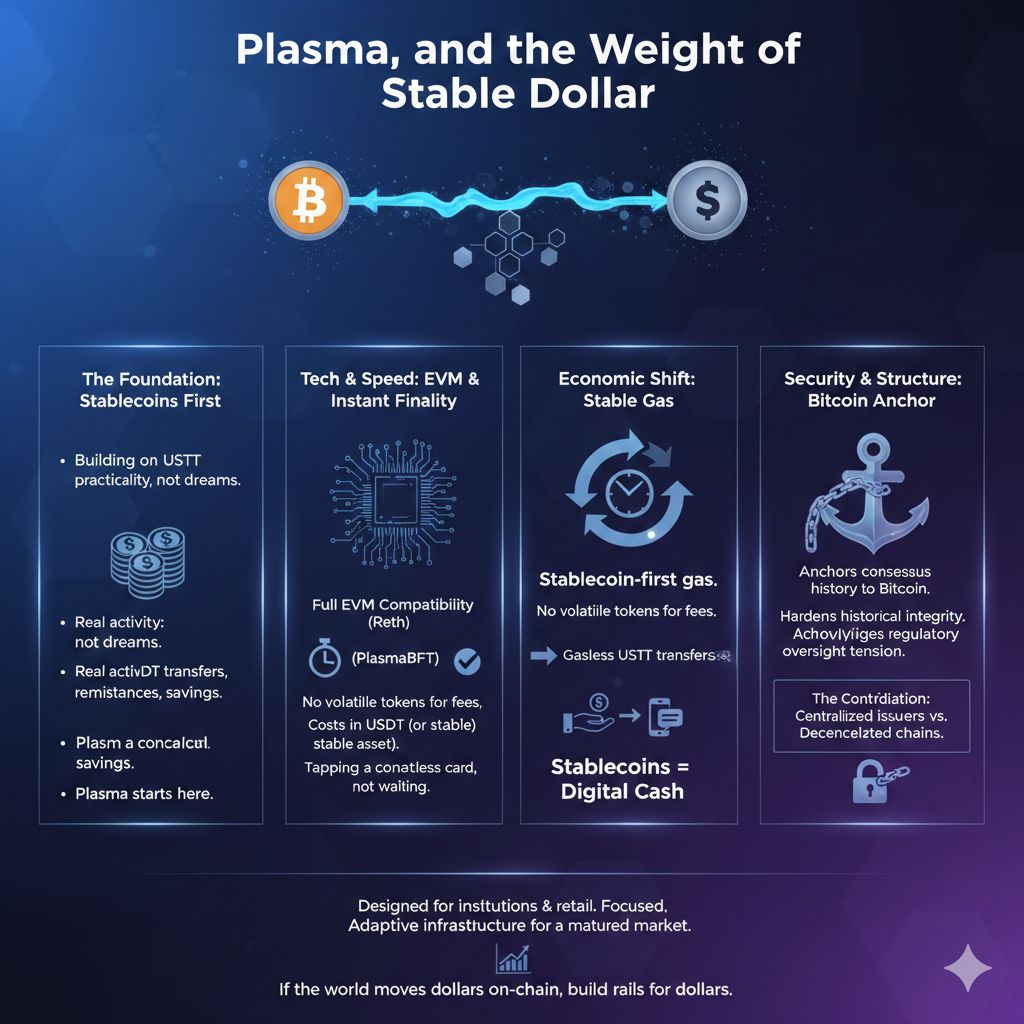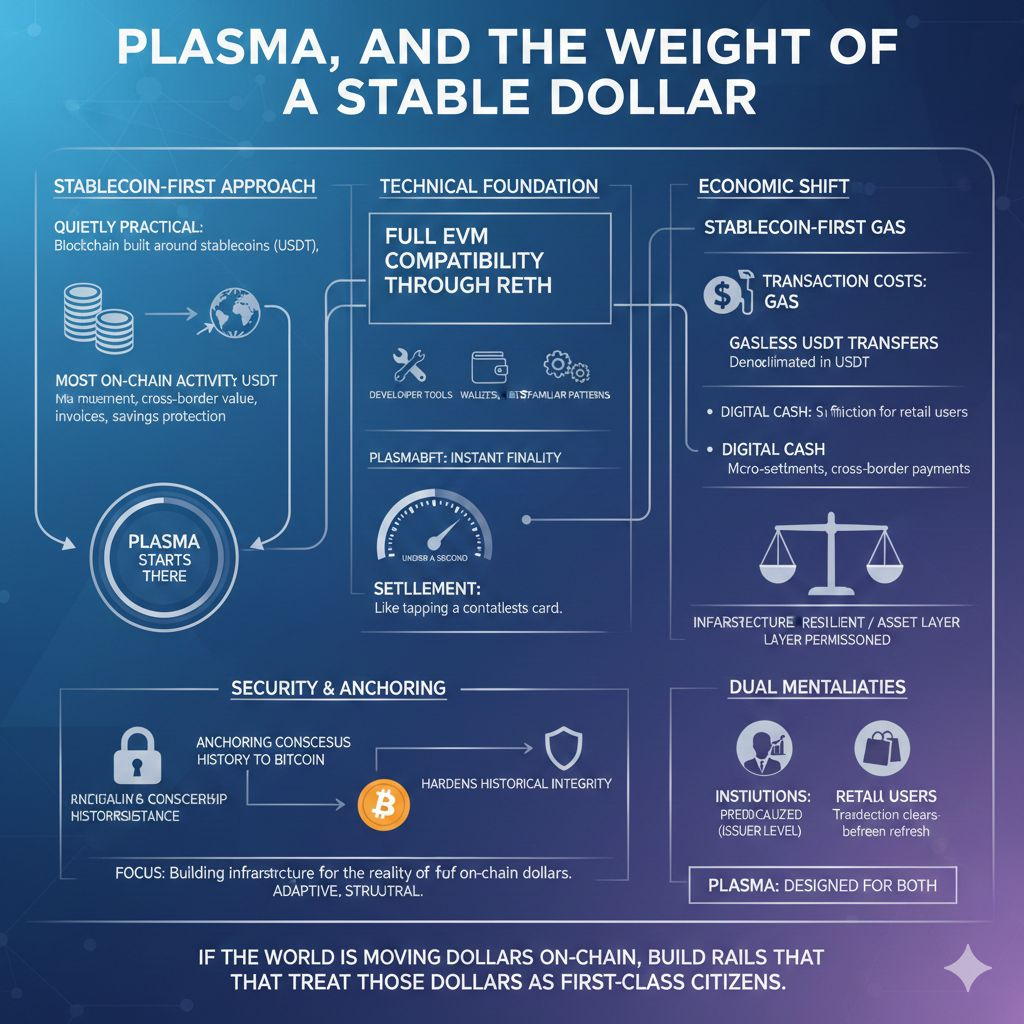
There’s something quietly practical about building a blockchain around stablecoins instead of around dreams.Right now, most real on-chain activity isn’t governance tokens or digital art. It’s people moving USDT between exchanges, sending value across borders, settling invoices, protecting savings from local currency volatility.Plasma starts there.It runs full EVM compatibility through Reth, which means developers don’t need to relearn their tools or rewrite contracts from scratch. Wallets, audits, familiar patterns — they still work. But under that familiarity, the chain behaves differently. PlasmaBFT pushes blocks to finality in under a second. Not “fast enough.” Actually fast. Settlement feels closer to tapping a contactless card than waiting for confirmations to stack.The more interesting shift is economic. Stablecoin-first gas changes what users feel at the surface. Instead of juggling volatile native tokens just to pay fees, transaction costs can be denominated in the asset people already hold. If most activity is USDT anyway, why introduce another currency into the loop? Gasless USDT transfers go further. They smooth friction for retail users in high-adoption markets who don’t want to think about fee mechanics at all. They just want to send value.It sounds small. It isn’t.Removing fee friction alters behavior. When users no longer hesitate over small transfer costs, stablecoins start to act more like digital cash than programmable capital. Micro-settlements become realistic. Cross-border payments feel less like a crypto operation and more like a message being sent.
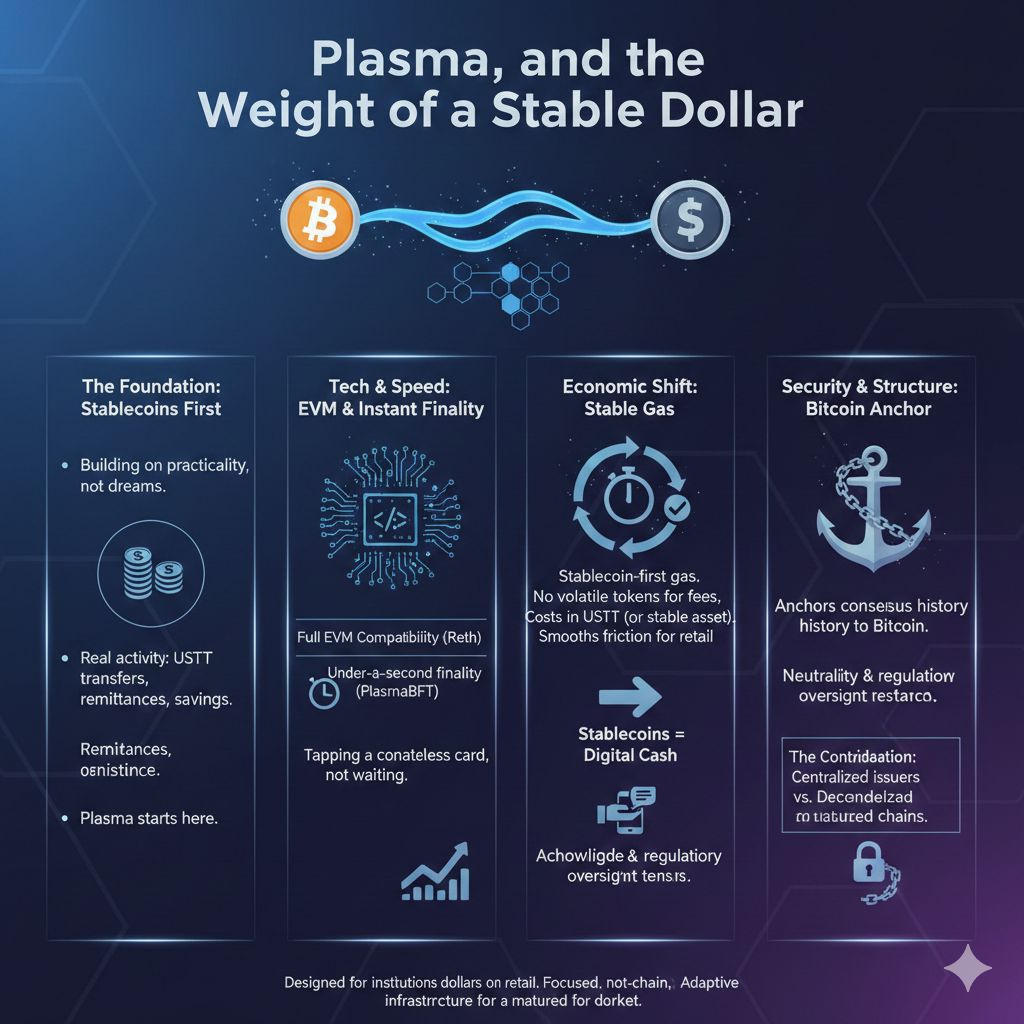
At the same time, Plasma doesn’t detach from crypto’s original security instincts. Anchoring consensus history to Bitcoin introduces a different kind of gravity. It leans on the longest-running proof-of-work network to harden historical integrity. That choice isn’t cosmetic. It signals that neutrality and censorship resistance matter — especially when stablecoins, by design, live in the shadow of regulatory oversight.And that tension is real.Stablecoins are centralized at the issuer level. Blockchains are not. Plasma sits at that intersection. It can finalize blocks quickly. It can anchor state roots to Bitcoin. It can offer economic clarity through stablecoin gas. But if a dominant issuer freezes addresses, the social layer shifts instantly. Infrastructure can be resilient while the asset layer remains permissioned. That contradiction doesn’t disappear just because finality is fast.For institutions in payments and finance, though, the clarity is attractive. Settlement rails that confirm in under a second, operate with EVM compatibility, and price fees in stable units reduce operational uncertainty. Treasury teams prefer predictable denominators. Volatility is a tax on accounting departments.Retail users think differently. They care about whether the transaction clears before the other side refreshes their screen.Plasma seems designed for both mentalities without pretending they are the same.There’s no attempt to be a playground for everything. It’s focused. Some might say narrow. Fair enough. But stablecoins already represent a massive share of on-chain volume across ecosystems. Building infrastructure explicitly for that reality isn’t conservative. It’s adaptive.The broader market has matured. Speculative cycles still exist, but payment flows, remittance corridors, and dollar-denominated savings in emerging economies are not temporary phenomena. They’re structural. Infrastructure that acknowledges that shift, rather than chasing novelty, may age better.And if it doesn’t, it won’t be because it lacked speed.It will be because stable value itself is a political instrument, and no blockchain can fully abstract that away.Still, the idea is simple: if the world is moving dollars on-chain, build rails that treat those dollars as first-class citizens. Everything else is decoration.