
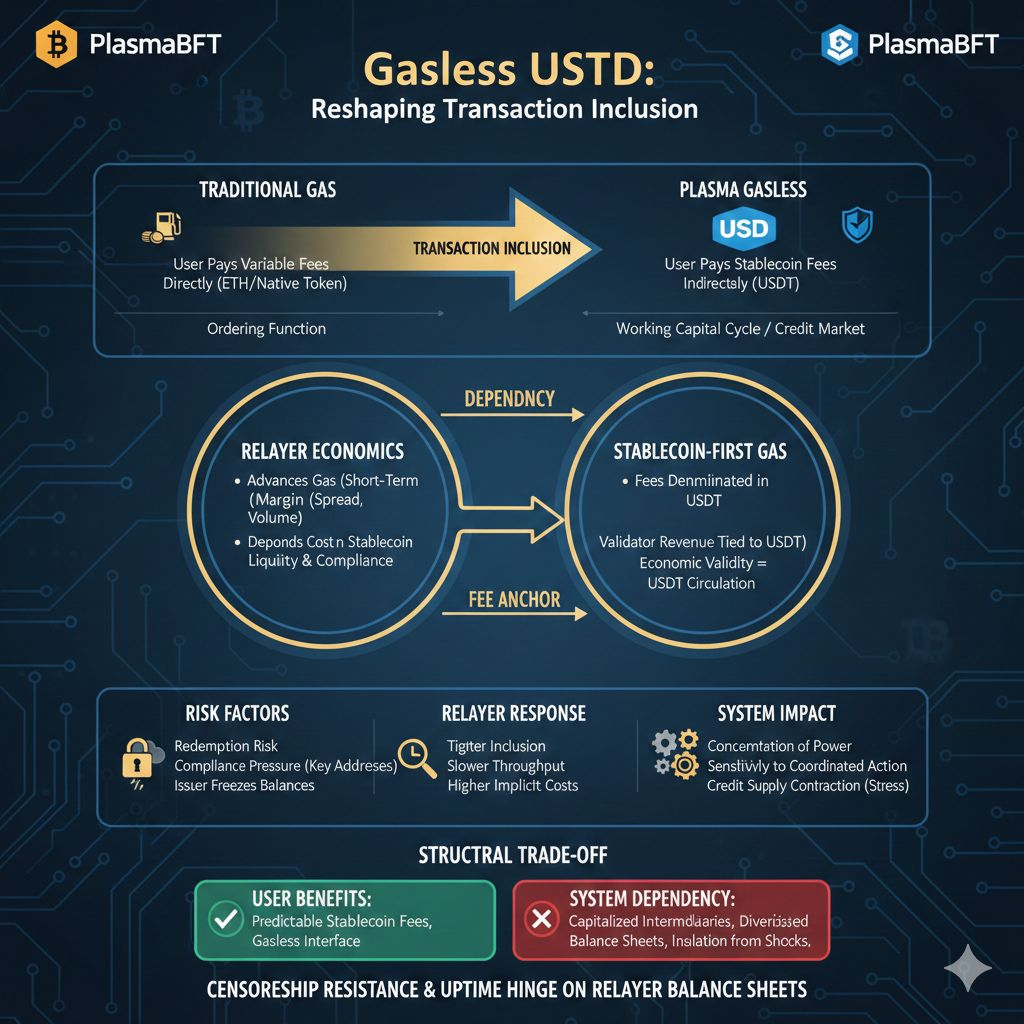
 Gasless USDT restructures who finances transaction inclusion. When users do not pay gas directly and relayers advance fees on their behalf, each transaction reflects short-term capital deployed in stablecoin terms. The relayer pays the fee up front, includes the transaction, and recovers cost only if balances remain transferable and redemption pathways stay intact. Their margin depends on spread, volume, and uninterrupted circulation. Inclusion therefore becomes a working-capital cycle rather than a pure ordering function.Stablecoin-first gas deepens that dependency. When fees are denominated in a dominant stablecoin, validator revenue and relayer reimbursement are both tied to the liquidity profile and compliance posture of that issuer. This is not merely denomination risk; it anchors fee economics to an externally governed balance sheet. Blocks can finalize quickly, yet the economic validity of those blocks depends on whether the settlement asset continues to move without restriction.
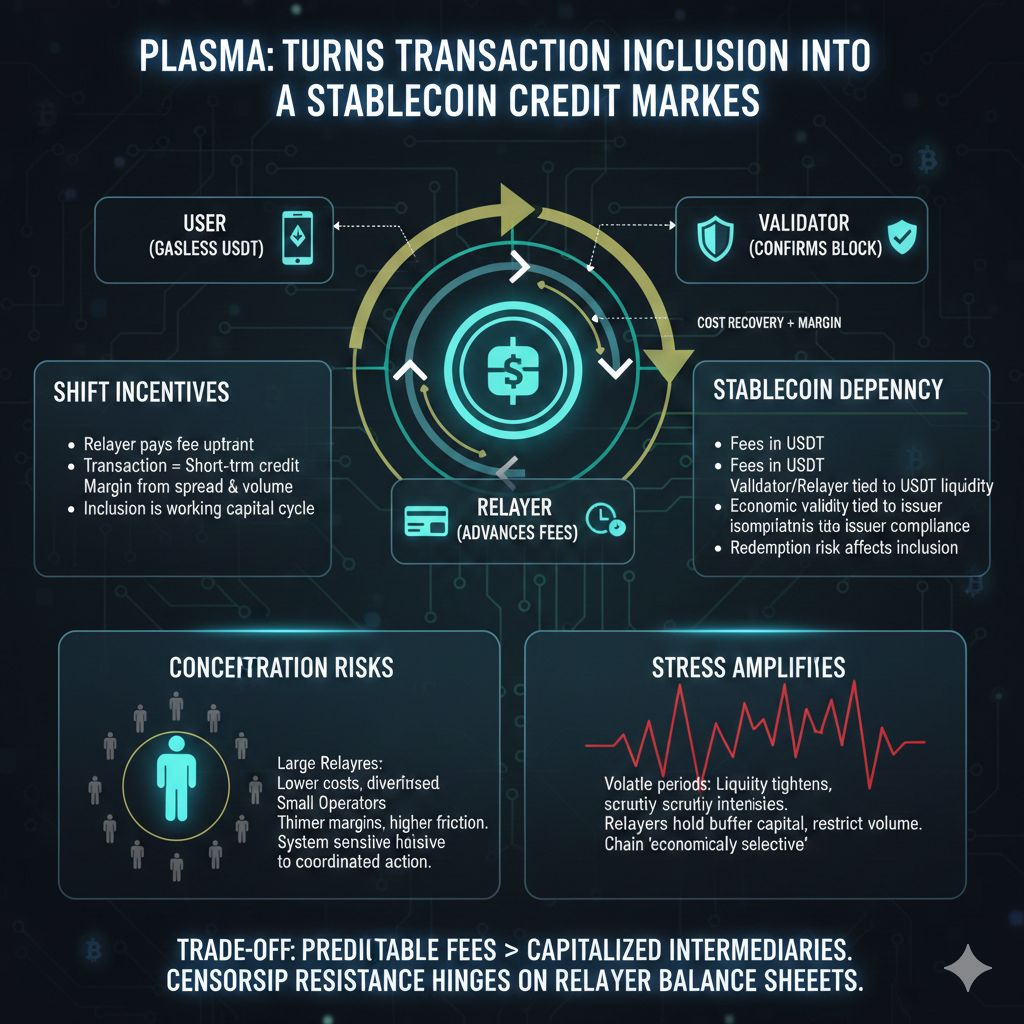 PlasmaBFT can guarantee agreement on state, and Bitcoin anchoring can preserve historical integrity. Neither compels a relayer to extend credit or offsets an issuer decision to freeze balances. If redemption risk rises or compliance pressure concentrates around key addresses, relayers must reassess exposure. Reduced risk tolerance translates into tighter inclusion criteria, slower throughput, or higher implicit costs embedded elsewhere in the flow.Scale dynamics push toward concentration. Large relayers benefit from lower funding costs, diversified compliance infrastructure, and better access to liquidity. Smaller operators face thinner margins and higher regulatory friction, making sustained competition difficult. Over time, transaction sponsorship gravitates toward actors with deeper balance sheets. That concentration increases the system’s sensitivity to coordinated regulatory action or issuer-level constraints affecting a limited set of intermediaries.Stress amplifies the feedback loop. In volatile periods, stablecoin liquidity can tighten and counterparty scrutiny intensifies. Relayers must hold more buffer capital or restrict sponsored volume. Inclusion does not halt because consensus fails; it slows because credit supply contracts. The chain remains technically live while economically selective, with certain flows prioritized and others deferred.The trade-off is structural. Users gain predictable, stablecoin-denominated fees and a gasless interface. In return, transaction inclusion depends on capitalized intermediaries willing to warehouse short-term exposure. Censorship resistance and uptime therefore hinge less on finality guarantees and more on whether relayer balance sheets remain diversified, competitive, and insulated from issuer compliance shocks.

