
The current crypto bear market in February 2026 offers a powerful contrast to conditions just two years ago.
In early 2024, Bitcoin was only beginning to recover from the brutal 2022–2023 winter, trading in the low-to-mid $40,000 range. Confidence was fragile, liquidity was thin, and market structure was still healing.
Fast forward to 2026, and Bitcoin now trades around $66,000–$70,000, after a sharp ~50% correction from its late-2025 peak above $126,000. While the drawdown is deep, this phase feels structurally different more mature, more controlled, and potentially less destructive.
1) Market Structure & Liquidity: A Stronger Foundation
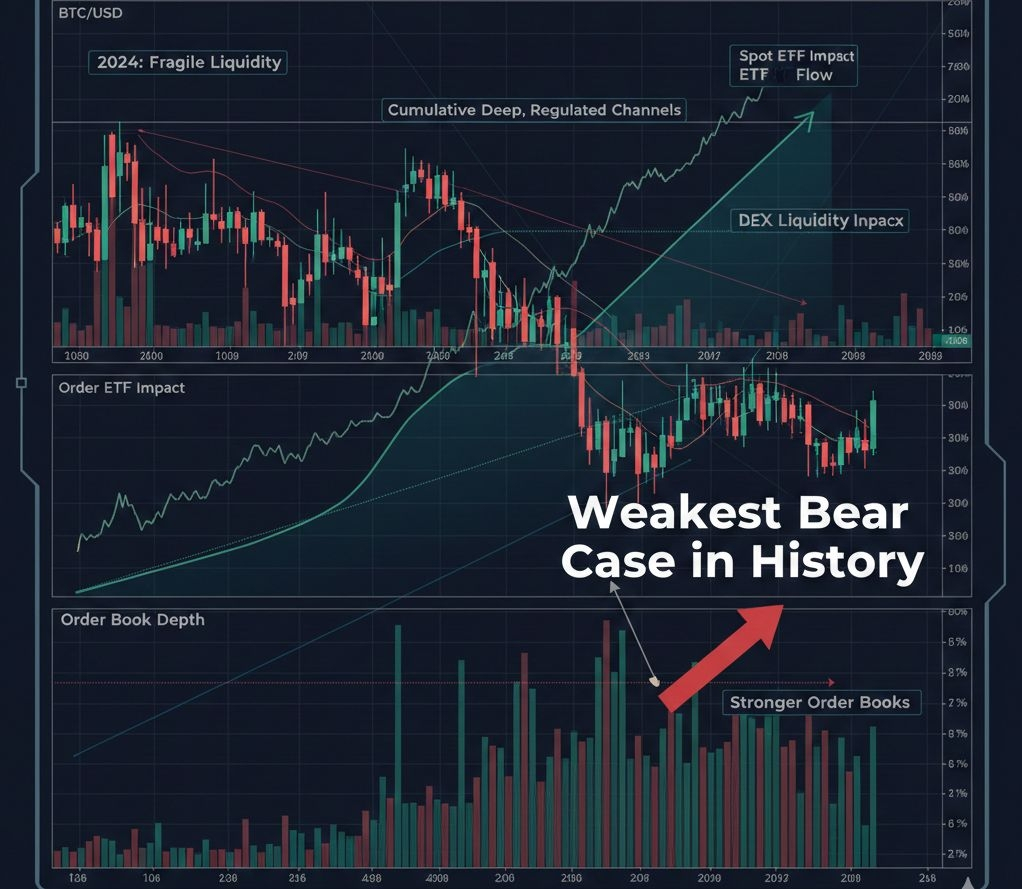
In early 2024, liquidity across crypto markets was fragile. Exchanges were still recovering from the collapses of 2022, order books were thin, and flash crashes were common. Stablecoin confidence was shaky, and global volumes remained subdued.
By 2026, the landscape has transformed.
Spot Bitcoin and Ethereum ETFs, which launched in 2024, have matured into deep, regulated liquidity channels. Layer-2 scaling solutions and improved DEX infrastructure have reduced fragmentation and improved execution quality.
Despite recent 20%+ volatility swings, order book depth remains significantly stronger than past cycles. Analysts increasingly describe this as the “weakest bear case in history”, because selling pressure is being absorbed without triggering systemic breakdowns.
2) Investor Psychology: From Panic to Controlled Fear
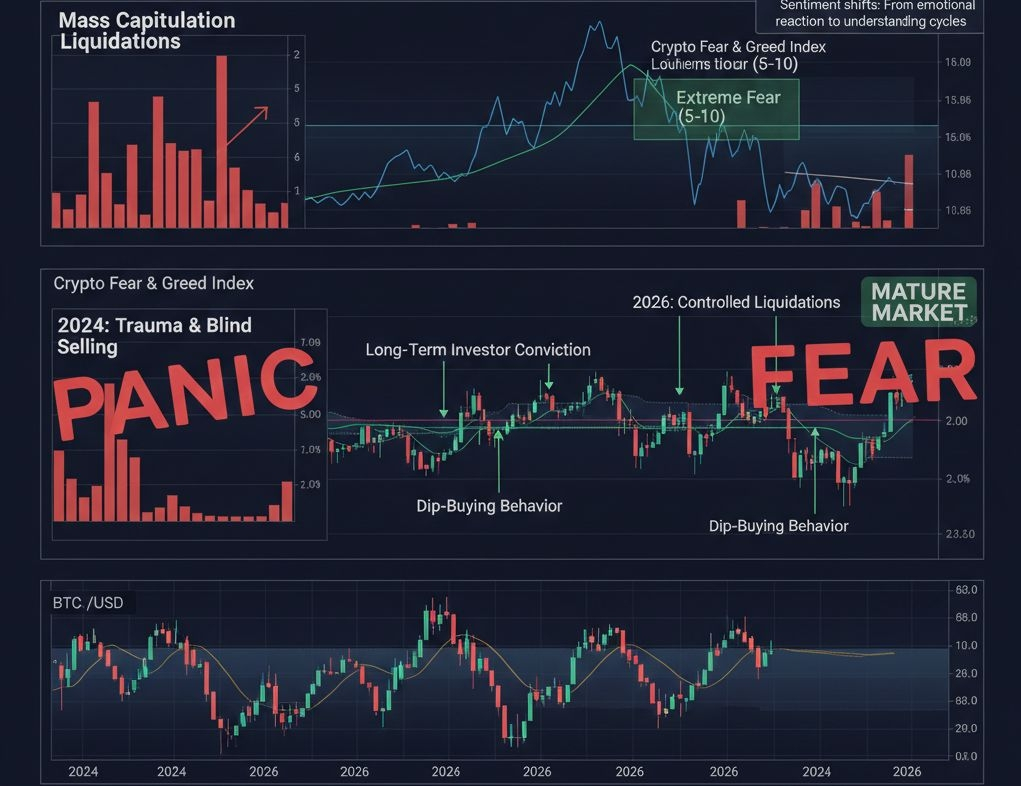
In early 2024, sentiment was dominated by trauma. Years of losses had pushed retail investors into extreme fear, forcing mass capitulation and deep skepticism toward recovery.
In 2026, the Crypto Fear & Greed Index has again dropped into extreme fear (5–10), one of the lowest readings since 2022. But the emotional tone is different.
Fear is present, but panic is limited. Liquidations are notably smaller, and market participants are far more experienced. Long-term conviction appears stronger, with dip-buying behavior replacing blind selling.
This reflects a maturing investor base that understands cycles, rather than reacting emotionally to volatility.
3) On-Chain Data: Smart Money Is Accumulating
In 2024, on-chain data showed distribution. Whales were reducing exposure, and long-term holder supply declined as uncertainty dominated.
In 2026, the story flips.
Whale wallets holding 1,000+ BTC recorded their largest accumulation week since late 2025, adding roughly 53,000 BTC during the recent correction. Long-term holder supply is rising, and HODL wave metrics show strong hands absorbing sell pressure.
Historically, this type of accumulation often precedes major market bottoms. Instead of exiting, smart money is positioning signaling that this move is likely a mid-cycle reset, not a cycle-ending collapse.
4) Institutional & ETF Flows: Tactical Pullback, Not Structural Exit
In 2024, spot Bitcoin ETFs were new. Flows were tentative, and volatility often triggered rapid inflows followed by sharp outflows.
By 2026, institutional participation is deeply entrenched. Cumulative ETF inflows now exceed $50B+, although recent months have seen notable net outflows as risk appetite cools.
The key difference?
These outflows appear tactical, not structural. ETFs now act as stabilizing liquidity engines, absorbing retail selling and enabling hedging strategies. Crypto has shifted from a speculative side bet into a core institutional asset class, reducing the probability of catastrophic collapses.
Final Take: An Evolved Bear Market
The 2026 bear market is not a repeat of 2024, it’s an evolved version.
Stronger infrastructure, smarter capital, institutional anchoring, and disciplined investor behavior make this downturn feel more like a healthy cycle reset than a destructive crash.
Historically, crypto bear phases last 12–18 months post-peak. Based on current drawdowns and on-chain positioning, this correction may already be halfway through.
That doesn’t guarantee an immediate rebound, further volatility and deleveraging remain possible. But history shows that maximum fear often precedes maximum opportunity.
For disciplined investors, these periods aren’t about panic,they’re about preparation, risk management, and positioning.

