
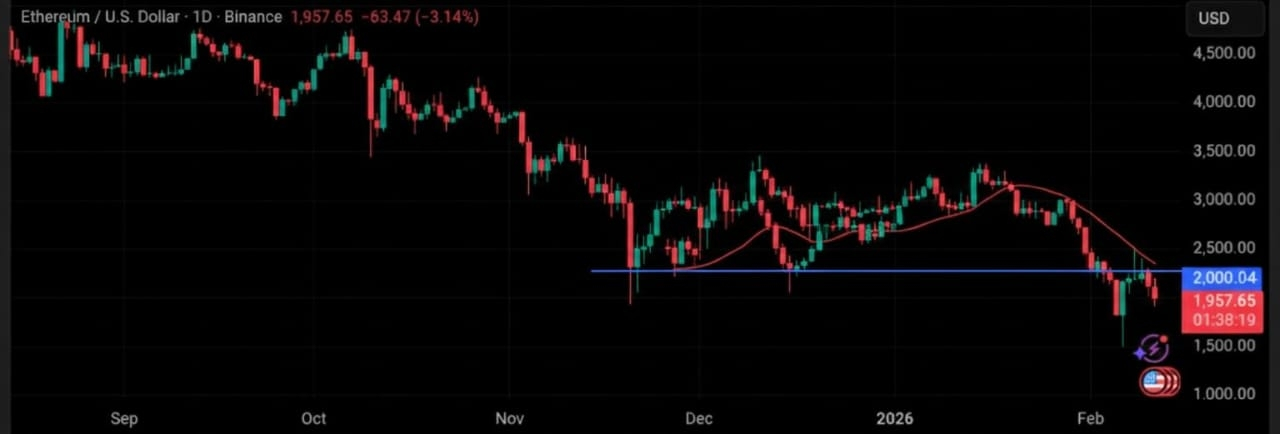
Ethereum is trading below the $2,000 level, and that alone tells you a lot about current market sentiment. Price has been sliding for weeks, and many people who bought higher are now sitting on losses. In fact, more than half of ETH holders are currently underwater.
This doesn’t mean Ethereum is “dead,” but it does mean the market is going through a painful reset phase.
Why $2,000 Matters So Much
The $2,000 level used to act as support, a price where buyers stepped in. Now, it’s doing the opposite.
When price drops below an important level like this, it often turns into resistance. That means every bounce toward $2,000 faces selling pressure from people who just want to exit at breakeven. Until ETH can clearly reclaim and hold above this zone, the short-term trend stays bearish.
Most Holders Are in Loss (And That Changes Behavior)
Right now, roughly 58% of Ethereum addresses are holding ETH at a loss. When this happens, markets behave differently:
• Some holders panic and sell into weakness
• Others hold and wait for price to return to their entry
• Rallies struggle because trapped buyers sell into strengt.
This creates heavy resistance overhead and choppy price action.
Whales Are Reducing Risk, But Not Disappearing;
Large holders (often called whales) have slightly reduced their ETH exposure over the past few months. That signals caution, not abandonment.
At the same time, ownership is slowly spreading out:
• Mid-sized wallets are growing
• Smaller holders are increasing
• Supply is becoming more distributed
This lowers concentration risk, but it also means rallies need broader participation instead of just a few big players pushing price up.
Exchange Outflows Suggest Quiet Accumulation
Here’s the interesting part: despite weak price action, a large amount of ETH has been leaving exchanges.
When coins move off exchanges, it usually means:
• Less intent to sell immediately
• More self-custody or staking
• Long-term positioning rather than panic selling
This suggests we’re not in a full liquidation phase, more like selective accumulation at lower prices.
DeFi Activity Is Still a Headwind
Ethereum’s DeFi ecosystem is under pressure. Total Value Locked has dropped significantly, meaning less capital is actively being used in lending, trading, and yield strategies.
Lower TVL usually equals:
• Lower network activity
• Less fee generation
• Weaker fundamentals in the short term
Until TVL starts recovering, ETH rallies will face resistance from the fundamentals side.
Long-Term Holders Are Quietly Buying
One of the strongest signals comes from accumulation wallets, addresses that only receive ETH and never sell.
These wallets have added a large amount of ETH recently, even as price falls. Historically, similar accumulation phases have happened near major market bottoms. It doesn’t guarantee a rally, but it does show confidence from patient capital.
ETFs Are Underwater, But Still Buying
Ethereum ETFs are deep in unrealized losses, yet inflows continue.
This matters because it shows:
• Institutions are thinking long-term
• ETF buyers aren’t trying to time bottoms
• Ongoing demand exists even during drawdowns
That steady buying can help stabilize price over time.
The Bigger Picture: This Feels Like a Reset, Not a Collapse
The recent drop wasn’t just about crypto. Broader market volatility, including sharp moves in gold and other assets, forced investors to de-risk across the board.
Some analysts are calling this a “mini crypto winter”, painful, but not a full bear market. Ethereum still has strong infrastructure, usage, and long-term believers.
Key Levels to Watch (Beginner Friendly)
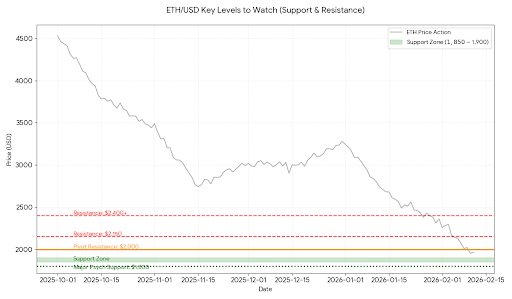
Support zones (where buyers may step in):
• $1,900 – $1,850
• $1,800 (important psychological level
Resistance zones (where selling may appear):
• $2,000
• $2,150
• $2,400+
As long as ETH stays below $2,150, the trend remains cautious.
So, Is This a Buy or Not?
This isn’t a clean “buy the dip” moment, but it’s also not a panic-sell zone.
Right now, Ethereum looks like:
• High risk
• High volatility
• Long-term accumulation friendly
• Short-term trend still bearish
For beginners, the smartest move is patience. Let price show strength before chasing rallies, and avoid emotional decisions during heavy drawdowns.
Bottom line:
Ethereum is weak on the chart, stressed on the surface, but quietly supported underneath. This is the kind of market where smart money builds slowly and impatient money gets shaken out.
