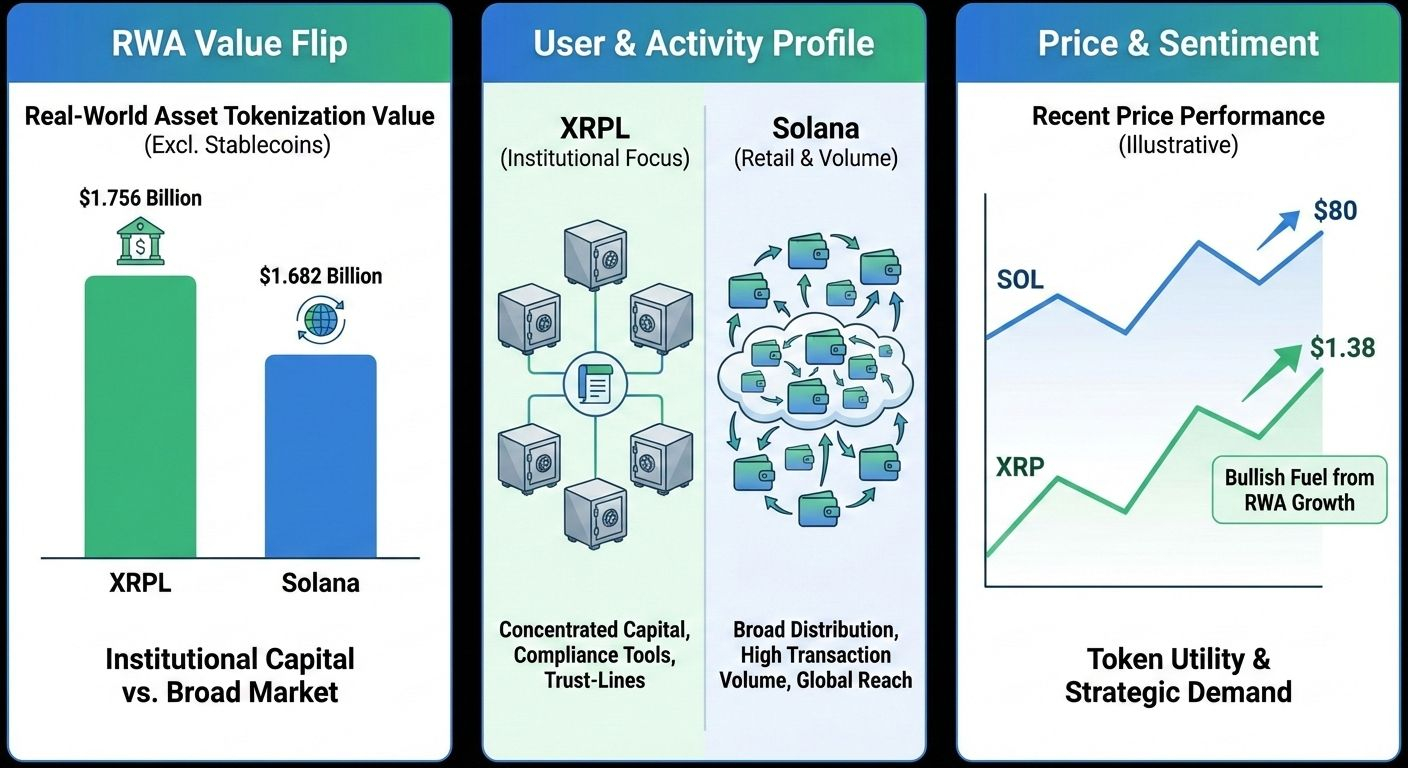
Forget the old narrative where speed and retail buzz defined blockchain winners. A new scoreboard has emerged and the $XRP Ledger (XRPL) is rewriting expectations. According to fresh onchain data, XRPL has surpassed Solana in real-world asset (RWA) tokenization value, hitting around $1.756 billion compared to $SOL $1.682 billion when excluding stablecoins. That’s a value flip that matters, and it’s driven by smart capital, not hype traders.
Why This Flip Is More Than a Number
At its core, this isn’t just about a billion here or there. It’s about where institutional capital chooses to live on-chain. Real-world asset tokenization captures things like treasury debt, tokenized funds, commodities, and other regulated financial products. These aren’t memecoins that zip in and out of wallets overnight, these are deep pools of capital, often tied to regulated institutions looking for blockchain efficiency with compliance guardrails.
#XRPL advantage in this space comes from a design that resonates with regulated players. The ledger supports built-in compliance tools, controlled issuance mechanics, and trust-line based token governance, which reduce operational risk and help institutions mirror existing market infrastructure. In plain terms, XRPL lets issuers put real assets on-chain with the controls they need, not the wild west of unbridled transferability.
Contrast With Solana
Solana’s profile tells a different, yet still strong story. Its RWA ecosystem has huge participant numbers and growing transfer volume, with hundreds of thousands of wallets holding tokenized assets and billions in monthly transfer activity. That represents broad market distribution and liquidity, and overall growth in RWA sectors. Solana has carved out real momentum in tokenized U.S. treasury debt and institutional funds, attracting global players with its throughput and low fees.
But XRPL edge on the value metric, especially in represented assets, shows something subtle and powerful: large, concentrated capital tends to choose XRPL when the priority is institutional grade issuance over frenetic trading. XRPL is quietly building the ledger that institutions trust for real-world asset lifecycles.
Institutional Signal
Institutions don’t pour a billion-plus dollars into a ledger on a whim. This is usually the product of deep due diligence, compliance alignment, and clear economic incentives. XRPL’s surge in represented tokenization suggests a shift in perception: blockchains aren’t just playgrounds for retail crowd action, they are digital rails for the next generation of financial plumbing. The fact that XRPL did this with a far smaller holder base than Solana simply underscores the nature of capital — a handful of big players can move more value than millions of small ones when the use case demands it.
What It Means Next?
1. More Institutional Issuance
As more legacy financial institutions explore tokenization, XRPL’s compliance-oriented architecture could make it a natural home for new issuances. Continued growth here might expand XRPL into the top tier of institutional blockchains.
2. Network Effects Beyond Retail Metrics
Traditional crypto narratives often focus on holder count and transfer volume. XRPL’s rise reminds the market that value under custody and institutional trust matter just as much.
3. Token Utility and Price Narrative
As real-world tokenization becomes a mainstream blockchain use case, assets tied to those networks (like XRP) can see demand from strategic positioning flows, not just speculative traders.
3. Cross-Chain Dynamics
Solana, $ETH , and others still compete fiercely for tokenized capital. XRPL’s leadership on this metric adds a new competitive layer to how capital rotates across ecosystems.
Bottom Line
This milestone isn’t just a flip on a chart, it’s a capital migration signal. XRPL is stepping into the institutional spotlight, proving it can attract and host serious financial value on-chain. For crypto markets hungry for reliable narratives backed by real money, this move is bullish fuel that could drive renewed interest in XRPL infrastructure and XRP itself as an execution layer for tokenized finance.