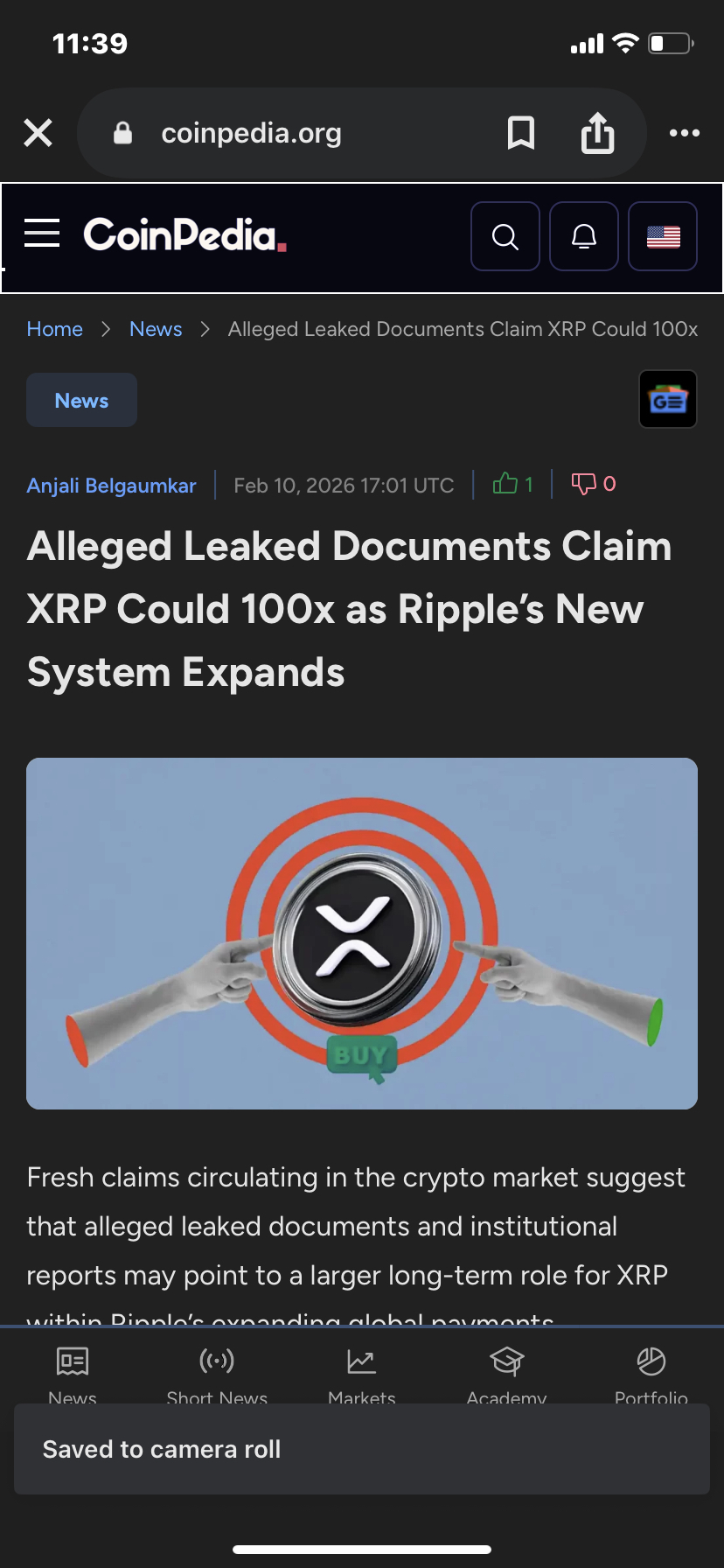
The new allegations circulating in the cryptocurrency market suggest that the alleged leaked documents and institutional reports may indicate a larger long-term role for #XRP’ within Ripple's expanding global payment infrastructure. Although the claims have not been officially confirmed, they fuel the debate over whether the company's new stable and institutional strategy could increase demand for digital assets.
The RLUSD strategy may expand the utility of XRP
According to claims, the planned stablecoin RRUSD from Ripple was not designed to replace XRP but to expand institutional adoption of the XRP Ledger. Analysts referred to in the discussion indicate that RLUSD could be integrated into institutional settlement and trading systems, allowing banks and financial institutions to use a dollar-based stablecoin while continuing to rely on XRP as a bridge asset for cross-border liquidity.
If this model is adopted, institutions using RLUSD for settlements will still require XRP to transfer value between different currencies and markets, increasing demand for the token over time.
Reports indicate increasing competition for stablecoins
Some institutional analyses mentioned in the discussion predict that the global stablecoin market, currently dominated by USDT and USDC, may shift towards a more competitive landscape with new issuers entering the sector. Ripple's entry through RLUSD is expected to target institutional payment flows, a sector that can play a critical role in settling transactions on a large scale across financial networks.
Market observers say that if RLUSD gains momentum among financial institutions, increased activity on Ripple's infrastructure could indirectly drive greater use of XRP within liquidity and settlement operations.
The alleged legal language raises discussion about licensing
One of the most controversial claims focuses on alleged legal documents suggesting that #XRP serves as a type of access or operational right within Ripple's transaction ecosystem. Proponents argue that if XRP is needed for certain system functions, broader network adoption would naturally create higher demand for the token.
However, experts warn that these interpretations remain uncertain and should not be treated as confirmed regulatory or legal classifications. Until official filings or company data clearly define such a structure, the interpretation of licensing remains speculative.
Institutional DeFi plans put #XRP at the center
Ripple has also outlined plans to build decentralized institutional financial infrastructure focused on compliance on the XRP ledger. In these plans, XRP is positioned as a settlement asset and bridge asset, meaning it can be used to finalize payments and connect different currencies during cross-border transactions.
Ripple CEO Brad Garlinghouse has repeatedly stated that #XRP remains a core part of the company's long-term strategy, even as Ripple expands into stablecoins and new payment technologies.
The price impact remains speculative
Some market commentators claim that if Ripple's infrastructure expands quickly, along with #RLUSD and institutional partnerships, #XRP may see significant price increases in the long term, with extreme forecasts suggesting '100x' scenarios.
However, these predictions are highly speculative and depend on regulatory approvals, institutional adoption, and growth in real-world transactions across the Ripple network$XRP .