
Let me say something most people won’t.
The real danger in payment infrastructure is not failure.
It’s ambiguity.
I’ve watched enough crypto payment systems to notice a pattern. Transactions go through. Balances update. Everything looks fine. Then six months later, accounting teams can’t reconcile. Support teams are buried. Finance starts building shadow spreadsheets because no one fully trusts the system.
Nothing exploded.
But something cracked.
That’s why my view on Plasma shifted.
The more I studied its execution model, the more I realized it isn’t designed to impress. It’s designed to prevent quiet breakdowns.
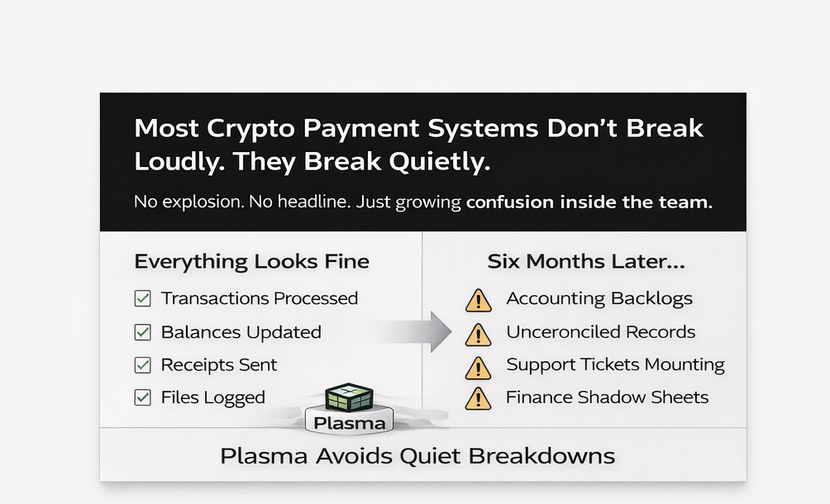
Plasma forces explicit execution states. A payment is not “kind of done.” It is in a defined lifecycle stage. Settlement windows are not vibes. They are structured. Outcomes are deterministic. History remains linked.
This matters because most operational damage comes from interpretation, not error.
When teams disagree on what happened, trust erodes internally before users ever notice.
From my exposure to Plasma’s architecture, what stands out is the discipline. Records don’t drift. States don’t blur. Finality is explicit. Adjustments don’t overwrite history.
That kind of design doesn’t look exciting on launch day.
But it compounds over time.
And in infrastructure, compounding discipline beats flashy features.
Here’s what most builders underestimate:
Payments aren’t stressful when they fail.
They’re stressful when no one can explain them.
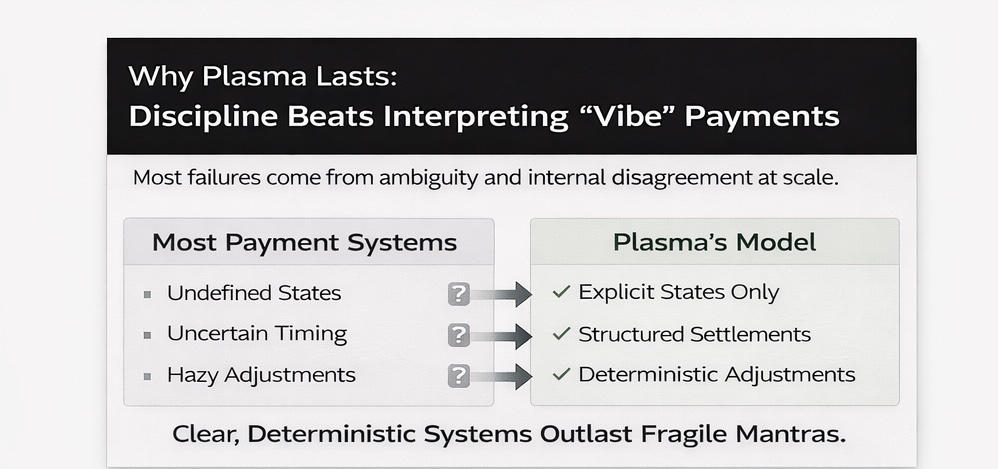
Plasma reduces that stress by design.
It turns ambiguity into structure.
And structure is what real finance runs on.
My honest take?
If your payment layer requires interpretation, it’s already a liability.
The systems that last are the ones that make internal disagreement impossible.
That’s why I’m watching Plasma more closely than most people realize.

