
Most people judge “early vs late” with the wrong lens.
They look at size, hype, and how often the name shows up on their feed. But in crypto, the real advantage usually shows up before the crowd arrives — when the product is being shaped around real-world constraints, not just market excitement.
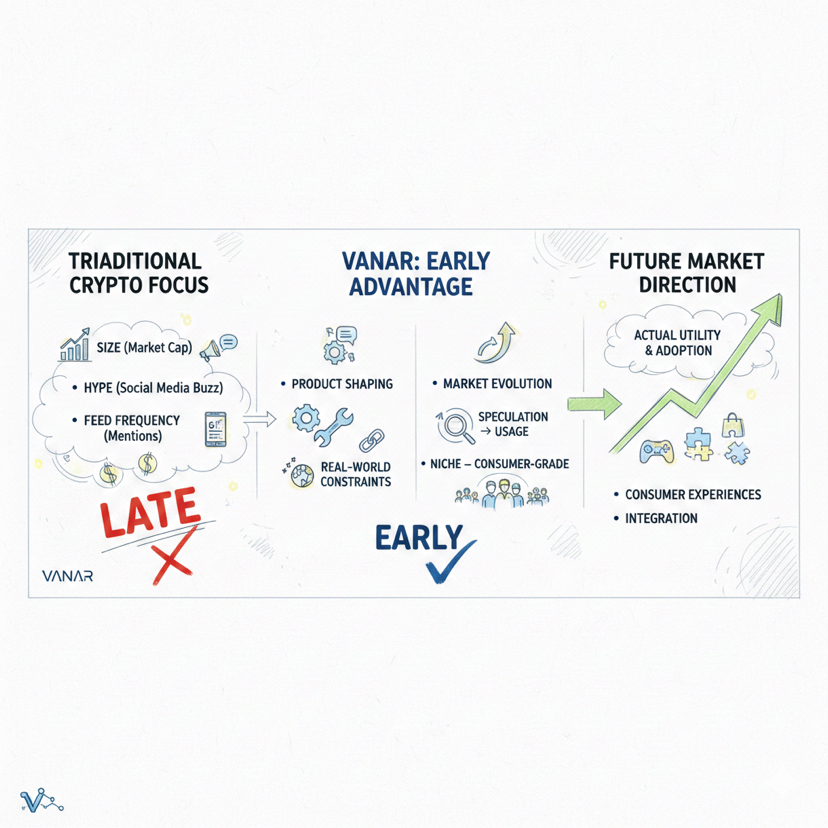
That’s why Vanar can be interesting from an “early, not late” angle. Not because it’s loud. But because the direction it’s taking fits where the market tends to move next: from speculation toward actual usage, and from niche crypto culture toward consumer-grade experiences.
If you zoom out, every cycle does this weird thing. First, the market gets obsessed with stories. Then the money floods into whatever narrative is easiest to explain in one sentence. Then, after the noise peaks, people slowly start caring about the boring stuff again — speed, cost predictability, onboarding, reliability, developer experience. That’s when infrastructure that was built properly starts to matter, even if it wasn’t trending earlier.
Vanar’s whole pitch is basically built around that “boring stuff.” Fixed fees instead of unpredictable fee chaos. Fast confirmation targets. Building in a way that makes sense for actual users who don’t want to think about wallets, gas, and constant friction. The team also positions itself around mainstream verticals like gaming, entertainment, brands, and broader consumer adoption — which is the exact area where chains either become invisible rails… or they fail because the UX is too heavy for normal users.
And the timing of narratives right now is important. People keep arguing whether the next wave is AI, RWAs, gaming, DePIN, or something else. The truth is, the market doesn’t move like a single-lane road anymore. It rotates, overlaps, and stacks themes on top of each other. That’s where a project can look “small” while still being positioned well — because it doesn’t rely on one story to survive.
Gaming is still one of the biggest onboarding funnels on the planet. It never stopped being massive. What stopped was the idea that users would tolerate clunky blockchain UX just because it’s “Web3.” If adoption is going to happen through games and entertainment, the chain has to fade into the background. It has to feel like an app, not a tutorial. So when a chain is built with consumer constraints in mind — predictable costs, responsiveness, simple onboarding — that’s not a minor detail. That’s the difference between a prototype and something that can scale.
AI is another one. A lot of projects attach “AI” to themselves like a sticker. But what’s happening now is bigger than hype. Agents and automation are pushing the conversation toward infrastructure — memory, structured data, execution environments, and systems that can actually run workflows instead of just making dashboards. Vanar’s positioning around semantic layers and reasoning/automation concepts is basically trying to sit inside that shift. Even if people debate how fast this will mature, the direction itself matches where attention is moving: away from “AI content” and toward “AI systems.”
Then you’ve got the real-world adoption side — whether you call it RWAs, PayFi, or just “apps that people actually use.” This is where fee unpredictability becomes a real business problem. If a product can’t forecast cost-per-action, it can’t price services cleanly. It can’t promise users a stable experience. That’s why fixed, predictable fees are not just a nice-to-have. They’re a structural requirement if you want mainstream usage without users feeling punished at random.
Developer growth also looks different when you’re thinking in this frame. The important thing isn’t “how many developers are tweeting about it.” It’s whether building feels easy and whether the economics make product design clean. If builders can ship without constantly fighting the chain, you don’t need the biggest dev army overnight. You need the right flywheel: deploy easily, iterate quickly, onboard users smoothly, then repeat.
And adoption itself… it rarely looks impressive until it suddenly does. It’s almost never a straight line. It’s slow, then it bends. First you see a few apps. Then you see a product that actually fits a real user behavior. Then the chain becomes a quiet rail behind something people genuinely want. And once the curve bends, everyone starts rewriting history like they “always knew.”
That’s the core idea behind “early, not late.” Early doesn’t mean unfinished. Early can mean the market hasn’t priced the setup yet.
So yeah, Vanar might look small today.
But the projects that end up feeling inevitable later usually looked small right before the world became ready for what they were building.
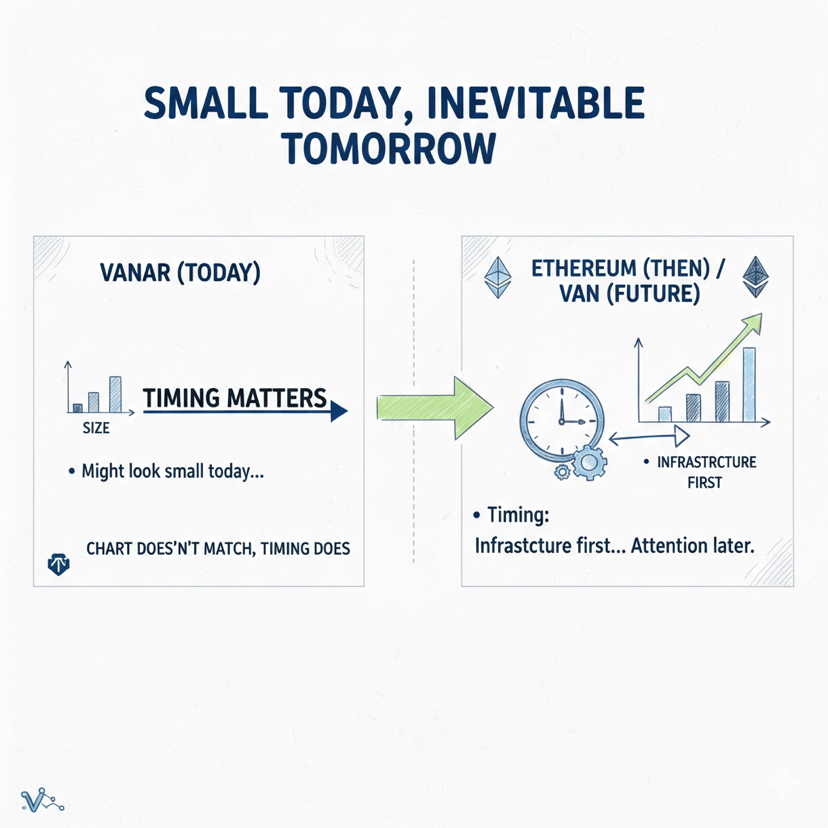
“This might look small today… but so did Ethereum once.”
Not because the charts matched.
Because the timing did: infrastructure first… attention later.
