
Everyone keeps framing Vanar as an entertainment-first Layer 1.
I think that’s slightly wrong.
The more I look at it, the more it feels like Vanar isn’t trying to win on throughput or branding. It’s trying to control behavior — not users’ behavior, but system behavior.
And that’s a much harder game.
Most chains let market forces dictate everything: gas spikes when activity rises, validators rotate freely, congestion becomes a feature of “demand.” It’s chaotic, sometimes impressive, often painful. Crypto tends to romanticize that chaos as decentralization.
Vanar doesn’t romanticize it.
It treats volatility as a liability.
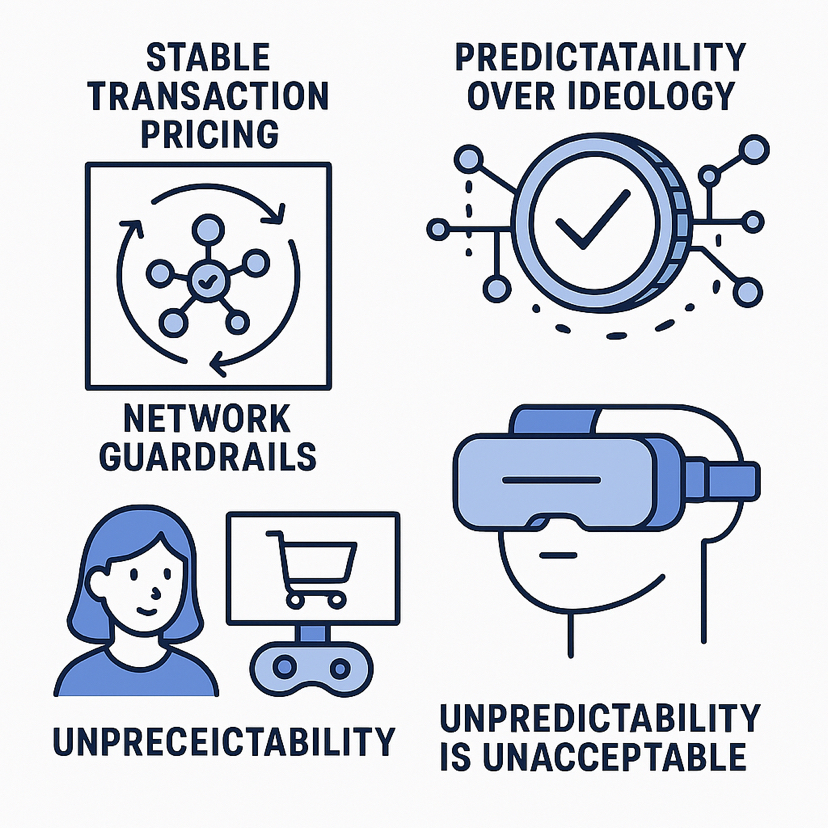
Stable transaction pricing. Managed validator participation. Clear guardrails around how the network operates. That’s not the typical “let it rip” philosophy. It’s closer to how payment rails or enterprise middleware think: predictability first, ideology second.
That choice won’t satisfy decentralization purists. And honestly, it’s not meant to.
If your target is gaming studios, digital marketplaces, or branded virtual experiences, unpredictability isn’t edgy — it’s unacceptable. A game economy can’t function if transaction costs swing wildly. A brand activation can’t pause because a network got congested. Behavioral consistency becomes the product.
This is where Vanar’s positioning starts to make more sense.
Instead of asking, “How decentralized can we be?” it seems to ask, “How controllable can the system remain under pressure?” That subtle shift reframes everything — from validator selection to fee design to ecosystem partnerships.
Even Virtua, which looks like a consumer-facing product, reinforces that logic. It’s not just a metaverse experiment; it’s a stress test. If you can run marketplaces, collectibles, and repeated user interactions at scale without chaos creeping in, you’re not just proving technical capacity — you’re proving operational discipline.
That matters more than TPS charts.
The same pattern shows up in how VANRY functions. It’s necessary for fees and staking, yes. But it isn’t theatrically positioned as the centerpiece of the narrative. That restraint tells you something. The token supports the rail; it doesn’t try to become the spectacle.

And then there’s the AI conversation.
Most blockchain-AI integrations feel like speculative overlays — buzzwords attached to infrastructure. Vanar’s angle is quieter: structured data, ownership primitives, compression layers like Neutron that focus on how information persists and is referenced. It’s less about “AI on-chain” and more about preparing the chain to coordinate AI-era applications.
That’s a sober approach. Possibly too sober for a hype-driven market.
But here’s the uncomfortable truth: entertainment at scale is not built on hype. It’s built on systems that don’t misbehave when thousands of simultaneous actions occur. Games crash. Networks stall. Markets freeze. And users leave instantly when that happens.
Vanar seems to understand that behavioral stability is the actual differentiator — not performance peaks.
The risk, of course, is perception. Crypto rewards visible aggression. Loud growth. Big narratives. A chain that focuses on predictability can look boring next to one promising revolutionary change every quarter.
But boring infrastructure often outlasts dramatic infrastructure.
The question isn’t whether Vanar can attract attention.
It’s whether it can maintain controlled behavior as usage deepens — without loosening its guardrails to chase short-term excitement.
Because once a system is tuned for predictability, compromising that for momentum is almost impossible to reverse.
If Vanar stays disciplined, it may not dominate headlines.
But it might quietly become the layer where digital entertainment behaves the way users expect it to.
And in this market, that might be the more radical move.
