
Plasma is one of those ideas that quietly shaped the direction of blockchain technology long before most people even noticed it. When we talk about scaling blockchains and making them faster and cheaper, we are often talking about solutions that grew from the original Plasma vision. I’m looking at Plasma not just as a technical proposal but as a turning point that asked a simple question. If blockchains are powerful but slow and expensive, how can we build something around them that keeps their security while unlocking real speed and usability. Plasma was created to answer that question in a bold and practical way.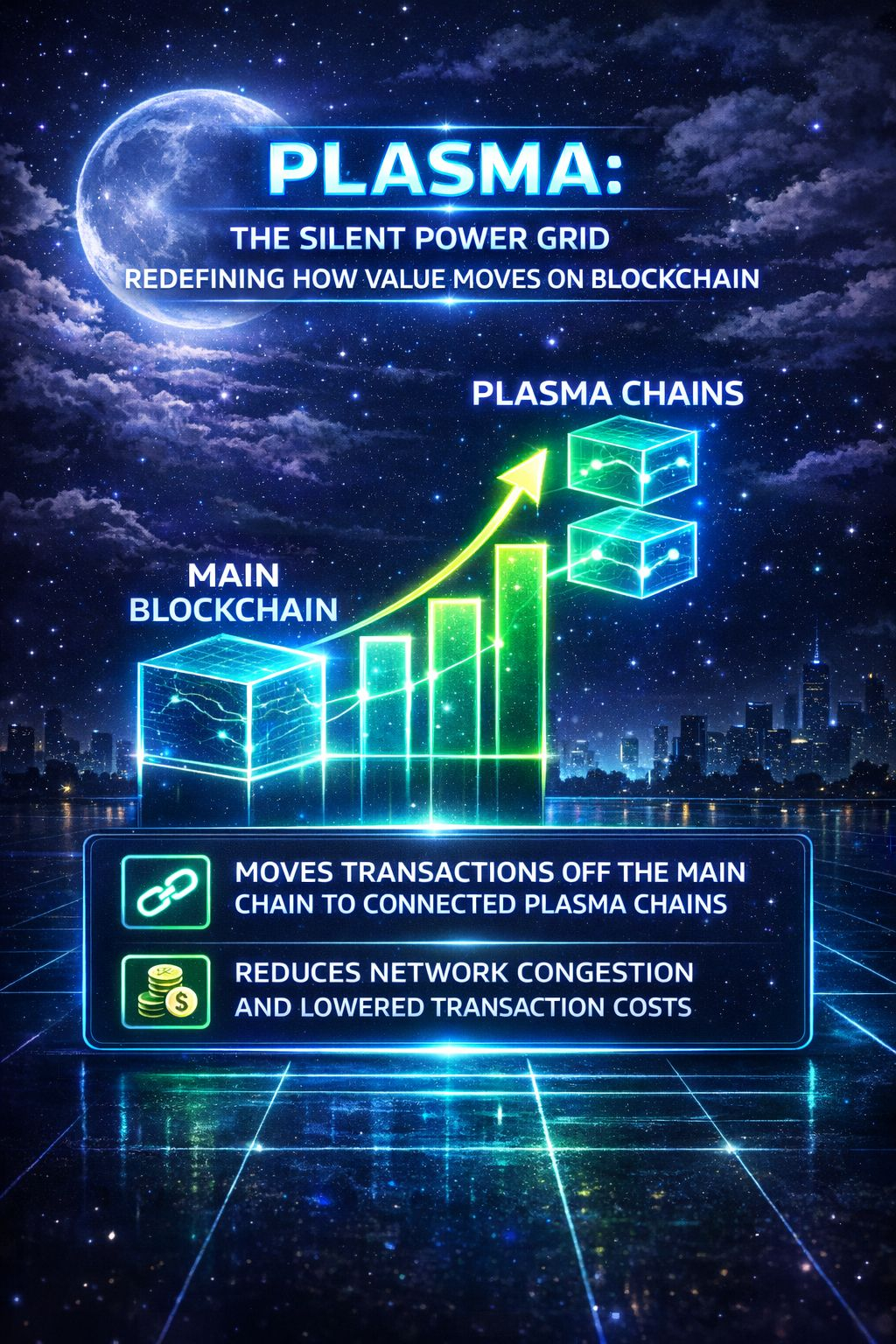
At its core, Plasma is a framework for building smaller blockchains that connect to a larger and more secure main blockchain. Think of it like a tree. The main blockchain is the trunk and Plasma chains are the branches. These branches handle most of the activity so the trunk does not get overloaded. Instead of sending every single transaction to the main network, Plasma allows many transactions to happen on smaller chains and only sends summaries or proofs back to the main chain. This design helps reduce congestion and lowers transaction costs. If we are seeing high fees and slow confirmations on large networks, Plasma was designed to change that reality.
The idea was introduced by Joseph Poon and Vitalik Buterin, two well known names in the blockchain world. They imagined a system where applications could run on their own Plasma chains while still relying on the security of the main blockchain. That means if something goes wrong on a Plasma chain, users can always exit back to the main network and protect their funds. This safety feature is one of the most important parts of Plasma. It gives users confidence that even if a smaller chain fails or behaves badly, their assets are not trapped forever.
What makes Plasma powerful is how it separates work. The main blockchain focuses on final settlement and security. Plasma chains focus on speed and volume. This separation creates a layered structure. Instead of forcing one network to do everything, Plasma spreads the load across many connected chains. I’m seeing this as one of the earliest clear visions of what a multi layer blockchain future could look like. Today we talk a lot about Layer 2 solutions and scaling networks, but Plasma was one of the first serious attempts to turn that concept into a working model.
Plasma works using smart contracts on the main chain. These smart contracts manage the rules for each Plasma chain. When users move funds into a Plasma chain, they lock their assets on the main blockchain. Then they receive equivalent value inside the Plasma chain. Transactions happen quickly within that smaller chain. When users want to leave, they submit a withdrawal request that includes proof of their ownership. There is a waiting period to allow anyone to challenge invalid exits. If everything checks out, the funds are released back on the main chain. This exit mechanism is critical because it ensures that users always have a path back to safety.
One of the key concepts inside Plasma is fraud proofs. Instead of the main chain checking every transaction from the Plasma chain, it only steps in when someone detects invalid behavior. If a Plasma operator tries to cheat, anyone can submit proof to the main chain showing that something is wrong. This makes the system efficient because the main blockchain does not need to process everything. It only acts as a judge when there is a dispute. If everything runs smoothly, the main chain stays light and fast.
Plasma was designed at a time when blockchain networks were struggling with limited throughput. As more people joined and more applications launched, networks became congested. Fees increased and simple transfers could take longer than expected. Plasma offered a way to scale without sacrificing security. Instead of increasing the size of the main blockchain endlessly, which could make it harder for regular users to run nodes, Plasma kept the base layer lean while pushing activity outward.
Over time, different versions of Plasma were proposed. There was Plasma MVP, which focused on basic payment systems. There were other variations that tried to support more complex smart contract interactions. Each version explored how to balance simplicity, usability, and security. Some designs were easier to implement but limited in features. Others were more flexible but harder to manage. This evolution shows that Plasma was not just one static idea but a family of concepts growing and adapting as developers learned more.
Value inside Plasma moves in a controlled and structured way. When users deposit assets into a Plasma chain, that value is represented within the smaller network. Transactions can happen almost instantly compared to the main chain. The Plasma operator or validators bundle transactions into blocks and submit commitments to the main blockchain. These commitments act like receipts. They prove that a set of transactions occurred. If everything is honest, users continue interacting within the Plasma chain without needing to touch the main chain again. This keeps costs low and performance high.
If someone tries to cheat by creating invalid transactions or hiding information, users can challenge the operator. The design assumes that at least one honest participant will watch the chain and raise an alert if needed. This watcher role is important. It creates a balance of power where operators cannot easily misbehave without being caught. In this way, Plasma shifts some responsibility to users or service providers who monitor the network, while still keeping final authority on the main chain.
Plasma also influenced many later scaling solutions. While not all projects adopted Plasma exactly as originally described, its ideas shaped the development of rollups and other Layer 2 systems. We are seeing how early experiments laid the groundwork for more refined solutions. Even when certain parts of Plasma proved complex in practice, the vision behind it pushed the entire ecosystem forward. It forced developers to think beyond the limits of a single chain.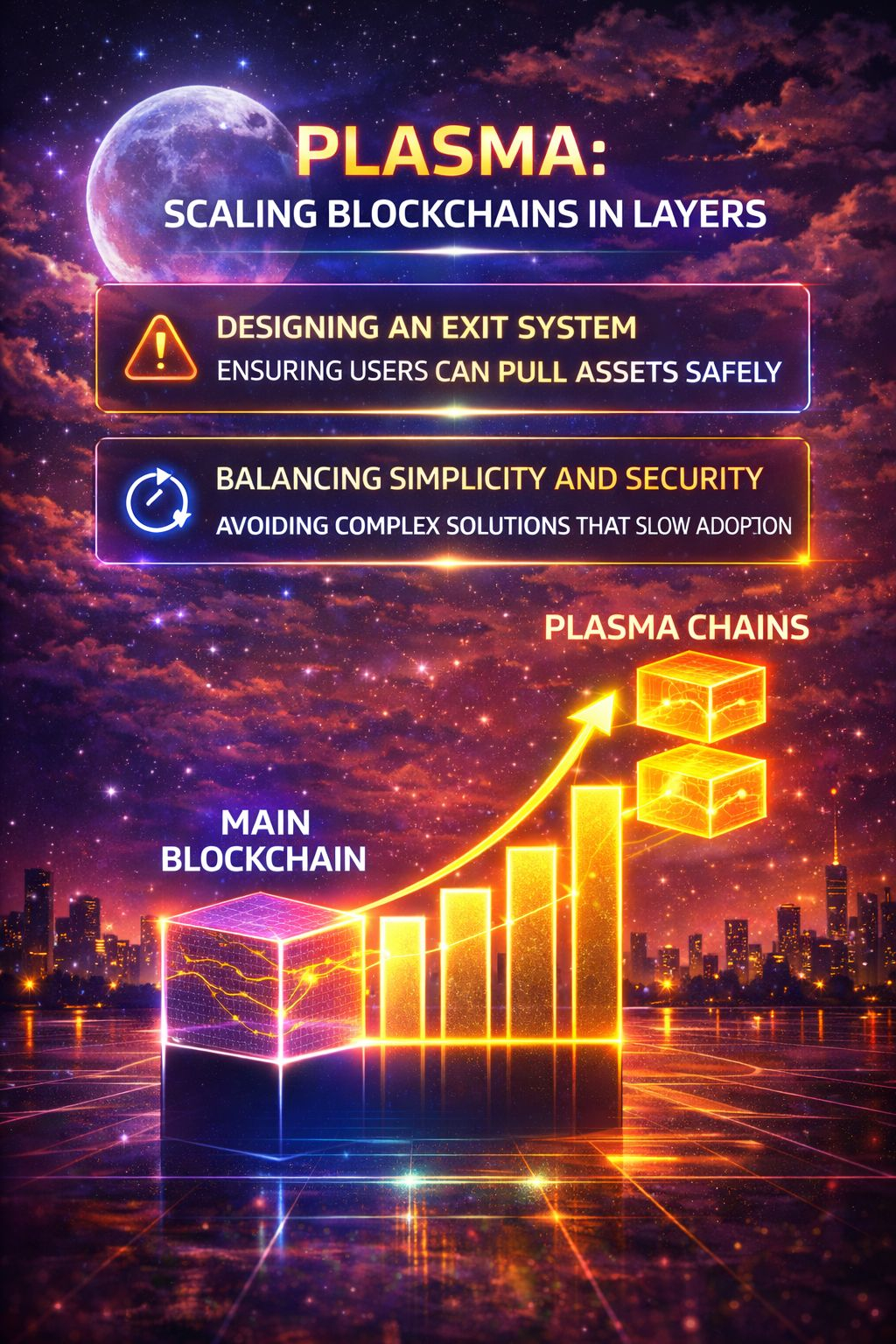
There were challenges along the way. One of the biggest issues was the exit game. When many users try to exit at the same time, the main chain can become overloaded with withdrawal requests. Designing a smooth and fair exit system turned out to be harder than expected. Some Plasma designs struggled with user experience because users had to stay online or rely on watchers to protect their funds. These challenges slowed down adoption, but they also taught valuable lessons about security and simplicity.
Despite these hurdles, the core idea remains powerful. Plasma showed that scaling does not always mean changing the base layer. It can mean building on top of it in smart ways. If blockchains are like cities, Plasma is like building new districts connected by strong highways rather than forcing everyone to live in the same crowded center. This layered approach keeps the foundation strong while allowing expansion.
In terms of long term direction, Plasma represents a mindset as much as a specific technology. The mindset is about modular design. It is about accepting that one chain cannot handle everything forever. Instead, networks can work together in layers, each with a clear role. As blockchain adoption grows and more real world applications come online, this layered structure becomes even more important. We are seeing increasing demand for fast payments, gaming applications, decentralized finance tools, and digital identity systems. All of these require scale. Plasma’s original goal was to make that scale possible without breaking the core principles of blockchain.
When we look at the broader market, including platforms like Binance that list many blockchain assets, scaling solutions often become central to growth. Users care about speed and cost. If a network becomes too expensive or slow, activity moves elsewhere. Plasma aimed to prevent that problem by creating a sustainable path forward. Even if the original Plasma chains are not the dominant solution today, the philosophy continues to influence how new networks are designed.
I believe Plasma’s real strength lies in its balance. It does not throw away decentralization. It does not ignore security. It simply reorganizes how work is done. Instead of asking one chain to process thousands of transactions per second directly, it says let smaller chains handle the noise and let the main chain act as the final court. This layered security model is simple in concept yet powerful in impact.
As blockchain technology moves into the future, the need for scaling will only increase. More users, more applications, and more value flowing through digital systems mean higher demand. Plasma was one of the earliest serious answers to that demand. It dared to imagine a world where blockchains could support global usage without collapsing under their own weight. If we are looking for the roots of today’s scaling revolution, Plasma is one of them.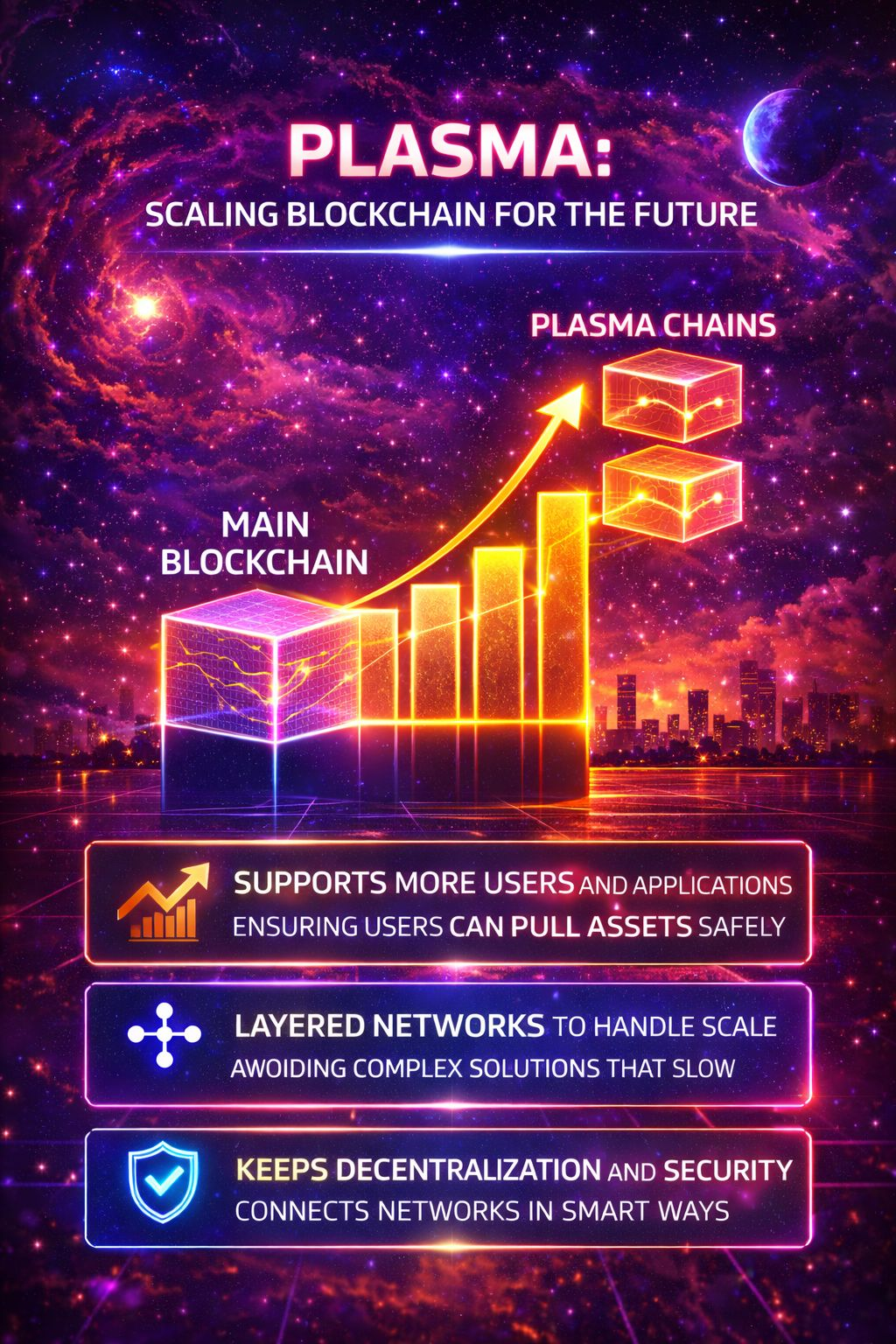
In the end, Plasma is not just about technology. It is about vision. It is about seeing limits and refusing to accept them. It is about building structures that allow growth without losing trust. I’m convinced that even years from now, when new solutions have taken the spotlight, the ideas behind Plasma will still be there quietly supporting the next wave of innovation. They remind us that progress in blockchain is not always loud. Sometimes it begins with a thoughtful design that changes everything behind the scenes.


