


Plasma is building for a world where stablecoin payments are normal, not experimental. That is a strong direction, but it also forces a very honest kind of risk check because payments do not forgive mistakes. If the rail is not trusted, people do not use it twice. If partners do not see long term reliability, they do not commit real volume. So the risks here are not abstract, they are practical, and they show up the moment the system meets real users.
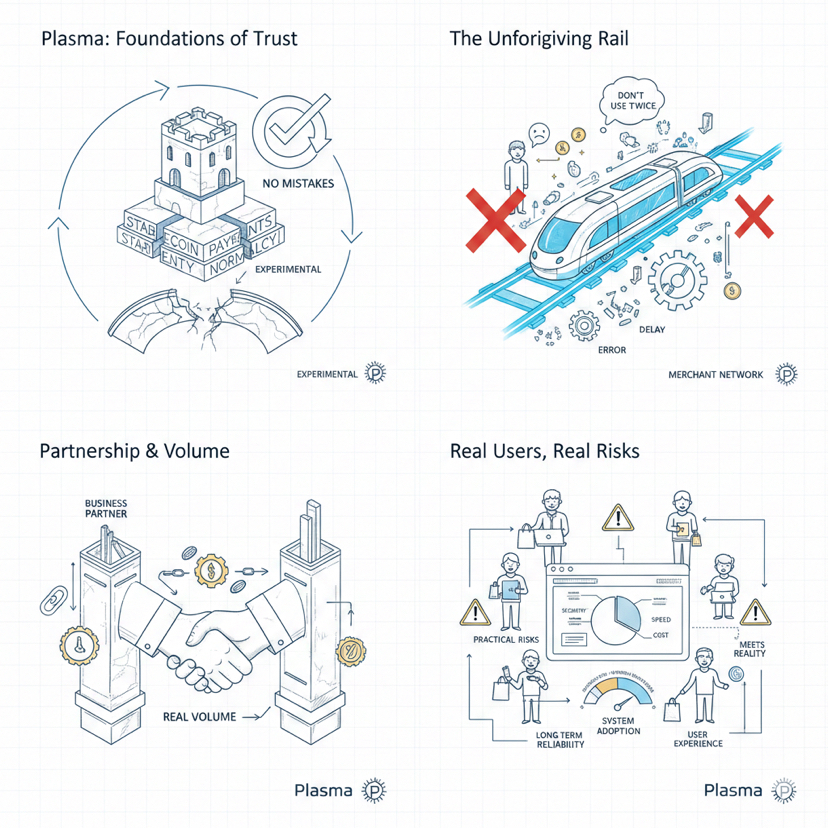
The first risk is simple: adoption is harder than technology. A chain can have fast finality, low costs, and clean stablecoin mechanics, and still struggle because distribution decides payments. Wallets, merchants, payout platforms, and payment providers already have routes that work well enough, and switching is painful unless Plasma makes the experience noticeably easier. The real danger is not failing to get attention, it is failing to get repeat usage. Plasma can reduce this risk by going after a few payment lanes where stablecoins already solve a daily problem, then proving reliability until it becomes routine. The strongest signal would be partners who keep sending flow month after month, not one time integrations that look good on paper.
The next risk is execution, because Plasma is shipping a stack that includes high performance consensus, an EVM environment, and stablecoin centered features that change how fees and transfers behave. Any one of those can be fine on its own, but the tricky part is integration, edge cases, and what happens under sustained load. Most failures happen in the boring corners, not in the demo. The mitigation here is disciplined sequencing. Lock down the core settlement path first, keep upgrades conservative, and test aggressively in public. It also helps to be transparent when something breaks. In payments, honesty about what failed and how it was fixed builds more trust than pretending nothing went wrong.
Token pressure is another real issue because incentives can become a weak spot if they outpace true demand. Even a reasonable inflation schedule and unlock plan can feel heavy if adoption takes longer than expected. The risk is not just price volatility. It is the perception that usage is being rented rather than earned. If rewards drive activity that disappears when rewards fade, it becomes harder to convince serious partners that this is stable infrastructure. The best mitigation is alignment. Incentives should reward behavior that looks like real payments, repeated settlement, retained partners, and growing transaction flow. And transparency matters a lot here. If Plasma is extremely clear about supply, unlock timing, emissions, and how ecosystem funds are used, people do not have to guess, and fear has less room to grow.
Security is the risk nobody gets to ignore, especially when a network is built around moving stablecoins at scale. Attackers go where the value moves repeatedly. Anything that touches stablecoin transfer logic, fee abstraction, or bridging becomes a target because it sits directly in the path of funds. The mitigation cannot be a single audit or a confident statement. It has to be layered. Deep audits for the contracts that matter most, ongoing bug bounties that reward real attack paths, staged rollouts with sensible limits, and strong monitoring that catches problems early. The goal is not to promise perfect safety. The goal is to show that the team assumes adversaries exist, designs for containment, and reacts quickly and clearly when issues appear.
Regulation is also not optional in this category. Stablecoin payments are moving closer to the center of finance, and that means compliance expectations rise, even for infrastructure. Partners who serve real users will want monitoring tools, reporting support, and clear policies. Different regions can push different requirements, and sudden changes can freeze integrations if the ecosystem is not prepared. The mitigation is to make it easy for regulated partners to operate without turning the entire network into a closed system. Practical compliance tooling, clear partner guidance, and a willingness to meet institutions where they are can turn regulation from a threat into a reason to choose Plasma.
Competition is always there, and in payments it is ruthless. Many chains and scaling systems already handle stablecoin volume, and they can copy surface features quickly. If Plasma tries to compete only on speed or fees, it will be dragged into an endless comparison game. The mitigation is to win on what is harder to copy: deep payment partnerships, reliable operations, strong compliance integration, and a settlement experience that partners trust for daily flow. A real moat in this space is reputation built through repeated delivery.
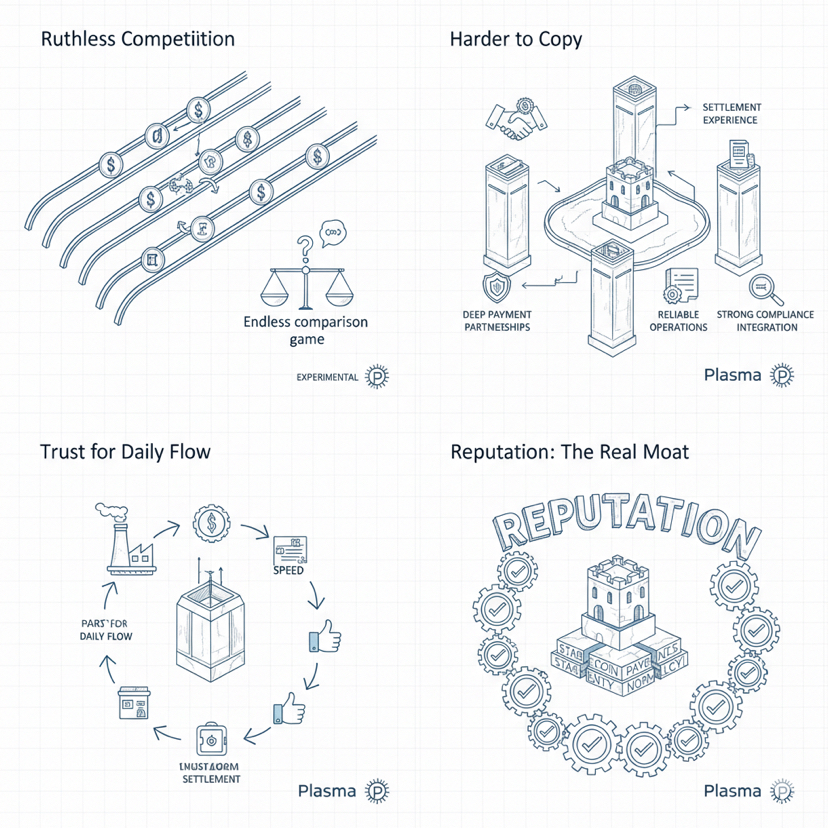
Plasma gets one thing right, it should be this: treat trust as the product. When the chain behaves predictably, when incentives feel aligned with real usage, when security is handled with discipline, and when partners can operate with confidence, the risks do not disappear but they become manageable. And that is what serious readers want to see, not a list of perfect promises, but a clear view of what can go wrong and how the team plans to keep moving forward anyway.

