
Stablecoins already feel like the internet’s dollar. People use them to move value any time, any day, across borders, without asking permission. But the part nobody really says out loud is this: even though stablecoins act like money, most blockchains still treat them like just another token. And that mismatch is where the real pain lives.
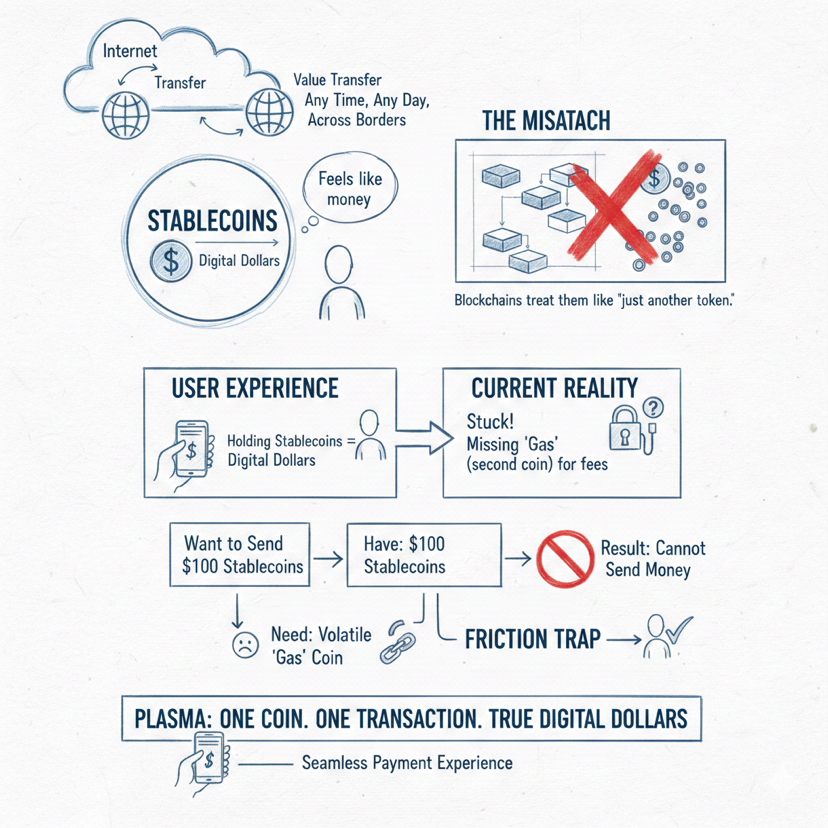
Plasma If I’m holding stablecoins, I’m basically holding digital dollars. So why do I still get stuck because I don’t have a second coin to pay fees? That’s the weird reality today. You can have the exact amount you want to send, but you can’t send it because you’re missing “gas.” For a trader, it’s an annoyance. For normal people trying to pay someone, or move money for family, or settle something quickly, it’s a dealbreaker. They don’t want to manage multiple assets just to do one simple thing. Nobody thinks, “Let me buy a volatile coin first so I can move my dollars.” That’s not a payment experience. That’s a friction trap.
And it gets worse because the fee isn’t even stable. People think gas is just a small cost, but the real problem is the uncertainty. Sometimes it’s cheap, sometimes it spikes. Sometimes the transaction goes through fast, sometimes it doesn’t. Payments can’t run on “it depends.” Merchants can’t build on “maybe it’ll confirm quickly.” Payment providers can’t promise a clean experience if the network decides to get busy. So the hidden cost isn’t only the fee you see. It’s the failed transfers, the delayed settlements, the extra support messages, the trust that disappears when users feel like the system is unpredictable.
A lot of teams tried to patch this with “gasless” experiences, and honestly it makes sense. If you want mainstream payments, you need the sender to just send money without thinking about anything else. But most of the time “gasless” has been duct tape. It’s relayers, paymasters, sponsored transactions, and custom systems each team rebuilds on their own. It works, but it’s fragile. It adds more moving parts, more maintenance, more risk of abuse, more places where something can fail. And when something fails in payments, users don’t sit around and debug it. They just stop using it.
There’s also a finality problem people don’t talk about enough. In payments, you want the feeling of “done.” Not “pending.” Not “wait for more confirmations.” Not “check again later.” When you’re dealing with real settlement—merchant flows, payroll, business transfers—timing matters. If confirmations are inconsistent, everything downstream becomes messy. Reconciliation gets harder, businesses hesitate, and users lose confidence. A payment rail has to be boring in the best way. It needs to feel certain.
And then there’s the trust layer. When money moves at scale, people start caring about neutrality and long-term reliability. Not in a dramatic way, but in a practical way. If a system is too dependent on a single actor, if it feels like it can be easily steered or disrupted, serious payment flows get cautious. Because once stablecoins start behaving like real settlement tools, the base layer stops being “just tech” and starts being infrastructure.
This is why the problem hasn’t been fixed cleanly yet. Most chains weren’t built for stablecoin settlement as the main job. They were built to do everything at once, and payments end up competing with everything else for the same space and the same resources. That’s fine when you’re early and experimenting. But it’s not fine when stablecoins are already being used like real money in the real world.
So when Plasma talks about what it’s building, the interesting part isn’t hype. The interesting part is that it’s treating stablecoins like the main character instead of a side feature. It’s basically saying: if the world wants digital dollars, the rails should be designed around digital dollars. That means making the stablecoin experience simple by default, not something every app has to “figure out.” It means solving the gas issue at the system level so users aren’t forced into holding extra tokens just to move money. It means building for fast, consistent settlement so payments feel final quickly. And it means thinking about security and neutrality in a way that fits long-term settlement, not just short-term activity.
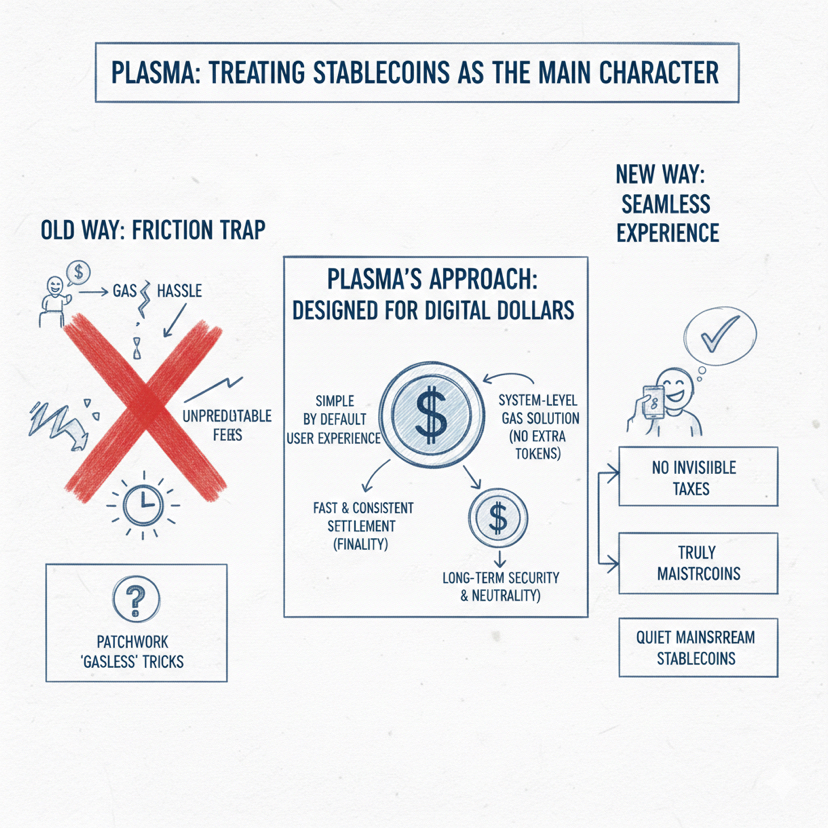
That’s the quiet conviction behind the whole thing. Plasma isn’t trying to win every narrative. It’s trying to remove the invisible taxes that stop stablecoins from feeling truly mainstream: the gas hassle, the unpredictable fees, the inconsistent confirmation experience, and the patchwork “gasless” tricks that break at scale.
If they get this right, it won’t feel like a new chain launch story. It’ll feel like something far more dangerous: stablecoins finally working the way people always assumed they should.

