

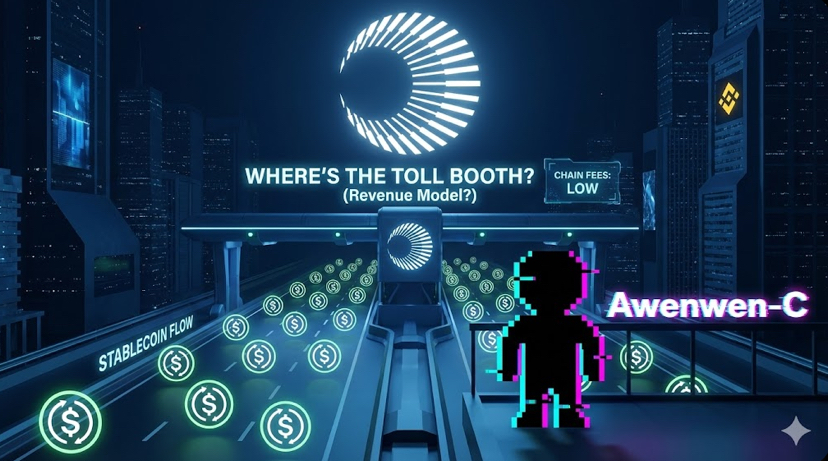
Brother, let's not talk about those grand financial models today. With this cup of tea, let's chat about something more practical.
Have you been tired from doing 'interactions' on those Layer 2 (L2) networks lately? To be honest, I almost got so exhausted that I was ready to vomit blood. Every day I set an alarm to move bricks, trade, and click that damned 'task panel' between a few so-called star L2s, just to chase that airdrop which might be sent sometime and might not even cover the Gas fees. Watching the little ETH I have flow away like water turning into transaction fees, and then looking at the project team's 'you're begging me to give you tokens' PUA face, I suddenly realized: we are not investing here; we are just digital serfs working for Ethereum!
With this rebellious spirit, I turned my attention back to a field that many people have forgotten, or even consider 'outdated'—independent Layer 1. Especially after recently deep-diving into Plasma ($XPL), I made a decision that goes against my ancestors: to liquidate those bloated L2s and put all my bullets into Plasma.
Why? Let me explain it to you slowly.
1. Tear off the facade of L2: You think it's expansion, but it's actually 'subletting'
A term called 'modularization' is popular in the circle now, which sounds very advanced, but to put it simply, the current L2 is just a bunch of 'subletters'.
* Living by reading people's faces: They buy block space from that batch on Ethereum and sell it to us at a markup. No matter whether they claim to be ZK or OP, as long as the Ethereum mainnet gets congested (like when they were doing inscriptions recently), L2 gas fees will still soar, or even directly go on strike.
* Floating without roots: No matter how luxurious a villa you build on L2, the land still belongs to someone else. If the landlord (mainnet) changes the underlying rules, or if the rent (DA fees) increases, the subletter has no choice but to pass the costs onto us.
Plasma's logic is completely different: it chooses to be an independent L1.
It doesn't rent; it buys land to build itself. This seems very foolish in today's era of 'being backed by a big tree to catch the breeze', but if you think carefully: which real business giant would establish its core business on someone else's territory? If Visa or Alipay goes on-chain, can they accept their systems crashing because someone else released an NFT? Plasma pursues that certainty of 'I control my territory', which is how financial infrastructure should be.
2. The engineer's stubbornness: No nesting dolls, just hardcore performance
Now, every project has PPTs that are more beautiful than the last, proclaiming 'ten thousand transactions per second', but as soon as they go live, they falter.
I went through Plasma's technical documents and found that these people are really quite 'stubborn'. They didn't ride on fancy ZK concepts to get funding but hid inside to rewrite the underlying P2P communication protocol.
* Why rewrite? Because they want to push network latency to physical limits.
* Who does this dirty and tiring work? Now everyone is busy with staking nesting dolls and issuing points, no one wants to do this slow-acting foundational work.
But it's this engineer's stubbornness that makes me feel secure. They know that if they want $XPL to really replace fiat currency settlement, performance must be genuinely achieved, not just blown up through PR articles. It controls block size and block speed itself; this autonomy is its confidence to challenge traditional payment systems.
3. Talking money doesn't hurt feelings: $XPL 's value capture is 'really good'
Bro, let's speak honestly, what use do the ARB and OP you hold really have?
* Governance rights? The coins we have can't even make a splash when voting.
* Transaction fees? They don't take it as gas fees; most of the network's money goes to Ethereum as 'rent'.
This is the most awkward part of L2 tokens: the hotter the ecosystem, the more valuable ETH becomes, while L2 tokens end up being like a mascot.
Let's take another look at $XPL:
In the Plasma network, XPL is like crude oil, it's electricity.
* Essential consumption: Every transfer, every smart contract call must genuinely consume XPL.
* Value closed loop: Transaction fees go to nodes, and nodes stake XPL to ensure security. This kind of native deflationary and demand model is the hard truth that supports the coin price.
I tried a transaction on-chain, and watching that tiny bit of XPL being burned didn't bother me at all; instead, I was quite happy—because I know this consumption is real, not a false prosperity created for air drops.
4. Pitfall guide: It does look a bit 'ugly' right now
Since we're chatting, I can't just pick out the nice things to say; I also have to critique Plasma's current situation.
* User experience is extremely poor: When I first set up its official wallet, I almost smashed my phone in frustration. That UI is designed like a product from the last century, and the mnemonic import process is excruciatingly complicated.
* Ecosystem like a desert: On the current Plasma chain, besides transfers and simple swaps, there is really nothing else. No lending, no meme coins, it's as dull as wandering through a late-night library.
But think from another angle: current public chains are all becoming overly entertaining and casino-like, with all kinds of meme coins rampant. This kind of 'dullness' might actually be what traditional financial institutions prefer. Banks need a stable, clean, and ultra-low-cost settlement channel, not a bizarre casino. The current desolation is precisely the best time for us to lay in wait.
5. Independent but not isolated: Plasma's 'hub' ambition
You might worry, will an independent L1 become an island?
I found Plasma's cleverness in that it has designed a very efficient cross-chain protocol. It does not reject Ethereum, nor does it reject BSC; what it wants to do is **'the atomic exchange hub for assets'**.
Imagine, in the future, you won't need to go to decentralized exchanges (CEX); directly on Plasma, you can swap Bitcoin for USDT on Ethereum in a second, with fees almost zero. If this hub's position is solidified, then $XPL 's ceiling? I really can't imagine.
6. Summary: Be a 'clear-headed person', wait for the wind to come
The current market severely underestimates the value of 'sovereignty'. Everyone is competing in that narrow L2 path, with severe homogenization. Plasma's insistence on taking the clumsy route of independent L1 instead shows its cost-effectiveness due to its scarcity.
* About marketing: Many people complain that its marketing is weak. Indeed, it doesn't buy trending searches or invite KOLs to shout out. But in my opinion, excessive marketing is often the beginning of a harvest. A solid team that writes code and solves payment latency issues is more trustworthy than a scammer who shouts 'To the moon' every day.
* About the price: To be honest, the current price compared to its fundamentals is really a bargain. Rather than handing over to L2 institutions with a market cap of hundreds of billions, it's better to buy a 'digital landlord' entry ticket here.
Investment is not about who is shouting the loudest now, but who hasn't been caught naked when the tide goes out. Refuse to be Ethereum's digital serf, hold onto your independent sovereignty, and leave the rest to time.



