The last decade has seen blockchain increase rapidly. However, there is one important question how can digital assets come into handy in the daily finance?
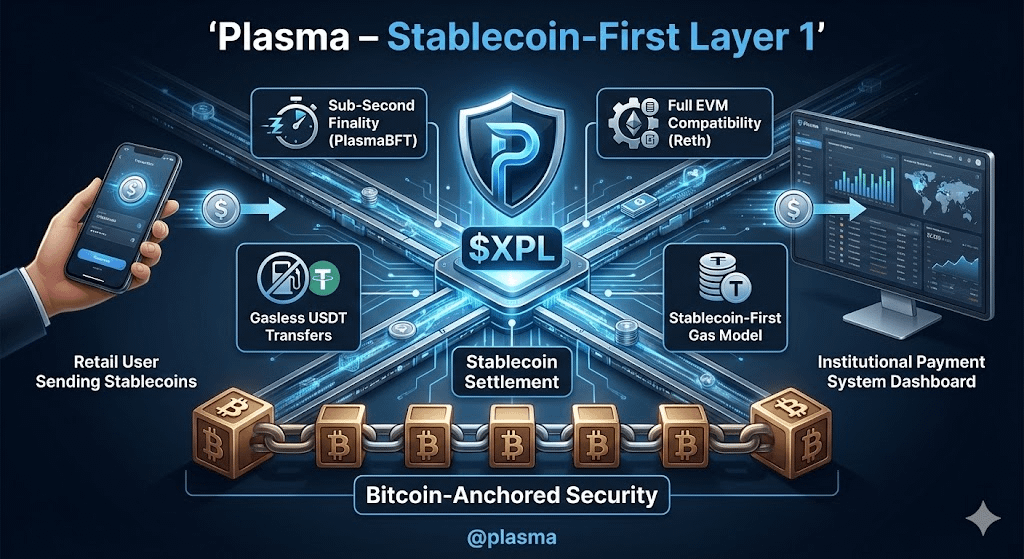
The vast majority of blockchains have a wide range of supported apps, but few were designed at the beginning of their existence to prioritize stable coin settlement. It is a Layer1 chain that is intended to operate exclusively on stable coins. It combines complete compatibility with EVM, immediate (sub second) confirmation, and stable coin based design. The native token of the chain, which is called $XPL , is the key that maintains the network in the long term. We should take a look at the real life uses of stable coins before we understand the importance of Plasma.
One of the most useful inventions of blockchain is now stable coins. They are risking in emerging markets wild currency volatility. Remote workers and freelancers can remit money to one another internationally without the inconvenience of banking. Programmable settlement lanes are available at 24/7 in institutions.
Nonetheless, even with them, blockchains that were not designed to be used as stable coins are still being utilized. Prices increase, approvals take varying durations, and the whole process becomes random. To the average users in the locations where the stable coins have gained traction, these issues are not merely technical, but they occur on a daily basis.
Plasma addresses these issues right away
@Plasma is a system that begins with stable coins, as opposed to the approach of adding stable coins to a general purpose network. It combines Reth, a rapid Ethereum ETH run time, with Plasma BFT, a sub second finality consensus. That is, the payments are verified practically immediately a required rate of a system that would like to compete with ordinary banks.
Speed by itself is not enough. The networks should also be trusted, predictable as well as neutral. Plasma has linked its security with Bitcoin that offers a high degree of censorship resistance and neutrality. Plasma extends Bitcoin and links to one of the most tested layers in the field of digital asset security. That is important to institutions and payment vendors in need of long term stability.
One more important characteristic is a stable coin first gas model. The majority of chains compel the users to possess and relocate a separate token to settle charges which makes it complex to shoppers aiming at transferring stable coins. Plasma will allow individuals to transfer USDT without a fee and convert stable coins into direct gas consumption. It simplifies the entire process particularly among individuals who are not crypto experts.
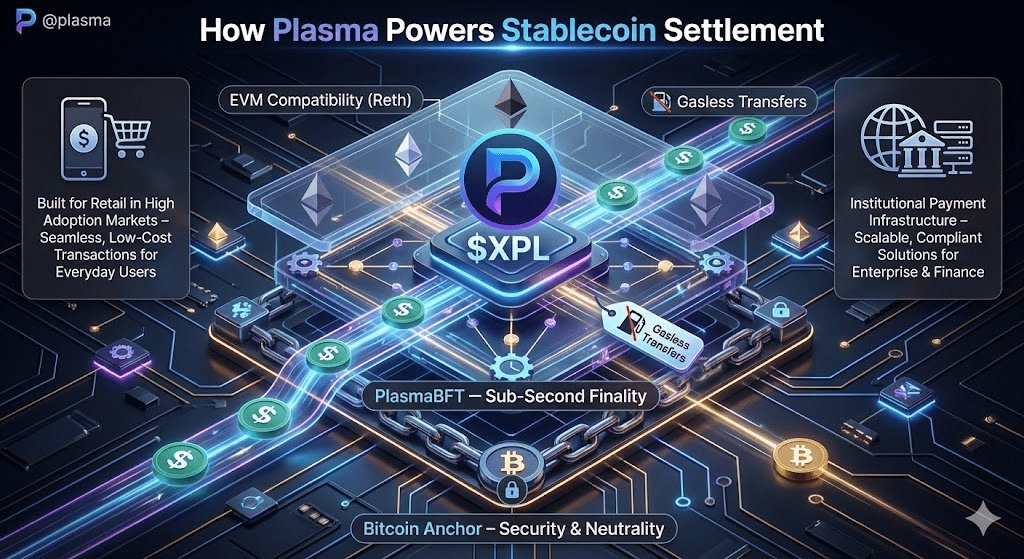
Under this design, popular markets have users who learn quicker, on a daily basis. They do not need to maintain a separate balance to hold and transport stable coins. Companies that receive and make payments have reduced operational inconvenience and accounting.
EVM compatibility is also desired fully. Plasma allows developers to execute the same smart contracts and tools that are used in Ethereum with minimal effort by using Reth. That reduces the entry barrier to builders and allows the apps that are already in existence to connect to settlement by using the stable-coin without starting from scratch.
Technologically, a combination of EVM compatibility, instant finality, and stable only gas is a niche environment. It does not attempt to be a universal one. It focuses on being a high performance base layer of digital dollars among other stable assets.
The role of XPL within the ecosystem is concerned with the role and security of the network. Similar to the majority of Layer1 tokens, $XPL supports validator rewards, governance and economics of the protocol. It is not a speculative asset, it is the structural backbone of the stable-coin settlement of Plasma.
In the case of blockchain infrastructure on a long-term basis, it is necessary to distinguish between general experiments and purpose-built systems. Plasma is exclusively under the latter. It is designed on the premise that stablecoins will remain the center of digital finance and that they require infrastructure tailored to their requirements.
The concept is correctly aligned with the trends. The remittances, payroll, on-chain trading, and treasury work are more often made with the help of stable coins. Stable coins are utilized by firms investigating tokenized assets to connect conventional finance with decentralized finance. Settlement velocity, predictable charges, and censorship resistance aren’t features in that world, they are necessities.
The finality delays of plasma are less than a second. It has a stable-coin-first gas model that enhances user experience. Security based in bitcoin is neutral and trusted. EVM compatibility enhances uptake by developers.
These decisions indicate a definite plan of attack. Plasma is not a matter of pace or hype its concern is a limited, demonstrated application. Such clarity is a competitive advantage in a profession that most networks are unable to define their purpose.
Real benefits are received by the daily users. Uncertainty is reduced through quicker confirmations. USDT gasless eliminates friction. Stable coins purchases make moves simpler. Institutions acquire a solid foundation: neutral security, standard finality, and interoperability with existing smart-contract standards- each contributes to long-term usage.
Specialization is also likely to increase with the development of blockchain. Old finance has settlement, clearing and messaging layers. Purpose-built chains to specific roles may be more frequently used in digital finance.
One of such specializations is plasma. Focusing on stablecoin settlement, it is in-between everyday users and institutional finance. The token that drives this system is its token, XPL which anchors the economic and governance layers. Within the larger scope of the vision of the network, the network will offer a payment centric Layer1 that prioritizes pragmatic work over theoretical testing.
It is in a market where narratives are so common to drive that the most sustainable projects are those that address tangible issues. Stablecoin settlement is not a mere theory, but it is already occurring on a scale. The challenge is whether the required infrastructure can develop to fulfill that demand in an efficient, safe and neutral way.
The structure of plasma responds to this. It redefines a standardized approach to performance and turns to effective financial use by constructing a blockchain that is specifically targeted at stablecoins. This focus can be its best innovation to users and institutions who seek a simplified, robust settlement layer.