

Execution speed is not the breakthrough credible payment finality is.
Most people miss it because they focus on smart contract features instead of settlement guarantees.
What it changes is how builders design apps and how users judge risk.
Over the past few years I have tested many chains that promised faster execution and richer virtual machines. In practice, what traders and users cared about was simpler: when is a payment truly done, and who stands behind that answer? I have seen complex apps fail not because the code was weak, but because the settlement layer was unclear. That experience shifted my lens from performance metrics to finalization rules.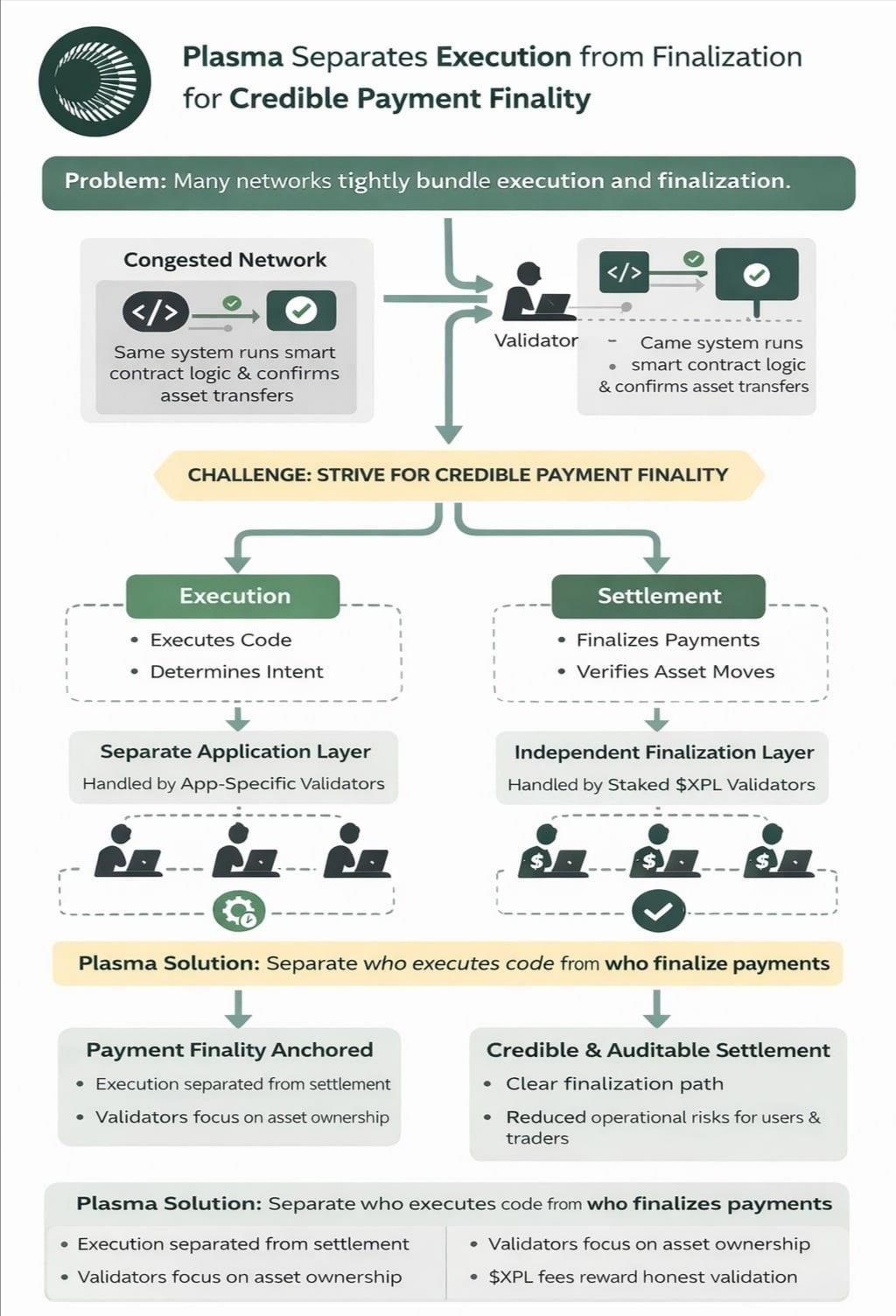
The core friction is this: on many networks, execution and finalization are tightly bundled. The same system that runs complex application logic is also responsible for confirming asset transfers. When congestion spikes or application logic becomes heavy, settlement confidence can become harder to reason about. For traders moving stable value or institutions tracking liabilities, ambiguity around finality creates operational risk. It is not about how fast a contract runs, but about whether a transfer can be reversed, censored, or delayed under stress.
It is like building a marketplace where the cashier and the shop floor manager are the same person.
Plasma’s core idea is to separate who executes code from who finalizes payments. The state model centers on clear asset ownership records, where balances and transfers are tracked independently from complex application logic. Applications can execute their own rules, but asset settlement is anchored to a defined finalization layer. A transaction flows in two logical steps: first, execution determines intent and validates conditions; second, settlement confirms asset movement through a simpler verification path focused only on balances and signatures. Validators verify payment correctness rather than reprocessing every layer of application logic.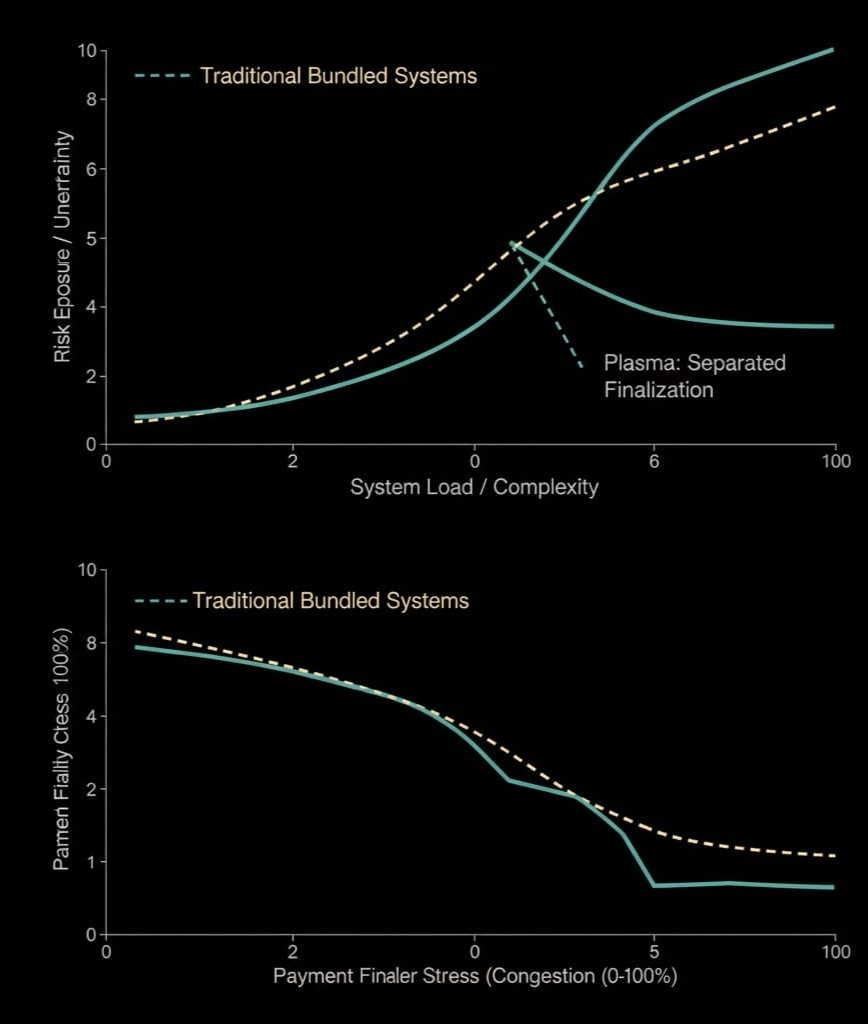
This separation narrows the verification surface. Instead of every validator simulating all application code, they check that state transitions for assets follow predefined rules. Incentives are aligned through staking: validators lock $XPL to participate in finalizing payments, and misbehavior can lead to penalties. Fees in $XPL compensate validators for processing and confirming transactions, creating an economic reason to maintain honest settlement. Governance with $XPL allows stakeholders to adjust parameters such as staking requirements or settlement rules, shaping how strict or flexible finalization becomes over time.
Failure modes still exist. If a majority of staked validators collude, they could attempt to finalize invalid state transitions, though this would put their stake at risk. Network liveness can also degrade under extreme congestion or coordinated attacks, delaying finality even if correctness rules hold. Plasma does not guarantee that applications themselves are bug free, nor does it eliminate the need for careful contract design. What it aims to guarantee is that asset finalization follows a clear, auditable path with defined economic consequences for misconduct.
The uncertainty is whether real world validator behavior under extreme stress will align with economic incentives as cleanly as the model assumes.
From a trader investor perspective, separating execution from finalization reframes risk analysis: instead of asking how powerful the virtual machine is, we ask how credible the settlement layer remains during volatility. If payment finality becomes the primary design focus, could that quietly become the real competitive edge in the next cycle?

