
Most blockchains were architected around a simple premise: a person sits behind a wallet, reviews a transaction, and manually approves it. Every interaction assumes human latency, human intent, and human decision cycles.
That design model is aging fast.
We’re entering an environment where autonomous AI agents transact, coordinate, and execute continuously. In that context, infrastructure built purely for human UX becomes a structural bottleneck.
Vanar Chain is approaching the problem from a different angle: design the base layer for machine-native participation first — and let human interfaces be secondary.
The Core Issue: AI Is Usually Bolted On
Many networks claim AI integration. In practice, the intelligence runs off-chain. The blockchain merely logs final outputs.
That creates structural weaknesses:
Memory exists outside the protocol
Reasoning cannot be verified
Automation depends on brittle off-chain scripts
Execution lacks native continuity
This model works for limited proofs of concept. It does not support autonomous agents operating persistently across environments.
For AI agents to function reliably, infrastructure must support four native capabilities:
Persistent contextual memory
On-chain reasoning and auditability
Automated multi-step execution
Deterministic settlement
Vanar’s architecture is aligned around those primitives — not as add-ons, but as foundational layers.
What AI-Native Design Looks Like
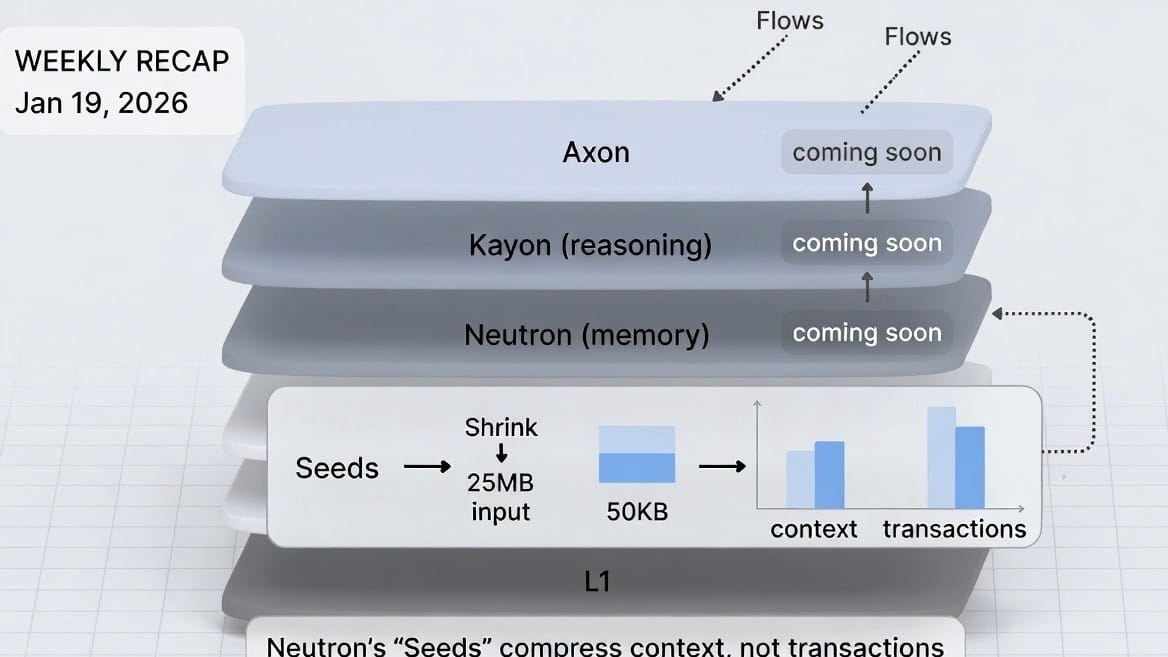
Vanar introduces a stack built specifically for intelligent systems:
myNeutron enables persistent semantic memory at protocol level. Agents can maintain state, context, and learned patterns across sessions instead of resetting each interaction.
Kayon brings verifiable reasoning on-chain. Decisions are not just executed they are explainable and auditable, which becomes critical when machines act autonomously.
Flows allow structured, automated workflows to execute without human triggers. This is where intelligence transitions from advisory to operational.
These components aren’t conceptual diagrams they’re active layers demonstrating that cognition can be integrated directly into blockchain infrastructure.
Cross-Chain Integration Is Strategic, Not Cosmetic
AI infrastructure cannot remain siloed.
Vanar’s expansion toward ecosystems like Base is about extending intelligence where applications already exist. Rather than forcing migration, Vanar positions itself as a modular intelligence layer that other ecosystems can plug into.
This transforms it from a standalone chain into a shared execution and reasoning backbone.
Network effect here isn’t about TVL alone — it’s about cognitive reach.
Settlement Is What Makes AI Economically Real
Autonomous agents require programmable, compliant payments. Without native settlement, AI remains theoretical.
With settlement, it becomes economic.
$VANRY functions as the transactional substrate across memory utilization, reasoning execution, workflow automation, and cross-chain settlement. As intelligent activity scales, protocol usage scales with it.
The economic model is tied to throughput and infrastructure dependency — not short-term narratives.
The Broader Shift
Web3 does not lack chains. It lacks machine-grade infrastructure.
Vanar isn’t branding itself as “AI-enhanced.” It’s building as though AI agents are already primary network participants.
That architectural assumption alters everything:
Resource design
Economic flow
Cross-chain positioning
Security modeling
In an environment saturated with surface-level AI messaging, Vanar’s differentiation lies deeper at the protocol layer.
Intelligence isn’t being layered on top.
It’s being embedded into the foundation.
#Vanar #VANRY @Vanarchain $VANRY
