
You know how when you ask your parents for twenty bucks and they squint at you and say, "What do you need twenty dollars for?" and then you have to explain your entire life choices? That's how most crypto projects raise money. They beg. They grovel. They release a "vision paper" with 47 diagrams that are really just arrows pointing to clouds labeled "synergy."
Plasma did something else.
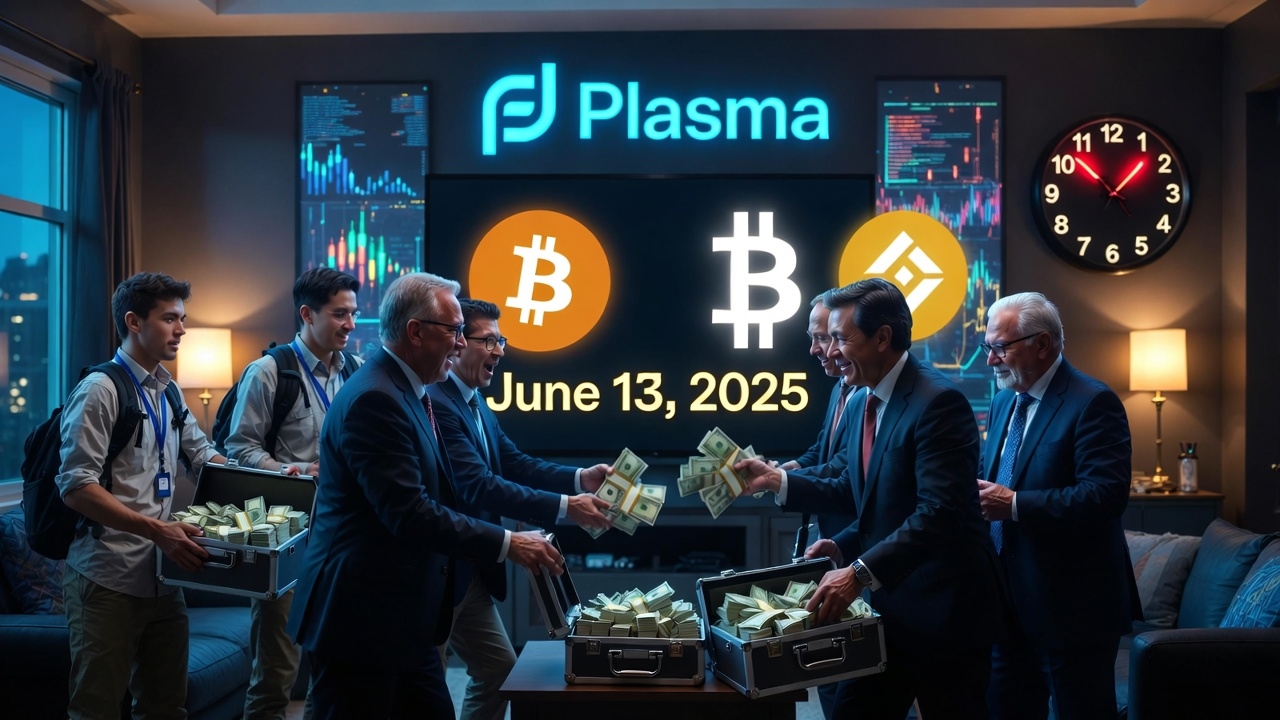
On June 13, 2025, the team essentially walked into the living room, looked at the couch where the entire crypto industry was sitting, and casually said, "Hey, anyone got $500 million lying around? We need gas money."
What happened next is either a testament to Plasma's credibility or proof that wealthy crypto people are incredibly impulsive with their wallets. Probably both.
According to actual, documented history that is not made up for comedic effect, Plasma set a record for the speed of capital intake that would make a vacuum cleaner blush. The $500 million target was met in five minutes . Not five days. Not five hours. Five minutes. The team, presumably staring at their screens with the same expression you'd have if your toaster suddenly started reciting Shakespeare, said, "Uh... double it?" So they doubled the cap.
Another $500 million arrived in the next 25 minutes .
Total haul: $1 billion. Total time: half an hour. Approximately 2,900 wallets participated, with the median contribution sitting at a casual $12,000 . You know. Pocket change. Just a bunch of people finding an extra twelve grand between the couch cushions and deciding to toss it at a blockchain they'd heard about, like, maybe three weeks prior.
This is the part where I admit that I, the writer, have never experienced anything remotely similar. The most money I've ever raised in thirty minutes was $14 for a colleague's birthday gift, and that required three separate Venmo reminders and a passive-aggressive Slack message.
But here's where it gets even more unrelatable. Later that month, Plasma opened a public sale for 1 billion XPL tokens at $0.05 each. They were hoping for, let's be generous, $50 million . They received $373 million . That's 7.5 times what they expected. It's like hosting a garage sale for your old blender and having 400 people show up offering to buy it for the price of a used Honda Civic.
Now, you might be thinking, "Wow, everyone must have gotten a fair shot at this! True decentralization in action!"
Ah. Yes. About that.
Roughly 70% of that $1 billion in deposits ended up with the top 100 wallets . This is the crypto equivalent of a pizza party where 100 people take 70% of the pizza and everyone else fights over the remaining crusts with increasing desperation. Industry observers, with the subtlety of a foghorn, noted that "retail users were all but shut out" . One commentator, Andrii Velykyi, posed the question that haunts every allocation conversation: "For the amount they raised, will there actually be enough buyers in the market?" .
This is the part where you, dear reader, are supposed to feel outraged on behalf of the excluded masses. But let's be honest—if you'd had $12,000 lying around in June 2025, would you have known to deposit it into a Plasma pre-TGE window? Neither would I. I was probably spending that week trying to figure out why my credit card declined a $4.50 coffee.
The beautiful irony is that Plasma, this supposed infrastructure for the masses, was bankrolled by what looks suspiciously like a very exclusive club of people who apparently communicate via telepathy or secret handshakes involving obscure NFT floor prices. The median contribution wasn't $500. It wasn't $1,000. It was $12,000 . That's not retail. That's organized financial behavior wearing a trench coat and pretending to be retail.
But here's the thing about billion-dollar sleepovers: they come with expectations. You don't let your friends crash on your couch and eat all your snacks without demanding something in return. In Plasma's case, the 2,900 wallets—especially the top 100—aren't donating. They're investing. And they're locked in. Team tokens? Locked three years. Investor tokens? Locked three years. Ecosystem tokens? Also three years . This isn't a weekend rave; it's a three-year hostage situation where everyone is tied to the same chair, and the chair is named "project success."
The XPL token distribution reads like a contract written by a lawyer who really, really hates early exits. Non-US users can trade freely. US buyers? Twelve-month lockup . It's the regulatory equivalent of "you can come to the party, but you have to sit in the corner and watch everyone else have fun for a year." As one observer dryly noted, "U.S. laws are very strict regarding fraud cases involving U.S. citizens' assets, which are generally felonies. The Wang family's project WLFI doesn't even dare to sell to U.S. citizens" . So Plasma basically said, "Fine, you can play, but your allowance is frozen until July 2026."
This is either prudent compliance or a masterclass in how to make American investors feel like they're being grounded.
So what do we make of a project that raised a billion dollars faster than most people can microwave popcorn, funded almost entirely by wallets that have never known the struggle of "insufficient funds," and then locked everyone—including themselves—into a multi-year commitment with the intensity of a arranged marriage?
We make this: Plasma is not your typical "we're building in public, please donate ETH" project. It's a financial institution wearing a blockchain costume, and its backers are not here for vibes. They're here because they believe—or at least are betting very large sums of money—that stablecoins are the next trillion-dollar market and that being early to the dedicated infrastructure is worth tying up capital for three years.
The billion-dollar sleepover isn't over. It's just that everyone woke up, realized they're all in this together, and now they have to figure out how to make the beds and cook breakfast for the next 1,095 days.
Pass the coffee. It's going to be a long, profitable morning.


