

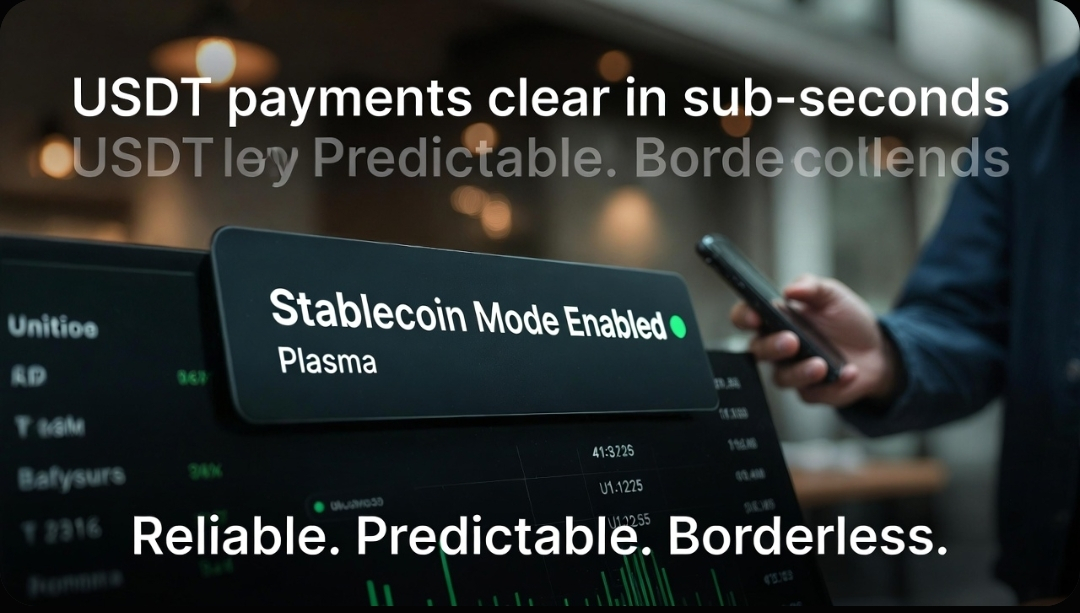
I noticed it first while glancing at a developer’s screen—an almost trivial change in the dashboard: a tiny green dot indicating “Stablecoin Mode Enabled.”

No one announced it. No fanfare. Just a quiet signal that a USDT payment rail was now live on Plasma, fully isolated from volatile tokens.
At first, it seemed unremarkable. Yet later, during a test transaction, I watched a merchant app process multiple payments. Each USDT transfer cleared in sub-seconds. The customer didn’t blink. The cashier didn’t flinch. The network hummed along, invisible and dependable.
It’s subtle moments like this that reveal Plasma’s core design philosophy. Traditional blockchains optimize for throughput and speculation. High TPS and volatile assets dominate discussions. But for real-world settlement, volatility is a liability. A single ETH swing or XPL surge can disrupt merchant accounting, treasury management, and cross-border transfers. A chain built around stablecoins, instead, allows certainty, predictability, and operational clarity—the lifeblood of institutional adoption.
Later that day, a colleague mentioned a new app migration: a stablecoin treasury service moving from Ethereum to Plasma. Reth-based execution meant the smart contracts, transaction logic, and tooling were almost identical. Minimal rewriting. Minimal integration cost. Sub-second finality worked in the background, invisible to end-users, but critical to maintaining operational continuity.
I watched the logs. USDT moved in waves across multiple nodes. Batch settlements executed automatically. The network never paused, never stuttered. For developers and institutions, this predictability is more valuable than TPS or token hype—it’s the foundation for a stablecoin-first economy.
At lunch, I observed a small café using Plasma-powered payments. A customer tapped to pay USDT. The screen flashed “Confirmed” almost instantly. No XPL needed. No gas surprises. No hesitation. That’s the operational reality institutions crave: a predictable ledger where stablecoins are the primary transaction asset, not speculative tokens requiring constant hedging or risk management.
Because Plasma is EVM-compatible, Ethereum-native apps can migrate without losing developer familiarity. Developers can leverage existing tooling, wallets, and dApp frameworks while switching the settlement layer to stablecoins. That reduces friction, preserves liquidity, and concentrates transactional volume where it matters. Stablecoins become the primary unit of account, and speculative assets like XPL act in supporting roles—collateral, incentives, or network security—without destabilizing daily operations.
The day ended with a subtle Slack ping: a validator reporting “Batch settlement latency <500ms across 20k transactions.” I smiled. That minor update, the green dot earlier, had quietly enabled a stablecoin-native ecosystem, bridging retail, merchant, and institutional workflows with a single, consistent ledger.
What stood out was how invisible it all was. No flashy dashboards. No marketing banners. No hype. Just reliable, predictable settlement. That’s Plasma’s real achievement: enabling stablecoins as the primary transaction asset, reducing migration pain, concentrating liquidity, and creating a foundation where payments actually work at scale.
By the time I left the office, I realized the pattern. Every minor UI element, every subtle network improvement, every seamless USDT transfer was part of a deliberate design: a chain optimized for stability over speculation, for operational certainty over volatility. It’s not about token price or market cycles. It’s about making stablecoin settlement real, usable, and frictionless—the invisible infrastructure behind digital-dollar commerce.
And that little green dot? It was the quiet symbol of a chain doing what matters most: enabling predictable payments, developer-friendly integration, and a stable, liquid ecosystem. Plasma doesn’t just process transactions—it anchors the real-world economy in a ledger that doesn’t waver when markets do.

