

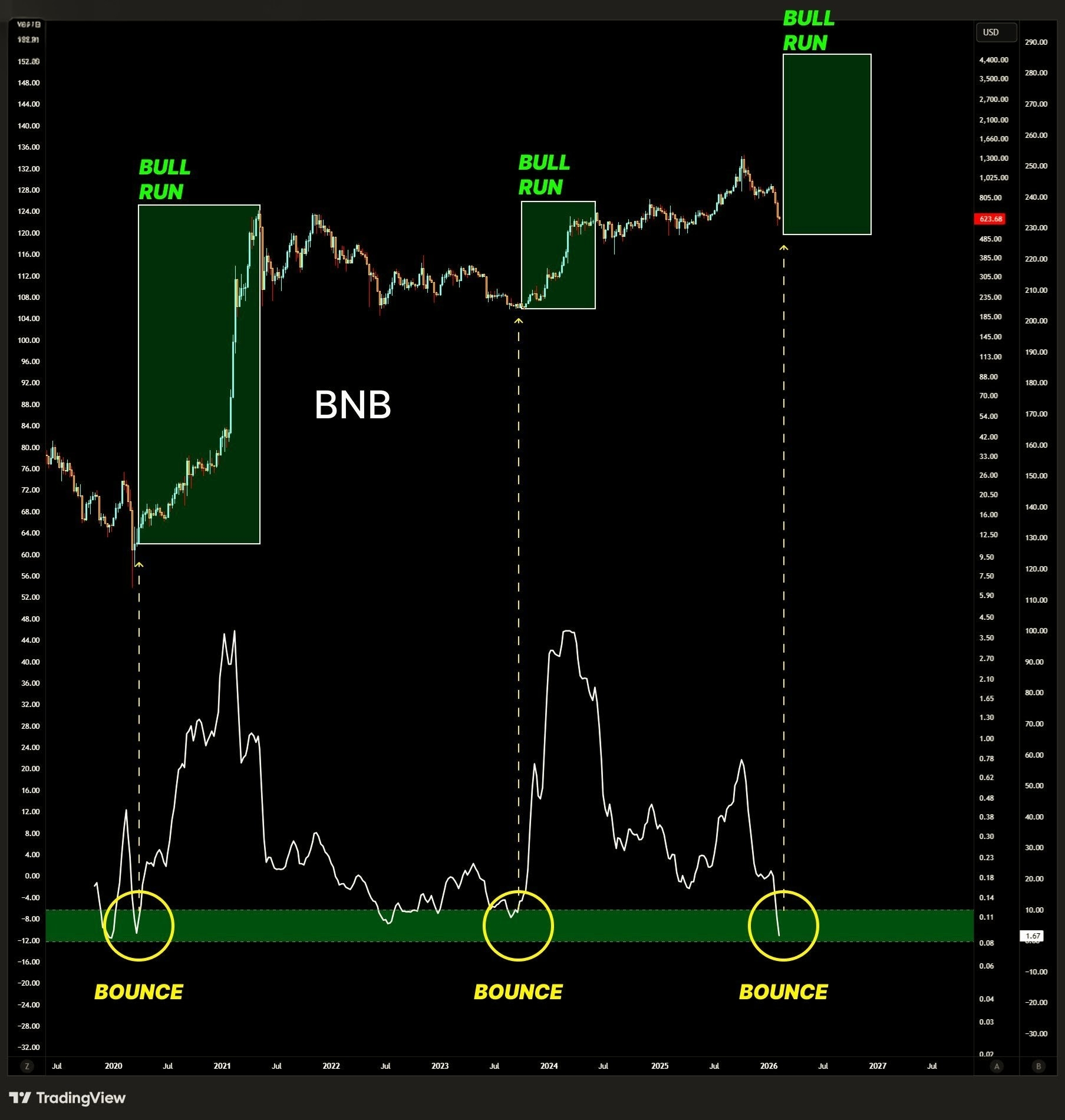
 Something interesting is happening with BNB in 2026. It is not loud. It is not built on hype. It is structural.
While much of crypto still moves in cycles of excitement and fear, BNB continues to operate on a more predictable pattern. Burn supply. Upgrade infrastructure. Expand regulatory footing. Repeat.
That rhythm matters.
As of early 2026, BNB trades in the low $600 range, with a circulating supply slightly above 136 million tokens. The total supply keeps shrinking because of its scheduled quarterly burns. The 34th burn removed more than 1.37 million BNB from circulation. That was not symbolic. It represented over a billion dollars worth of tokens at the time.
But the number itself is not the story.
The real story is discipline.
BNB’s burn mechanism is not reactive. It is programmed. Every quarter, supply decreases based on a transparent formula tied to activity. This creates a steady deflationary pressure over time. It does not guarantee price movement. Nothing does. But it builds long-term scarcity into the structure of the asset.
Think of it like a company that consistently buys back shares every quarter. Not when headlines look good. Not when sentiment is high. But as part of its operating system.
That consistency builds trust.
At the same time, BNB is not just reducing supply. It is upgrading its engine.
The BNB Chain introduced the Fermi hard fork as part of its performance roadmap. The goal is simple. Faster block times. Lower latency. Smoother execution. Reports suggest block speeds targeting under half a second.
That shift is not about marketing.
It is about usability.
If you want real consumer applications like games, social platforms, and micro-transactions to run smoothly, speed matters. Nobody waits five seconds for a simple action online. Users expect instant feedback. Infrastructure must match that expectation.
This is where BNB’s strategy becomes clear.
Instead of positioning itself as the most experimental chain or the most ideologically pure, it leans into practicality. Speed. Low fees. High throughput. Stable environment for builders.
You can see it in how developers use it.
BNB Chain has long attracted projects that need scale at low cost. Many retail-focused applications choose it because it works reliably under load. It is not chasing the narrative of being the most decentralized experiment. It is focused on being functional.
That difference shapes its identity.
There is also a governance layer evolving quietly in the background. Binance, the exchange most closely associated with BNB, announced a new regulated corporate structure under ADGM in early 2026. This matters more than it seems.
Regulation in crypto is often treated like an enemy. But for large capital flows, regulatory clarity is not a burden. It is a requirement.
Institutions do not enter markets that lack structure. They need compliance pathways. Reporting clarity. Legal certainty.
By restructuring under regulated frameworks and pursuing licensing in regions like the EU, Binance signals that it understands the long game. Stability attracts capital. And BNB, as the ecosystem token, benefits from that stability.
This does not remove all risk.
BNB still moves with broader market sentiment. If Bitcoin drops sharply, BNB does not live in isolation. If macro conditions tighten, liquidity across crypto compresses.
But BNB has an advantage that many tokens lack. It is deeply integrated into an operational ecosystem.
BNB is used for gas fees on BNB Chain. It provides trading fee discounts on Binance. It supports staking. It plays a role in launchpad participation. It is not just a speculative asset sitting idle.
Utility creates baseline demand.
The burn mechanism reduces supply. Utility sustains demand. Infrastructure upgrades expand potential usage. Regulatory steps reduce structural uncertainty.
These pieces connect.
Imagine a small business that consistently improves its tools, reduces costs, and strengthens legal foundations. It may not always trend on social media. But over time, it builds resilience.
BNB feels similar.
Another factor often overlooked is behavioral psychology. Many crypto tokens depend heavily on new narratives to maintain attention. When the narrative fades, activity fades.
BNB operates differently. Its value proposition is not built on being new. It is built on being integrated.
This makes its growth quieter but potentially steadier.
That said, no ecosystem is immune to execution risk. Faster block times introduce complexity. Validator requirements increase. Network optimization must balance speed with stability.
There is also concentration risk tied to Binance’s brand. While regulatory progress is positive, dependency on a single dominant exchange ecosystem can be viewed both as strength and as exposure.
Investors should understand both sides.
It is easy to look at quarterly burns and assume automatic upward pressure. Markets do not work that simply. Price depends on demand growth matching or exceeding supply reduction.
If network usage grows, if more developers build, if institutional pathways expand, then the deflationary model compounds over time.
If usage stagnates, burns alone are not enough.
So what does 2026 really represent for BNB?
It looks like a transition phase.
The early years were about expansion and rapid ecosystem growth. The middle phase dealt with regulatory friction and market volatility. Now the focus appears to be optimization and normalization.
Less noise. More structure.
BNB is positioning itself as infrastructure rather than a trend.
In practical terms, that means prioritizing block performance. Maintaining low fees. Continuing predictable burns. Aligning with regulatory standards where possible.
For retail users, this shows up as smoother transactions and stable fee structures.
For developers, it shows up as a chain that handles load without surprise spikes in cost.
For institutions, it shows up as a token connected to a globally recognized exchange that is actively engaging with regulators.
Each audience sees a different layer of the same system.
From a strategic standpoint, BNB’s model is relatively straightforward. Strengthen the ecosystem. Reduce supply over time. Improve performance. Expand compliance reach.
No dramatic reinvention. No sudden ideological pivots.
Just iteration.
And in crypto, iteration can be underrated.
It is also important to stay grounded. Crypto markets remain volatile. Regulatory landscapes evolve. Competition from other Layer 1 and Layer 2 chains continues. Ethereum scaling solutions, emerging modular chains, and new performance-focused networks all compete for developer attention.
BNB’s edge is familiarity and integration.
It already has users. It already has volume. It already has infrastructure.
The question is whether it can maintain relevance while others innovate aggressively.
So far in 2026, the signs suggest it is leaning into its strengths rather than chasing every new narrative. That is a strategic choice.
When evaluating BNB, it helps to think less in terms of short-term price movement and more in terms of system design.
Is supply decreasing? Yes.
Is infrastructure improving? Yes.
Is regulatory positioning becoming more structured? Yes.
Those are foundational elements.
None of them guarantee returns. But they build a framework that reduces uncertainty over time.
In a market where many projects promise transformation without operational depth, BNB presents something simpler.
It is a working network tied to a working business.
It burns tokens on schedule. It upgrades performance on schedule. It engages regulators on schedule.
That consistency might not create headlines every week. But it creates continuity.
And continuity, in financial systems, is often more powerful than excitement.
BNB in 2026 does not look like a speculative experiment. It looks like infrastructure refining itself.
Whether that translates into sustained long-term growth depends on adoption and broader market conditions. But the direction is clear.
Scarcity is tightening.
Speed is increasing.
Structure is strengthening.
And in crypto, structure tends to outlast noise.
