Plasma has entered 2026 with a noticeably different posture from its launch phase. The narrative is no longer about speculative momentum or token excitement; it is about infrastructure execution. Mainnet is live, core validator operations are active, staking and governance mechanisms are functioning, and stablecoin transfers are happening on production rails. The transition from beta optics to operational blockchain infrastructure is the most important development in Plasma’s lifecycle so far.
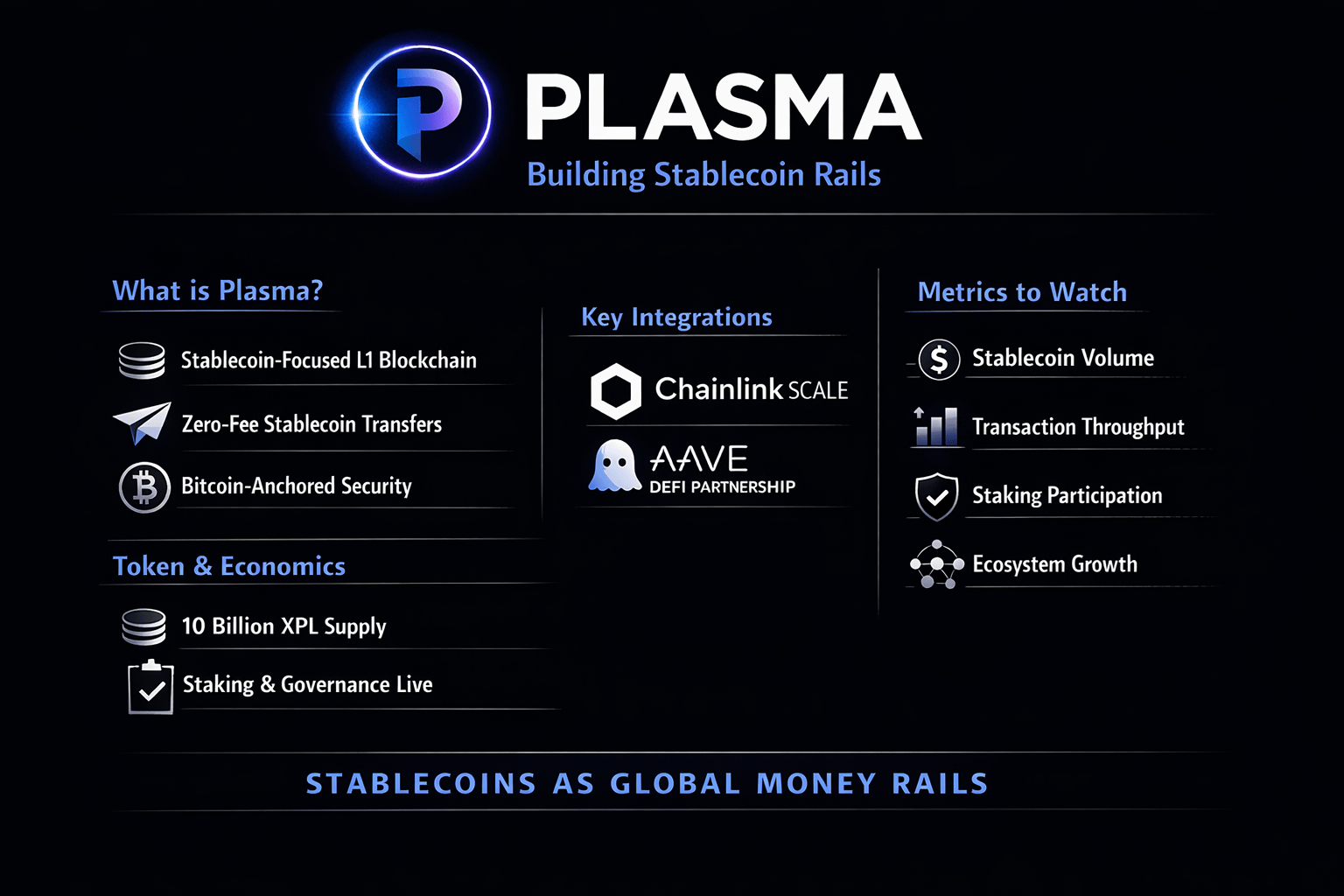
At its core, Plasma is purpose-built for stablecoins. Instead of positioning itself as a general-purpose Layer 1 competing across every vertical, it concentrates on high-throughput, low-cost settlement for on-chain dollars. The design philosophy is straightforward: if stablecoins are becoming the dominant medium of exchange in crypto, then they require optimized rails rather than generic smart contract capacity. Plasma’s architecture reflects this thesis, prioritizing transaction efficiency, predictable execution, and a user experience that abstracts away unnecessary friction.
One of the most discussed components of the network is its zero-fee stablecoin transfer model. Through a paymaster-style mechanism, users can move supported stable assets without holding the native token for gas in typical payment flows. This removes a common usability barrier that has historically limited crypto payment adoption. In practical terms, Plasma is attempting to compete not just with other chains, but with fintech payment processors by reducing cost variability and execution latency.
Ecosystem integrations have reinforced this positioning. Plasma joined Chainlink’s SCALE program and integrated oracle infrastructure from Chainlink, strengthening price feed reliability and smart contract data integrity. In parallel, integration with Aave expanded DeFi composability, enabling liquidity to interact with Plasma’s stablecoin rails rather than remaining siloed. These moves are strategically significant: infrastructure credibility often precedes capital confidence.
Tokenomics remain central to the discussion around XPL. The total supply is fixed at 10 billion tokens, with allocations spanning ecosystem incentives, team, investors, and public distribution. Ecosystem and growth allocations are substantial, reflecting Plasma’s need to bootstrap liquidity and developer participation. However, scheduled unlocks through 2026 introduce measurable supply-side considerations. Market participants are increasingly evaluating Plasma not solely on roadmap announcements but on staking participation, circulating supply expansion, and real on-chain demand absorption.
Price volatility following launch underscored a broader reality: incentive-driven liquidity is transient. After initial enthusiasm and reward cycles, XPL experienced retracement as early holders realized gains. Yet the more instructive metric is stablecoin presence and transactional activity on the network rather than short-term token performance. Infrastructure chains mature through utility curves, not hype cycles.
Technically, Plasma differentiates itself by combining EVM compatibility with a consensus design optimized for throughput and settlement efficiency. EVM support ensures that Solidity-based contracts can be deployed without rewriting core logic, lowering the barrier for developers migrating from Ethereum-aligned ecosystems. At the same time, throughput optimization positions Plasma for high-frequency stablecoin movement, which is critical if it aims to service remittances, treasury operations, and merchant settlements.
The broader macro backdrop also matters. Stablecoins continue to expand as a bridge between traditional finance and crypto-native markets. As regulatory clarity improves in multiple jurisdictions and on-chain dollar usage grows in emerging markets, specialized settlement layers become increasingly relevant. Plasma’s strategy is implicitly long stablecoin adoption; its success correlates directly with the expansion of on-chain dollar velocity.
Still, execution risk remains. Distribution is a competitive battlefield. Established Layer 1s and Layer 2s already host deep liquidity pools and entrenched developer ecosystems. Convincing users and institutions to migrate settlement flows requires not only technical superiority but partnership depth and user experience reliability. Additionally, token unlock schedules must be balanced against staking incentives to prevent sustained sell pressure from overshadowing network progress.
What to watch in 2026 is not headline announcements but measurable indicators: total stablecoin value secured on Plasma, daily transaction throughput, validator decentralization metrics, staking ratios, and third-party application deployments. These are the data points that determine whether Plasma evolves into critical financial infrastructure or remains a niche settlement experiment.
In summary, Plasma’s latest updates signal a maturation phase. Mainnet functionality, staking activation, oracle integration, and DeFi composability demonstrate forward movement. The project’s identity is clear: specialized stablecoin rails rather than a generalized smart contract playground. Whether that specialization becomes a structural advantage will depend on adoption velocity and disciplined token supply management throughout the year.