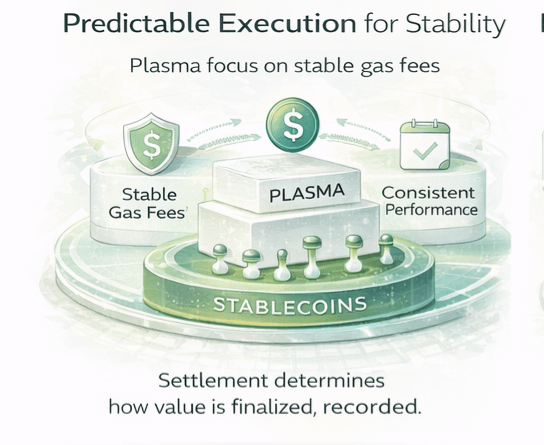
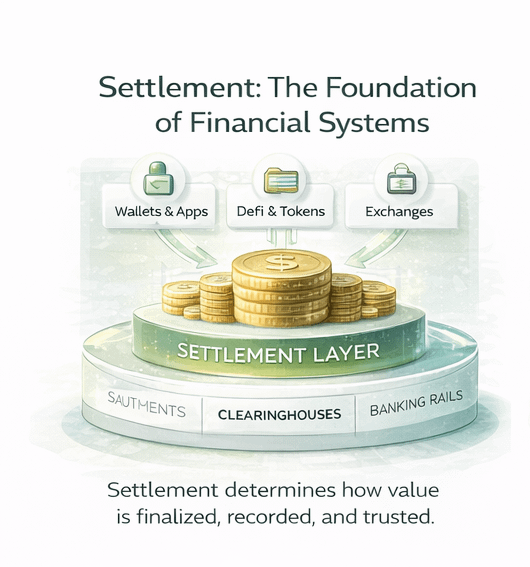
When people think about blockchain innovation, they often focus on applications, user interfaces, or token models. But in financial systems, the most important layer is often the least visible: settlement. Settlement determines how value is finalized, recorded, and trusted. Plasma is built around this principle.
In traditional finance, settlement layers define the structure of the entire system. Payment networks, clearinghouses, and banking rails all depend on predictable settlement rules. If settlement is unstable or inconsistent, every layer built on top becomes fragile. The same logic applies to blockchain infrastructure.
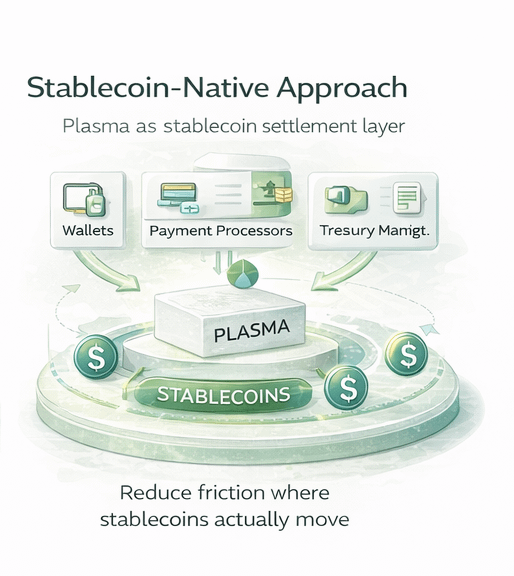
@Plasma positions itself as a stablecoin-focused settlement layer rather than a consumer-facing application platform. By making stablecoins native and supporting gas abstraction, @undefined reduces friction at the point where value actually moves. This design prioritizes consistency and clarity in how transactions are finalized.
Settlement layers also influence system behavior over time. If fees fluctuate unpredictably or execution varies under load, financial processes become difficult to automate. Plasma’s emphasis on predictable execution supports recurring payments, treasury management, and continuous financial operations that depend on steady behavior rather than peak performance.
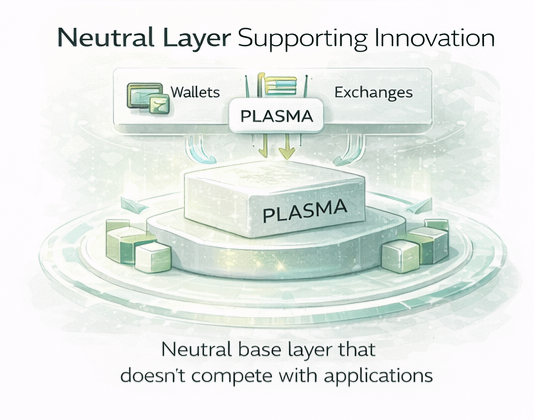
Another key aspect of settlement is neutrality. A reliable settlement layer does not compete with the applications built on top of it. Plasma maintains clear protocol boundaries, allowing wallets, payment processors, and financial tools to innovate independently while relying on stable infrastructure beneath them.
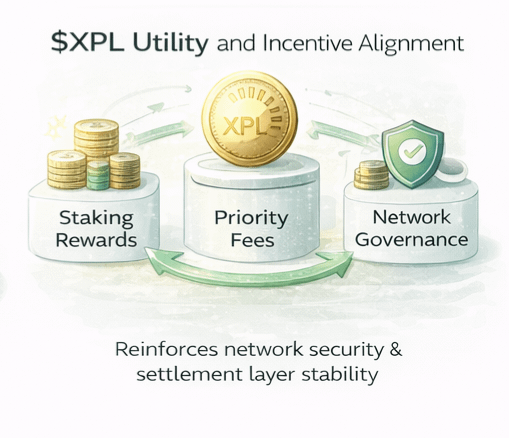
The role of $XPL aligns with this structure. Through staking, fees, and governance, the token supports the security and operation of the settlement layer itself. Value accrues from sustained usage and network participation, reinforcing the infrastructure rather than driving short-term experimentation.
As blockchain adoption matures, attention will increasingly shift from front-end innovation to the quality of underlying settlement. Systems that aim to support real commerce must offer clarity, consistency, and operational dependability. By focusing on settlement as a foundational layer, plasma positions itself not as an application trend, but as financial infrastructure designed to endure.