
Majority of Blockchains Are code runners. Vanar Chain Is Trying to Implement Intelligence.
As the market remains in an argument of TPS, fees and short-term catalysts, a more subdued architectural change is occurring within Vanar Chain.
The most recent updates do not put it in the same category as Layer 1 that competes based on speed.
Rather, they put it in a more structural form, an AI-native blockchain in which the protocol level is encoded with memory, adaptive logic, and autonomous agents.
That does not make a marketing difference. It’s an architectural one.
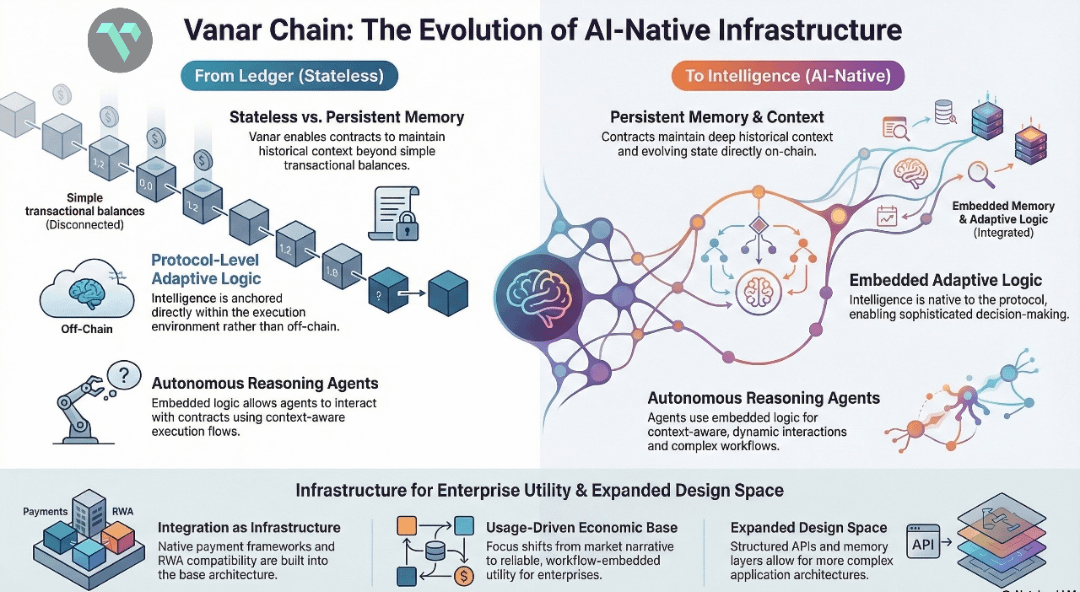
1. Traditional smart contracts are transactional, and they are poised at Stateless Execution.
They take action, update state as well as wait until they are called again.
The direction of Vanar adds a continuous on-chain memory layers on which contracts can hold an organized historical context not just balances and mappings.
It provides support of stateful behavioral systems, long-lasting autonomous logic, contracts that adapt to interaction patterns, and well-structured data persistence optimized to execute AI-driven programs. Practically, this brings blockchain a step closer to distributed intelligent systems, as opposed to distributed ledgers.
2. The Adaptive Logic in the Protocol Layer The majority of chains incorporate AI off-chain. The model by Vanar tries to put adaptive logic directly into execution environments.
Autonomous reasoning agents provide infrastructure focus, interoperating with contracts, context-driven execution flows, logic layers with dynamic responses based on past state.
This eliminates reliance on external orchestration layers and drives intelligence nearer to consensus-guaranteed settings.
3. Infrastructure, not Extension Vanar updates Vanar focuses on the depth of integration: payment frameworks integrated into base architecture, Real-World Asset compatibility layers, APIs facing the enterprise, and organized interoperability tooling.
It is indicative of a larger change in which blockchains are now considered in terms of workability, rather than ecosystem stories.
4. Variations in the Design Space Developers observe enlarged design space.
The continuous memory and adaptive logic provide space to more complex application architecture.
Businesses consider predictability, tooling SIF, and reliability of operations. The development of structured APIs and payments infrastructure fulfills this need.
The market observers are moving out of narrative momentum and into utility founded on use.
The layer of economic base established by AI-execution and system-level deployment is different.
5. Why This Shift Matters In case blockchains are still transaction engines, they are competing on throughput.
When blockchains are transformed into smart infrastructure, they will focus on the system design and long-term dependency.
The new developments in Vanar Chain make it look like it is trying the second way.
It is not the most noisy story in the market. Structurally it might be one of the more significant ones.
Since embedded infrastructure ceases to be traded as a theme, it becomes a foundation to which it is relied on.
