

I've been talking about VANRY for so long, but there's a question I haven't fully addressed.
This is its token economic model.
 It's not that I don't want to talk, but I just didn't fully understand it before. There are too many projects in the market with their so-called 'deflation models,' which are really just buying a few thousand dollars' worth of coins under the guise of transaction fee buybacks, throwing them into a black hole address, then posting a flyer and letting the community celebrate for three days while on the fourth day the price continues to decline.
I've seen this kind of trick too many times; it makes people numb.
During this time, I revisited Vanar's white paper and economic model, and with its AI subscription service set to launch in Q1, I suddenly felt like, 'So you were waiting here all along.'
I think the design of VANRY is quite a grand strategy.
It does not rely on marketing to pump prices but attempts to design a self-circulating demand engine at the system's core level.
Come on, let me break it down for you.
First layer: Gas fee, but the Gas fee is not the main character.
Vanar's transaction fee is fixed at $0.0005 per transaction, which is almost the floor price in the industry.
This is a good thing for users; transferring, interacting, and playing games almost feel costless.
But for token holders, if the demand relies solely on the Gas fee, that’s too thin — 10,000 transactions only make $5, which cannot support the market value.
So Vanar has no intention of relying on Gas fees to tell a story.
Second layer: Subscription model, this is the real killer move.
Starting from the first quarter of 2026, if you want to use Vanar’s advanced AI features — like calling Neutron to store massive amounts of data or letting Kayon help you with on-chain reasoning — you will have to pay with VANRY.
This is not a traditional 'transaction fee', but a subscription fee for Software as a Service.
Think about how Adobe, Salesforce, and Zoom make money.
What Vanar wants to do is to transform the blockchain from a 'transaction ledger' into an 'AI application store', and VANRY is the only universal currency in this store.
More importantly, the project party has left a loophole: this part of the subscription income may be used for repurchasing and destroying VANRY in the future.
This is the essence of the grand strategy.
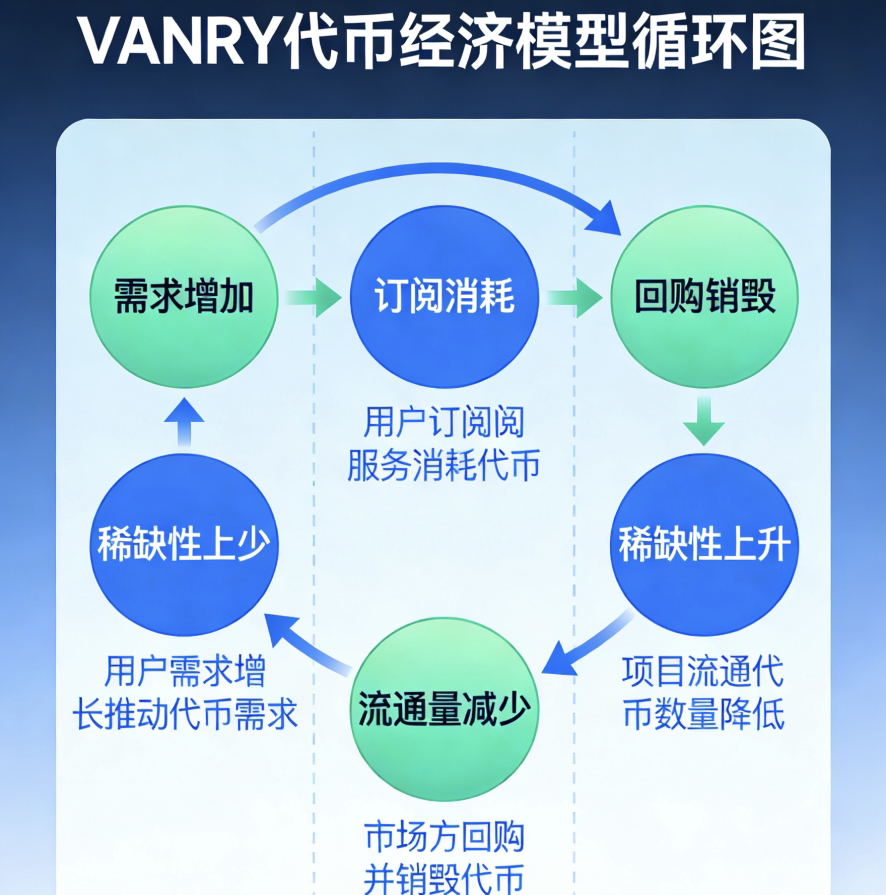
If Vanar's AI tools are really utilized by developers, and real enterprises are willing to pay VANRY to store contracts, verify invoices, and run inference models, then this cycle will start turning:
Demand increases -> Subscription consumption of VANRY -> Project party repurchase and destruction -> Circulation decreases -> Scarcity rises -> Further incentivizes holding.
It’s not the type of short-term strategy that says 'announce today and pump tomorrow', but attempts to build a positive flywheel on the technical and business levels.
Third layer: Supply side, there really isn’t much story left to tell.
I looked at the latest circulation data.
The total supply of VANRY is 2.26 billion pieces, and the current circulation is also 2.26 billion pieces, basically already in a fully circulating state.
This is actually a piece of information that can be easily overlooked but is very important.
Many projects seem to have low prices, but when you calculate, 80% of the tokens are locked in the hands of the team and investors, and there will be tens of millions of unlocking pressure every month in the coming years. The higher the price of such projects rises, the more you fear because you don't know when the giant wheel will turn around.
But VANRY is not like that.
What needs to be unlocked has been unlocked early, and what needs to circulate has circulated out early.
The current price is the result of the market being gamed with real money, with no 'future hidden sell-off bombs'.
I personally feel that for a project that wants to hold long-term, having a 'clean' chip structure is more important than anything else.
Fourth layer: Governance is not fictitious; it is real ecological decision-making power.
I want to specifically point this out.
Many projects' governance tokens are just for show; what’s the point of voting? The foundation has already decided, and your opposing vote is useless.
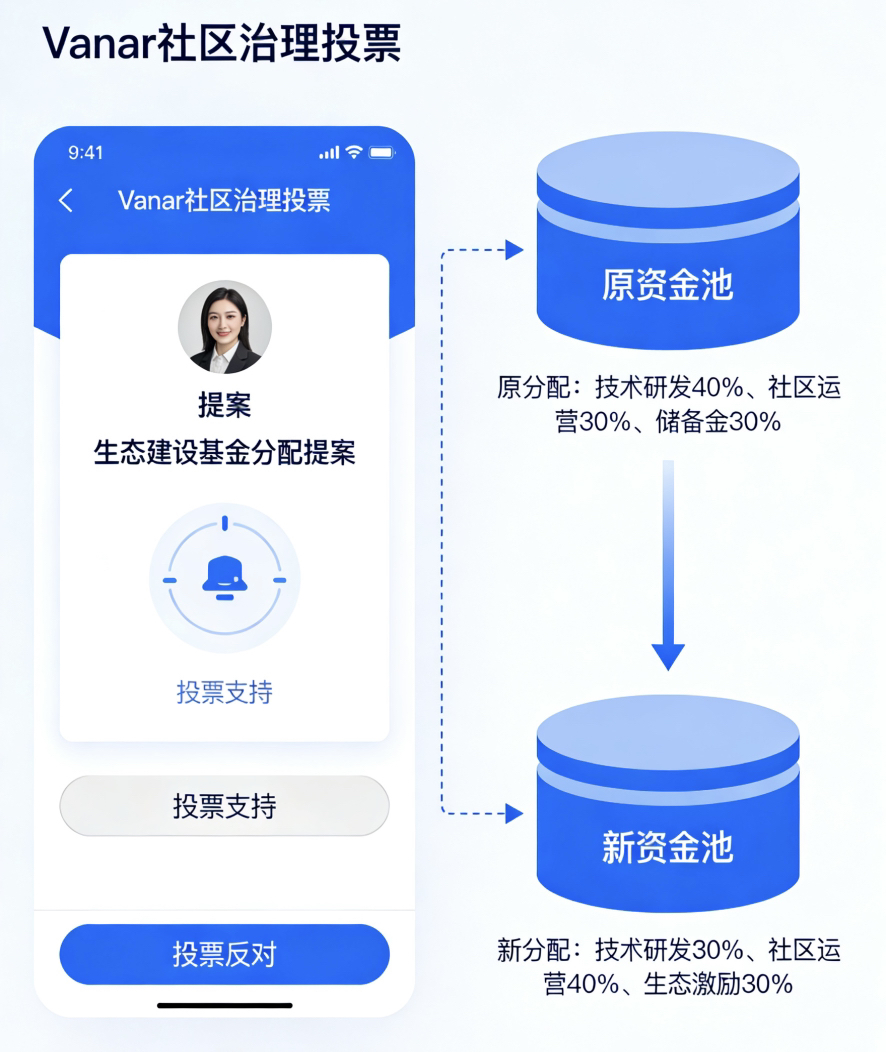 But Vanar's proposals this year have genuinely influenced the direction through community voting.
For example, the previous adjustment of the ecological fund allocation ratio was directly changed by the votes of staked users, altering the final flow of funds.
What does this indicate?
This indicates that the VANRY in your hands can be used not only for payment, staking, and arbitrage but also serves as a ballot to participate in the future direction of the project.
I think this is quite a strong psychological anchor for long-term holders.
You are not just a simple 'gambler'; you are also one of the 'co-builders' of this ecosystem.
My core conclusion: VANRY is not selling dreams; it is building infrastructure.
I’ve been worried about one thing before.
Many Web3 projects have PPTs that are beautifully written, but after three years of the mainnet going live, the number of applications running on-chain can be counted on one hand.
But Vanar's actions this year have made me feel that they are seriously making products and building infrastructure.
From Neutron's data compression storage, to Kayon's on-chain reasoning engine, to EVM compatibility allowing developers to migrate seamlessly, to payment integration with traditional giants like Worldpay, to LetsExchange’s cross-chain bridge facilitating liquidity.
Each of these things is not sexy, and none of them resembles a '100x coin forecast'.
But when they pile up together, they form a system that you can point to and say, 'This thing is indeed useful.'
The biggest risk of investment is not that the price drops, but that what you invested in is ultimately proven to never have existed in the first place.
I dare not say that VANRY will definitely succeed in the future.
But at least for now, I can see it running, and the direction is towards real-world business scenarios.
That's enough.
Q1 is just around the corner; what does the AI subscription service look like, how is the pricing set, and who are the first batch of customers? These answers will soon be revealed.
I will continue to hold and keep watching.
When real enterprises start paying VANRY for on-chain AI functions, the market will naturally reprice.
