


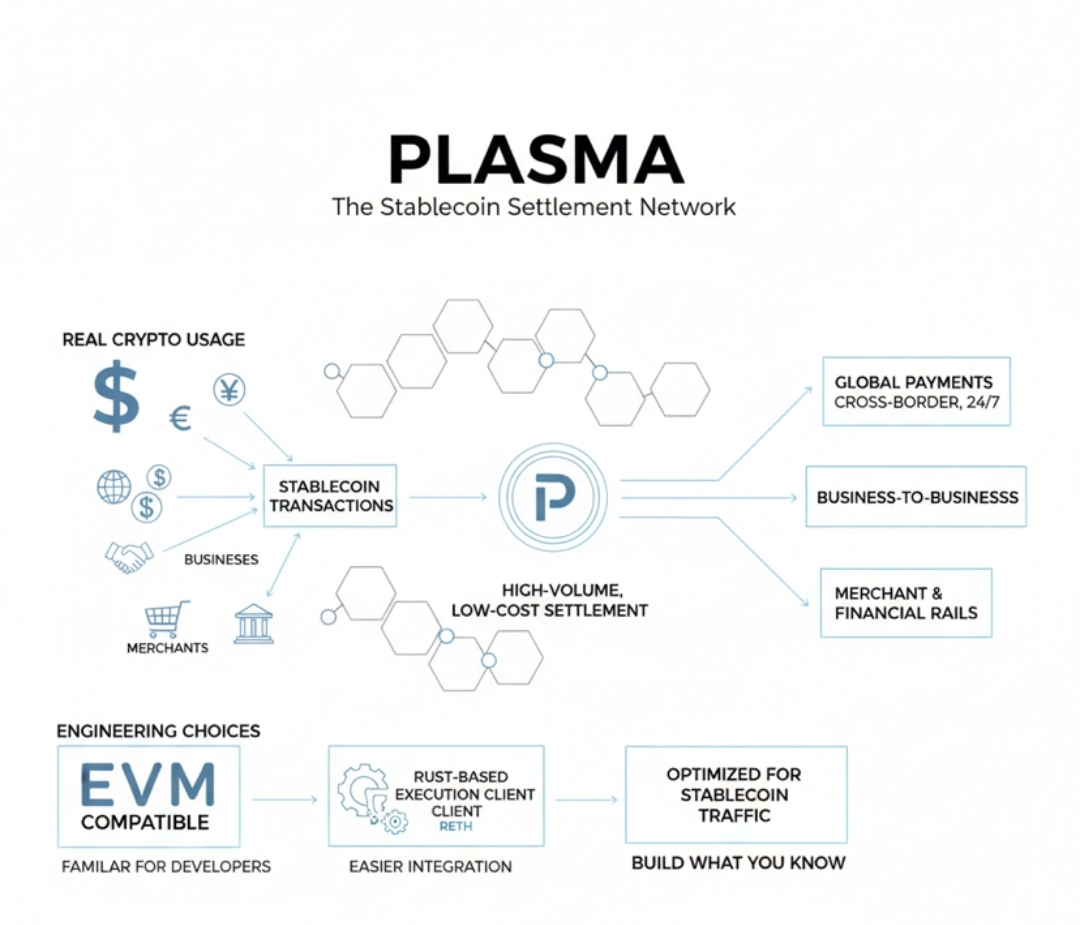
Most Layer 1 chains try to be everything at once. DeFi, NFTs, gaming, AI, social, you name it. Plasma doesn’t really play that game. It picked one lane and stayed in it: stablecoin settlement.
That sounds simple, maybe even boring at first. But when you actually look at how much value stablecoins move every single day, it starts to make more sense. Stablecoins are already the backbone of crypto liquidity. They’re used for trading, cross-border payments, treasury management, remittances, even day-to-day transfers in some countries. Yet the infrastructure they sit on wasn’t designed specifically for them.
They were just added later.
Plasma is different in that way. It doesn’t treat stablecoins like one app among many. It treats them as the core unit of the system.
Technically, Plasma is a Layer 1 with full EVM compatibility through Reth. That part is important because it means developers don’t have to relearn everything. Solidity works. Existing tooling works. Audits don’t suddenly become a guessing game. For teams that already operate inside Ethereum’s ecosystem, that reduces friction quite a bit.
On the consensus side, PlasmaBFT is built for sub-second finality. Now, speed gets thrown around a lot in crypto, but this isn’t really about marketing fast blocks. It’s about certainty. When you’re moving stable value for payments or settlement, you need to know when something is actually final. Not “probably done,” not “wait a bit more.” Just done.
That predictability matters more than raw TPS numbers.
Where Plasma really breaks from the usual Layer 1 design is around fees. On most chains, even if you’re transferring stablecoins, you still need a volatile native token for gas. That makes sense in speculative ecosystems. It makes less sense when the whole point is stable value transfer.
Plasma introduces stablecoin-first gas and gasless USDT transfers. So instead of forcing users to hold an extra token just to move dollars, the system adjusts around the stablecoins themselves. For retail users in high-adoption markets, that removes an unnecessary step. For institutions, it simplifies operations. No juggling multiple assets just to settle one.
Security is also approached in a slightly different way. Plasma is designed with Bitcoin-anchored security in mind. That’s not just a buzzword. Anchoring to Bitcoin adds an external reference layer, something widely recognized for neutrality and resilience. For a chain that wants to handle meaningful settlement volume, neutrality is not optional.
And the audience reflects all this.
On one side, you have retail users in countries where stablecoins are already functioning as parallel dollars. They care about ease, low friction, and not having to understand gas mechanics. On the other side, institutions in payments and finance need reliability, auditability, and systems that don’t behave unpredictably during volatility.
Plasma is clearly trying to sit between those two realities.
It’s not trying to be a playground for every new trend. It’s not chasing app explosions. It’s focused on doing one thing well: moving stable value cleanly.
That kind of specialization might look limiting compared to chains promising everything. But infrastructure usually benefits from constraints. Payment systems don’t succeed because they’re flashy. They succeed because they don’t fail when people rely on them.
Stablecoins already won the demand side. The infrastructure underneath them is still catching up. Plasma’s bet is that building a chain around stablecoins from the ground up makes more sense than continuously patching general-purpose systems.
If it works, growth won’t look dramatic. It’ll look like more settlement volume, smoother integrations, and users not thinking about what chain they’re on at all.
And honestly, when it comes to payments, that’s probably the point.

