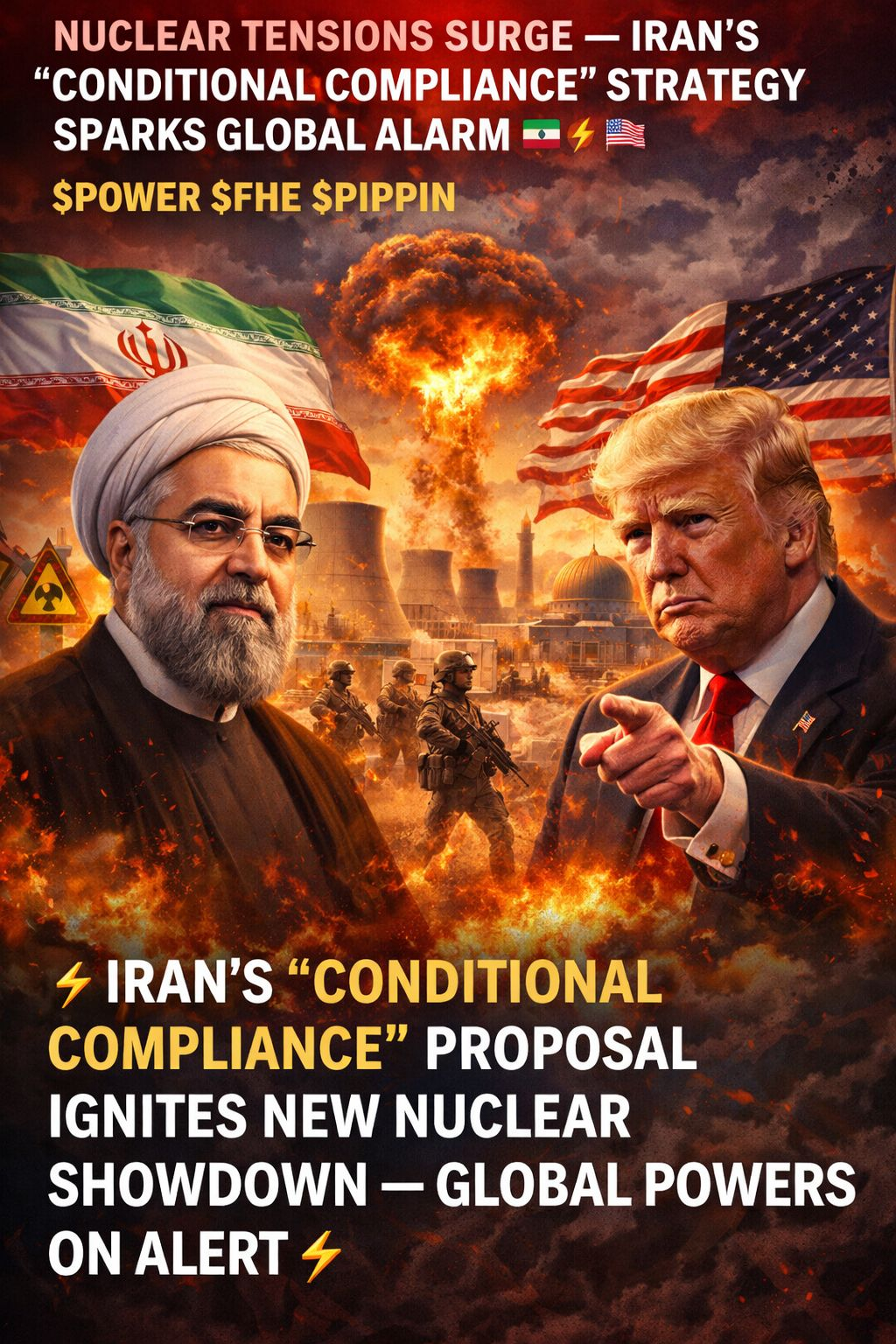
🚨⚡ GLOBAL NUCLEAR SHOWDOWN INTENSIFIES — IRAN’S “SUSPEND BUT SUSTAIN” STRATEGY PUTS WASHINGTON ON HIGH ALERT 🇮🇷🇺🇸🔥
$POWER $FHE $PIPPIN
In a development that has sent shockwaves through diplomatic circles and defense communities alike, Iran has introduced what observers are calling a “suspend but sustain” uranium policy — a framework that appears to promise restraint while simultaneously preserving core enrichment capabilities. The announcement has reignited debate over compliance, credibility, and the fragile architecture of nuclear diplomacy in the Middle East.
At the heart of the controversy lies a paradox. Iranian officials have indicated a willingness to “halt expansion” of uranium enrichment under certain conditions. However, they also insist on maintaining existing enrichment infrastructure, research capacity, and technical expertise. Supporters within Tehran describe the move as a sovereign right combined with a gesture of flexibility. Critics abroad argue that such positioning risks creating a legal and diplomatic gray zone — one where nuclear advancement continues beneath the surface of formal restraint.
A Strategy of Ambiguity
Analysts say Iran’s approach reflects a sophisticated negotiation tactic rooted in strategic ambiguity. By offering limits without dismantlement, Tehran may be attempting to secure sanctions relief or diplomatic concessions while retaining long-term leverage.
Nuclear policy experts explain that enrichment capacity is not defined solely by the act of spinning centrifuges. It also includes technical know-how, stored materials, advanced centrifuge designs, and the ability to quickly scale production. Even if enrichment levels are capped temporarily, the preservation of infrastructure can dramatically shorten the “breakout time” — the period required to produce weapons-grade material, should a nation choose to do so.
Iran maintains that its nuclear program is for peaceful energy and research purposes. International observers, however, remain cautious. The distinction between civilian nuclear capability and potential military application is often measured in technical thresholds rather than political promises.
Washington’s Calculated Response
In Washington, officials have responded with measured but unmistakable firmness. Public statements emphasize diplomacy as the preferred path forward, yet reiterate that preventing nuclear proliferation remains a core national security priority. Defense analysts note increased coordination with regional allies and a renewed focus on deterrence messaging.
While reports of “secret warnings” cannot be independently confirmed, seasoned observers suggest that private diplomatic communications often run parallel to public rhetoric during high-stakes negotiations. Historically, such backchannel exchanges serve to clarify red lines and reduce miscalculation — though they can also heighten tension if misinterpreted.
The phrase “all options remain on the table” has resurfaced in policy discussions, signaling that while diplomatic solutions are favored, alternative strategies are not being dismissed outright.
Regional Ripples: Israel and the Gulf
Beyond Washington and Tehran, the ripple effects are being felt across the Middle East. Israel has long expressed concern about Iran’s nuclear ambitions, viewing enrichment capabilities as a potential existential threat. Gulf states, meanwhile, weigh the balance between regional stability and the risk of escalation.
Security analysts warn that even perceived advances in nuclear capability can trigger defensive realignments. Military preparedness exercises, intelligence coordination, and strategic partnerships often intensify during periods of uncertainty. Such moves, while defensive in intent, can contribute to a broader atmosphere of suspicion.
The delicate balance of deterrence in the region depends not only on capabilities, but also on perception. In geopolitics, perception frequently shapes reality.
Energy Markets on Edge
Global markets are also paying close attention. The Middle East remains central to global energy supply chains, and any indication of rising tension tends to influence oil prices and investor sentiment. Traders monitor diplomatic statements almost as closely as production data, aware that instability can disrupt shipping routes or trigger sanctions that reshape supply flows.
Economic strategists caution against overreaction but acknowledge that geopolitical risk premiums are already factoring into market calculations.
The Legal Labyrinth
One of the most contentious aspects of Iran’s proposal lies in the interpretation of compliance. International nuclear agreements often rely on technical definitions — enrichment percentages, stockpile limits, inspection protocols, and reporting mechanisms. The difference between “limiting” and “eliminating” enrichment can hinge on precise wording.
Legal scholars note that international agreements frequently involve phased implementation. A temporary suspension of certain activities may satisfy the letter of a deal while leaving long-term capabilities intact. Whether this constitutes genuine compromise or strategic maneuvering depends largely on perspective.
Critics argue that ambiguity can erode trust. Supporters counter that diplomacy inherently requires compromise language that allows all parties to claim partial success.
Diplomacy or Deadlock?
The central question remains: Is this proposal a step toward de-escalation, or a calculated move to prolong negotiations without substantive change?
Some experts believe Tehran is testing the flexibility of international partners, gauging how far it can push interpretative boundaries without triggering unified opposition. Others see a government seeking economic relief and strategic stability, attempting to craft a framework that protects domestic interests while reducing external pressure.
The United States and its allies must now decide whether conditional restraint constitutes sufficient progress to justify reciprocal concessions.
Historical Context
This is not the first time nuclear diplomacy with Iran has entered turbulent waters. Past agreements have oscillated between optimism and breakdown, shaped by political shifts in Washington, Tehran, and beyond. Each round of talks has revealed the complexity of aligning technical nuclear parameters with political trust.
History demonstrates that nuclear negotiations rarely produce sweeping breakthroughs overnight. Instead, they unfold through incremental steps — confidence-building measures, verification arrangements, and reciprocal concessions.
Yet history also shows that miscalculation or miscommunication can rapidly escalate tensions.
The Military Dimension
While diplomacy dominates headlines, military analysts quietly evaluate scenarios. Defense planning often considers worst-case outcomes, even as policymakers pursue peaceful solutions. Increased surveillance, regional troop coordination, and defensive readiness are typical during periods of heightened uncertainty.
Importantly, readiness does not equal inevitability. Military posture can function as deterrence — a signal intended to prevent escalation rather than provoke it.
Strategists emphasize that open conflict would carry profound consequences for regional stability, global markets, and humanitarian conditions. As a result, most actors remain cautious about actions that could spiral beyond control.
The Role of International Inspectors
International oversight bodies play a critical role in verifying nuclear commitments. Inspection regimes provide transparency and technical assessment, helping to separate political rhetoric from measurable reality.
Whether inspectors will gain expanded access under any revised framework remains a key question. Transparency provisions often determine whether agreements succeed or falter.
Without credible verification, skepticism tends to grow.
Domestic Pressures on Both Sides
Political leaders in both Iran and the United States face domestic constituencies that influence negotiation strategies. Hardline voices may resist compromise, while economic pressures encourage engagement.
In Iran, economic sanctions have weighed heavily on the population, creating incentives for relief. In the United States, preventing nuclear proliferation remains a bipartisan concern, though methods of achieving that goal differ across political lines.
Domestic political landscapes often shape the tone and tempo of international diplomacy.
A Narrow Diplomatic Window
Time may prove a decisive factor. Diplomatic momentum can dissipate quickly if talks stall. Conversely, incremental progress can build confidence over weeks or months.
Observers describe the current moment as a narrow window — one in which both sides must calculate risks carefully. Too much rigidity could collapse negotiations. Too much flexibility could invite criticism at home.
The art of diplomacy lies in balancing these competing pressures.
Global Powers Watching Closely
European nations, Russia, and China also maintain stakes in the outcome. Each actor brings distinct strategic interests and economic considerations. Unified international pressure has historically proven more effective than fragmented approaches.
If global powers align behind a common interpretation of compliance, Iran may face clearer expectations. If divisions emerge, ambiguity could widen.
The Stakes: Capability, Credibility, Conflict
Ultimately, three core issues define this standoff:
Nuclear Capability — The technical capacity to enrich uranium and maintain infrastructure.
Diplomatic Credibility — The ability of agreements to build trust and withstand political shifts.
Conflict Avoidance — Preventing escalation that could destabilize an already volatile region.
Each dimension interacts with the others. A perceived erosion of credibility can fuel suspicion about capability. Rising suspicion can heighten the risk of confrontation.
What Happens Next?
The coming weeks will likely involve intensified negotiations, technical consultations, and strategic messaging. Whether the “suspend but sustain” concept evolves into a formal framework or fades under scrutiny remains uncertain.
For now, the world watches as diplomacy balances on a razor’s edge.
⚡ FINAL HEADLINE: IRAN’S “SUSPEND BUT SUSTAIN” NUCLEAR STRATEGY TESTS U.S. RESOLVE — GLOBAL STABILITY HANGS IN THE BALANCE
The path forward will depend not only on policy documents and enrichment percentages, but on trust, verification, and the willingness of leaders to prioritize long-term stability over short-term advantage.
In nuclear diplomacy, words matter. Definitions matter. Timing matters.
And in moments like this, so does restraint.