
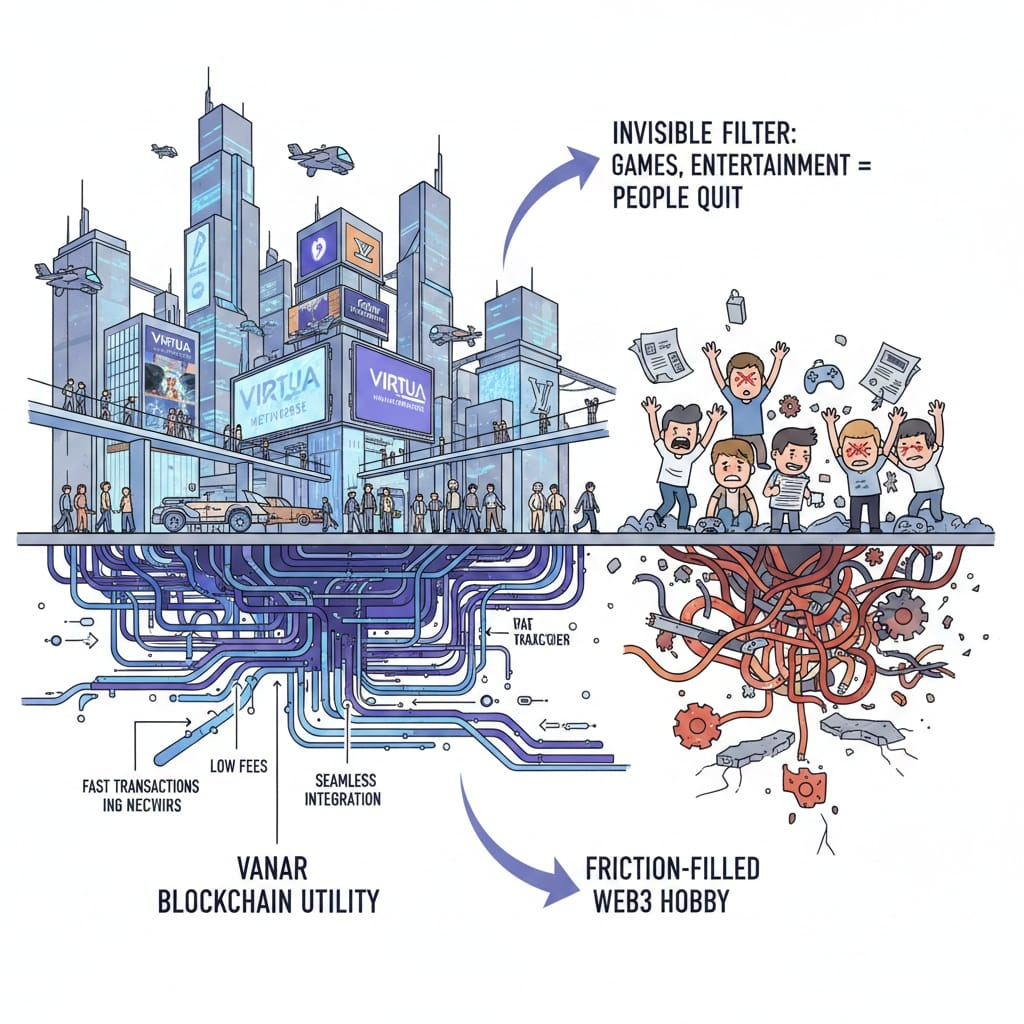
When I look at Vanar, I don’t picture “another Layer-1 trying to win crypto headlines.” I picture something way less glamorous and way more useful: the little set of rails under a busy city that everyone depends on, but nobody talks about unless it breaks.
That’s the vibe Vanar gives off—especially because its DNA comes from games, entertainment, and brand work. Those industries have a ruthless filter: if your product adds friction, people don’t write thinkpieces about it… they just quit. So Vanar’s whole approach (Virtua Metaverse on one side, VGN as a games network on the other) feels like it’s trying to make Web3 behave like an invisible utility instead of a hobby.
The on-chain numbers are the first thing that made me pause and take it seriously. As of today (February 11, 2026), Vanar’s mainnet explorer shows about 8.94M blocks, 193.82M total transactions, and 28.63M wallet addresses.
Those aren’t “proof of adoption” by themselves—chains can inflate activity in all kinds of ways—but they do suggest something important: Vanar has already lived through the messy part where a chain has to handle constant real usage without falling over.
And what makes those metrics interesting is the shape of the ecosystem Vanar is aiming for. Most chains end up dominated by finance-shaped activity: swaps, liquidations, arbitrage loops, bots interacting with the same contracts all day. Vanar’s product mix pushes toward consumer-shaped activity: lots of small actions tied to play, identity, collectibles, brand campaigns, and “I clicked a thing and it worked” moments. That’s a completely different stress test. It’s less about winning a TPS benchmark and more about surviving a million tiny interactions that have to feel instant and cheap.
That’s also why I like that VANRY isn’t trying to be “mystical.” Vanar’s docs are blunt: VANRY is used for gas/transaction fees, and it’s tied into staking and validator support in their dPoS model.
In consumer tech, the best infrastructure is boring. You don’t want users “thinking” about the token. You want the token to behave like the electricity bill behind the wall: predictable, necessary, and only noticed when it spikes.
The staking setup tells you something about what kind of customers Vanar expects to serve. The docs describe a dPoS flow (delegate to validators, earn rewards, periodic distribution, no unstaking penalties mentioned in their how-to).
Whether someone loves or hates dPoS philosophically, it’s a very “let’s run this like real infrastructure” choice. Games, studios, and brands don’t just ask “is it decentralized?” They ask: who keeps it stable, what happens during incidents, and can I rely on it when my users show up at the same time? A network built to face those questions early tends to develop a different kind of maturity than one built purely for speculative DeFi flows.
Now for something that’s actually fresh (not recycled narratives): in January 2026 there was a Binance Square CreatorPad campaign tied to VANRY token voucher rewards, published January 20, 2026 (and updated January 27, 2026).
I’m not bringing this up as “hype.” I’m bringing it up because campaigns like that are a real-world distribution test: they create a burst of new wallets, new transfers, and new curiosity, and they reveal whether the onboarding path is smooth or brittle. For a chain obsessed with mainstream entry, these moments matter more than a fancy roadmap graphic—because they mimic what happens when a popular game or brand activation drives a sudden wave of first-timers.
Another “current-state” datapoint: major trackers are showing VANRY trading around fractions of a cent right now (with Binance’s page showing live price, market cap, and short window performance).
I’m not saying price equals progress. But I do think low price periods are where you learn the truth about an ecosystem: if usage and building keep moving when nobody’s cheering, that’s usually where the real projects separate themselves from the attention projects.
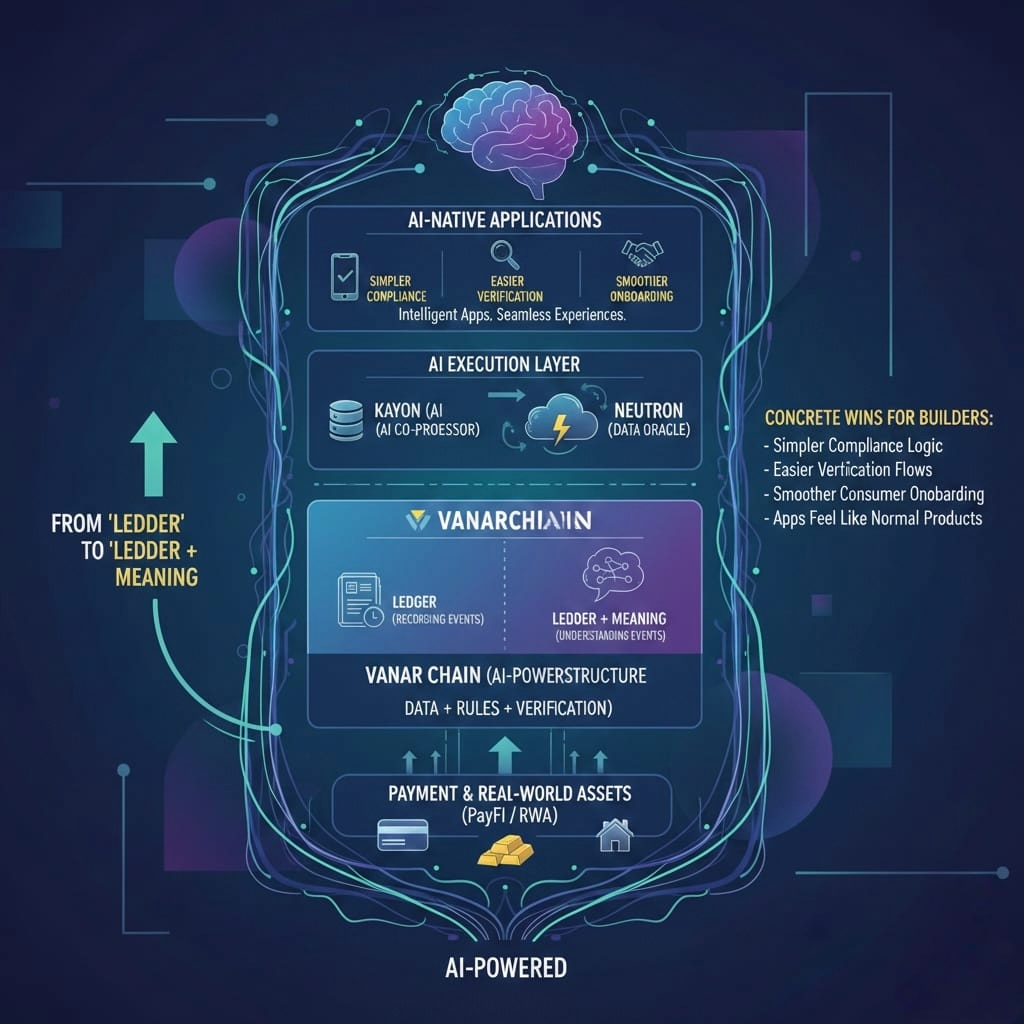
The part of Vanar that I keep circling back to because it’s either going to be its real edge or its biggest overreach is the “AI-native stack” framing. Vanar’s own site leans into this hard, describing a layered stack (Vanar Chain plus components like Neutron and Kayon) and positioning itself as “AI-powered” infrastructure for PayFi / real-world assets.
If this becomes real in developer hands, it’s not a cosmetic rebrand. It changes what the chain is for. Instead of “a place to deploy contracts,” Vanar is basically trying to be “a place where data + rules + verification live closer together,” so apps can behave intelligently without duct-taping everything off-chain.
Here’s the way it clicks for me: most chains are great at recording events, but they’re not great at understanding them. Vanar is trying to move from “ledger” to “ledger + meaning.” That’s a bold goal. And it’s only going to land if builders can point to concrete wins: simpler compliance logic, easier verification flows, smoother consumer onboarding, and apps that feel like normal products.
So if you want my most human, non-brochure summary: Vanar feels like it’s trying to win by being the chain people don’t have to think about. The ecosystem (Virtua, VGN, brand routes) pushes it toward users who don’t care about crypto culture—and that pressure can be a gift. Because if you can make a gamer, a fan, or a customer use on-chain rails without realizing it, you’re not “bringing users to Web3.” You’re just shipping a product that happens to settle on-chain.
And the nice thing is: you can track whether this is working without guessing. Watch the explorer metrics over time for sustained activity. Watch whether VANRY stays a simple, reliable fuel inside apps instead of becoming a complicated story. And pay attention to onboarding stress tests like the January 2026 CreatorPad campaign—because those are tiny rehearsals for what happens when a real mainstream moment arrives.
