
When blockchain shifts from the race of 'who is faster' to the era of 'who connects better'
In the early years of crypto, the biggest question was:
"Which blockchain is the fastest? The cheapest fees? The highest TPS?"
But entering the mature phase of Web3, the game is no longer revolving around a single chain. Instead, the ecosystem is moving towards:
🔹 Layer-2 to scale
🔹 Multi-chain to optimize specifics
🔹 Interoperability to connect everything
If Layer-1 wallet is a 'country', then Layer-2 is a 'satellite city', and interoperability is the 'cross-border transportation system'.
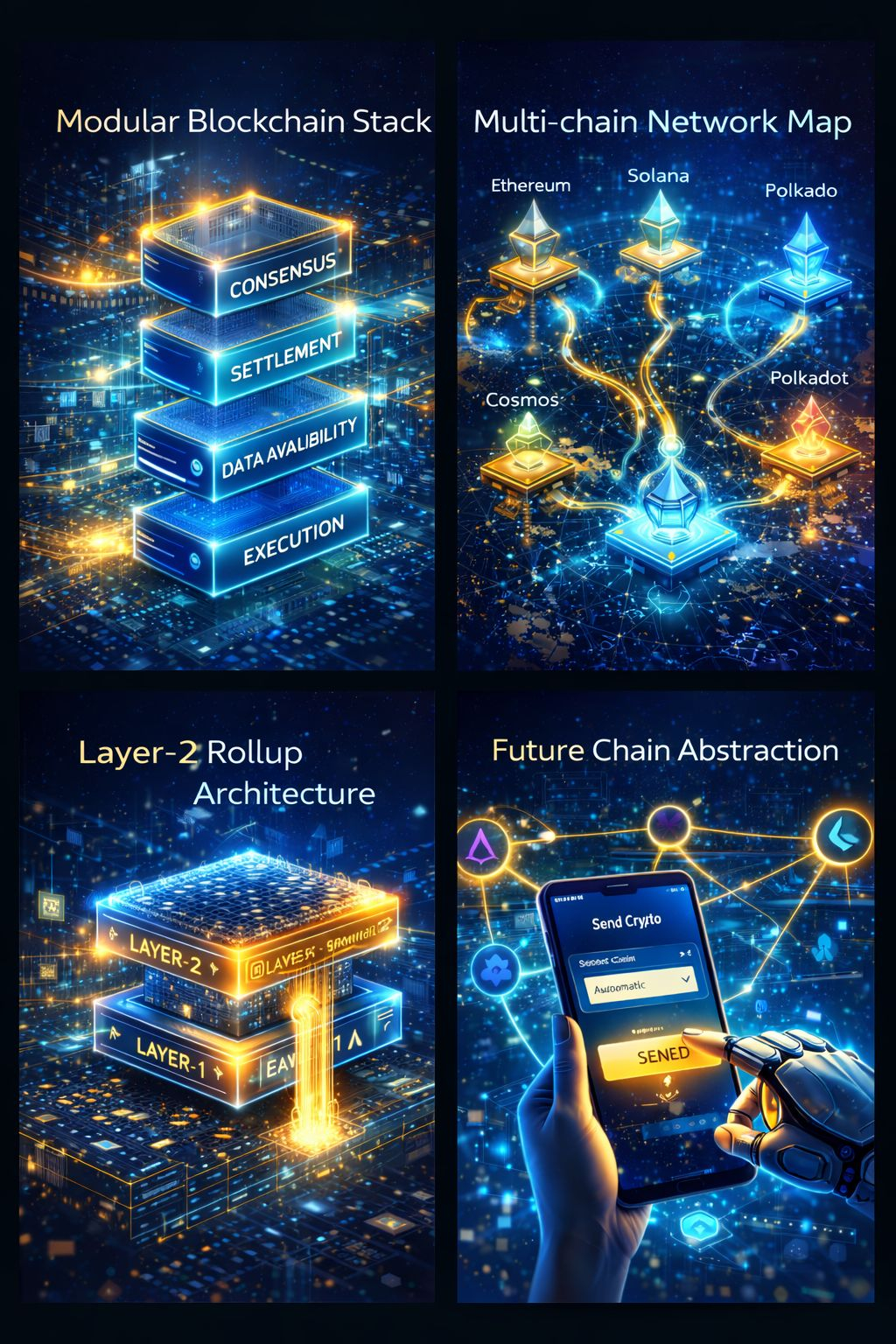
We are entering the era of modular blockchain architecture – where blockchain is no longer a monolithic block, but a combination of specialized layers working together.
🧱 Part 1: Why Layer-2 becomes a necessity?
1️⃣ Physical limits of Layer-1
⭐ Ethereum, Bitcoin or any Layer-1 faces the 'impossible triangle' problem:
🔐 Security
🌐 Decentralization
⚡ Scalability
⭐ Layer-1 often prioritizes security & decentralization. This means:
Limited block time
Low TPS
High gas fees when demand rises
⭐ When DeFi, NFT, GameFi exploded, Ethereum was once congested to the point that a swap transaction could cost tens of USD.
⭐ Layer-2 was born not to replace Layer-1, but to expand it without compromising core security.
2️⃣ What is Layer-2 really?
⭐ Layer-2 is a transaction processing system outside of Layer-1, but:
🔗 Inherit security from L1
📤 Periodically send proofs to L1
📉 Reduce the computational load
⭐ Two main groups:
🔹 Optimistic Rollups
Valid transaction assumptions
Allow challenges if fraud is detected
Examples: Arbitrum, Optimism
🔹 ZK Rollups
Creating cryptographic proof (Zero-Knowledge Proof)
Validating immediately
Examples: zkSync, Starknet
➡️ ZK rollups are considered the long-term future due to better scalability and stronger cryptographic security.
3️⃣ Strategic benefits of Layer-2
⭐ Layer-2 is not just about 'reducing fees'. It creates:
🏗️ Specialized app ecosystem
🧪 Experimental space for innovation
🧵 New economic model (sequencer revenue, MEV optimization)
⭐ Instead of a 'general overloaded network', each L2 can:
Optimized for gaming
Optimized for DeFi
Optimized for NFT
Or serve enterprises
➡️ Blockchain is shifting from 'monolithic' to 'modular stack'.
🌐 Part 2: Multi-chain – When one chain is not enough
Even if Layer-2 solves scaling, another issue arises:
Should every application live on the same ecosystem?
👉 The answer is no.
1️⃣ Each chain has its own philosophy
Ethereum → DeFi & high-security smart contracts
Solana → High speed, good UX
Cosmos → Sovereign chain architecture
Polkadot → Specialized parachains
Multi-chain is the natural result of diverse demands. Just as the world does not have just one country, crypto cannot have just one chain.
2️⃣ But multi-chain creates fragmentation issues
⭐ As many chains emerge:
Liquidity is fragmented
Assets are isolated
UX becomes complex
⭐ Users must:
Bridge token
Managing multiple wallets
Understanding many different standards
Multi-chain is only truly valuable if there is strong interoperability.
🔄 Part 3: Interoperability – The undervalued infrastructure layer
Interoperability is not simply 'bridge token'.
That is:
The ability to transmit data, state, and value securely between blockchains.
1️⃣ Traditional bridge – security weaknesses
⭐ Many of the largest hacks in crypto are related to bridges:
Ronin Bridge
Wormhole
Harmony
⭐ Why?
Bridges often keep assets locked → mint wrapped tokens.
If the bridge is attacked → the original assets lose value.
2️⃣ The new generation of interoperability
⭐ More advanced solutions:
🔹 Messaging Protocol (LayerZero)
🔹 IBC of Cosmos
🔹 Shared security model
🔹 Restaking + cross-chain validation
⭐ Instead of 'wrapping assets', the new direction is:
Message passing
State sharing
Cross-validation
This is the evolution from 'moving assets' to 'connecting ecosystems'.
🏗️ Part 4: Modular Blockchain Architecture
⭐ The future is no longer one blockchain doing everything. The new architecture is divided into 4 layers:
Execution layer
Data availability layer
Settlement layer
Consensus layer
⭐ Example:
Rollup handles execution
Celestia provides data availability
Ethereum handles settlement
Blockchain becomes a flexible stack like Internet protocol layers. This is the foundation of the next generation Web3.
💰 Part 5: Economics of L2 & Multi-chain
Layer-2 is not just a technique – it also changes the flow of capital.
1️⃣ Sequencer revenue
L2 can charge its own transaction fees.
2️⃣ MEV optimization
Layer-2 can redesign the way MEV is distributed.
3️⃣ Specialized tokenomics
⭐ Each L2 can:
Issuing a separate token
Designing separate incentives
Supporting ecosystem grants
Multi-chain creates a 'micro-ecosystem' economy.
⚠️ Challenges ahead
🔸 Liquidity is fragmented:
Need a unified liquidity solution.
🔸 Complex UX:
Need an abstraction layer so users do not have to know which chain they are on.
🔸 Cross-chain security:
Interoperability must meet Layer-1 security standards.
🔮 Future: Chain Abstraction
The next big trend:
Users no longer care which chain they are using.
⭐ The future wallet will:
Choosing the optimal chain
Self-bridge
Self-optimize fees
Self-manage liquidity
Layer-2 and Multi-chain will become the 'underlying infrastructure'. Just like when you send an email, you don't care which server it goes through.
📌 Conclusion
Layer-2 helps blockchain scale.
Multi-chain helps blockchains specialize.
Interoperability helps blockchains connect.
These three elements do not compete with each other – they form:
🧠 Nervous system
🩸 Circulatory system
🦴 Framework of the new generation Web3
We are moving away from the 'chain wars' phase, entering the 'chain collaboration' era.


