


Most blockchains are still designed around a single assumption: a human is sitting behind a wallet. Clicking buttons. Signing transactions. Making deliberate choices one action at a time.
That assumption is already breaking.
Vanar Chain is built for a different future — one where AI agents are the primary users, not an edge case. And when the user changes, the infrastructure has to change with it.
This is where Vanar quietly separates itself from most “AI-enabled” chains.
AI-Added Systems Break Under Real Usage
A lot of chains talk about AI, but what they usually mean is AI running off-chain. The blockchain just records outcomes. Memory lives elsewhere. Reasoning is opaque. Automation relies on fragile scripts.
That approach works for demos. It doesn’t work for autonomous systems operating continuously.
AI agents need four things at the infrastructure level:
Persistent memory
Native reasoning
Automated execution
Reliable settlement
Vanar was designed around these requirements from day one. Not retrofitted. Not abstracted away.
What AI-First Infrastructure Looks Like in Reality
Vanar’s stack is a practical response to how intelligence actually behaves.
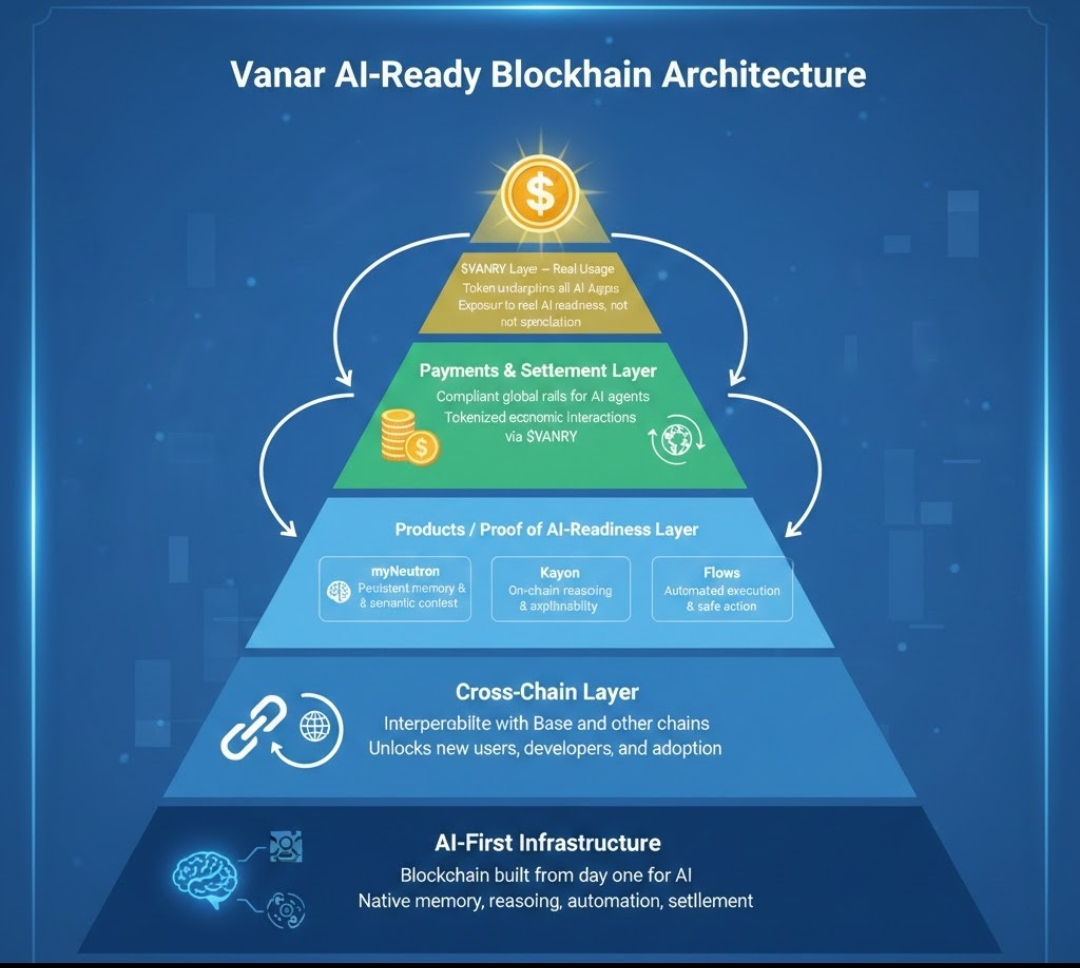
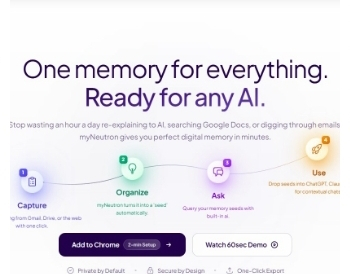
myNeutron introduces persistent semantic memory at the chain level. AI agents can maintain context, history, and learned behavior across interactions. This is essential for long-lived agents — whether in games, virtual worlds, or enterprise environments.
Kayon brings native reasoning and explainability on-chain. Decisions aren’t just executed; they’re verifiable. In a world where AI acts autonomously, understanding why an action occurred becomes as important as the action itself.
Flows complete the loop by enabling safe, automated execution. Multi-step workflows can run without manual intervention, translating intelligence directly into action. This is where AI stops being assistive and starts being operational.
None of this is theoretical. These are live components proving that intelligence can exist at the infrastructure layer.
Why Cross-Chain Reach Is Essential
AI infrastructure doesn’t scale by staying isolated.
Vanar’s cross-chain expansion, starting with Base, is about reach, not marketing. Applications don’t need to migrate ecosystems to use Vanar’s intelligence layer. They can integrate it where they already operate.
This turns Vanar from a single-chain environment into a shared intelligence backbone. The more ecosystems that connect, the more relevant the infrastructure becomes.
Payments Are the Final Constraint for AI
AI agents don’t interact with wallet UX. They require programmatic, compliant settlement.
Without payments, intelligence stays trapped in simulations. With payments, it becomes economic.
This is where $VANRY fits. It underpins memory usage, reasoning execution, automated workflows, and settlement across the stack. As AI-driven activity grows, usage translates directly into on-chain demand — not speculative narratives.
Value accrual here is tied to readiness and throughput, not hype cycles.
Why Vanar’s Approach Matters
Web3 doesn’t lack infrastructure. It lacks infrastructure designed for non-human users.
Vanar isn’t positioning itself as “the next AI chain.” It’s acting as if AI agents are already here and building accordingly. That mindset changes everything — from architecture to economics.
In a market obsessed with surface-level narratives, Vanar is focused on something deeper: making intelligence native to the chain.
And that’s a much harder thing to copy.
