A couple of days ago, I went to help Brother Wang downstairs to adjust the cash register system in his store. It was an old machine that had been used for almost five years, and it responded as slowly as a sloth.
I asked him, 'Since it's so difficult to use, why not switch to the latest one? Those aggregation payment apps can be installed in just a few minutes now.'
Brother Wang, while typing on the keyboard, smiled wryly and said, 'It's not that easy. The data of thousands of members in my store, three years of accounting records, and the settlement templates with suppliers are all in there.
Changing to a new app only takes a few minutes, but to redo my entire business logic, I would have to cease operations for half a month. I can't afford that loss.
At that moment I suddenly realized that in the business world, the top-level competitiveness is never about innovative narratives, but about this path dependence that makes people want to escape but cannot.
This is exactly the core feeling I derived from observing @Plasma recent dynamics.
——————————————————————————————————————
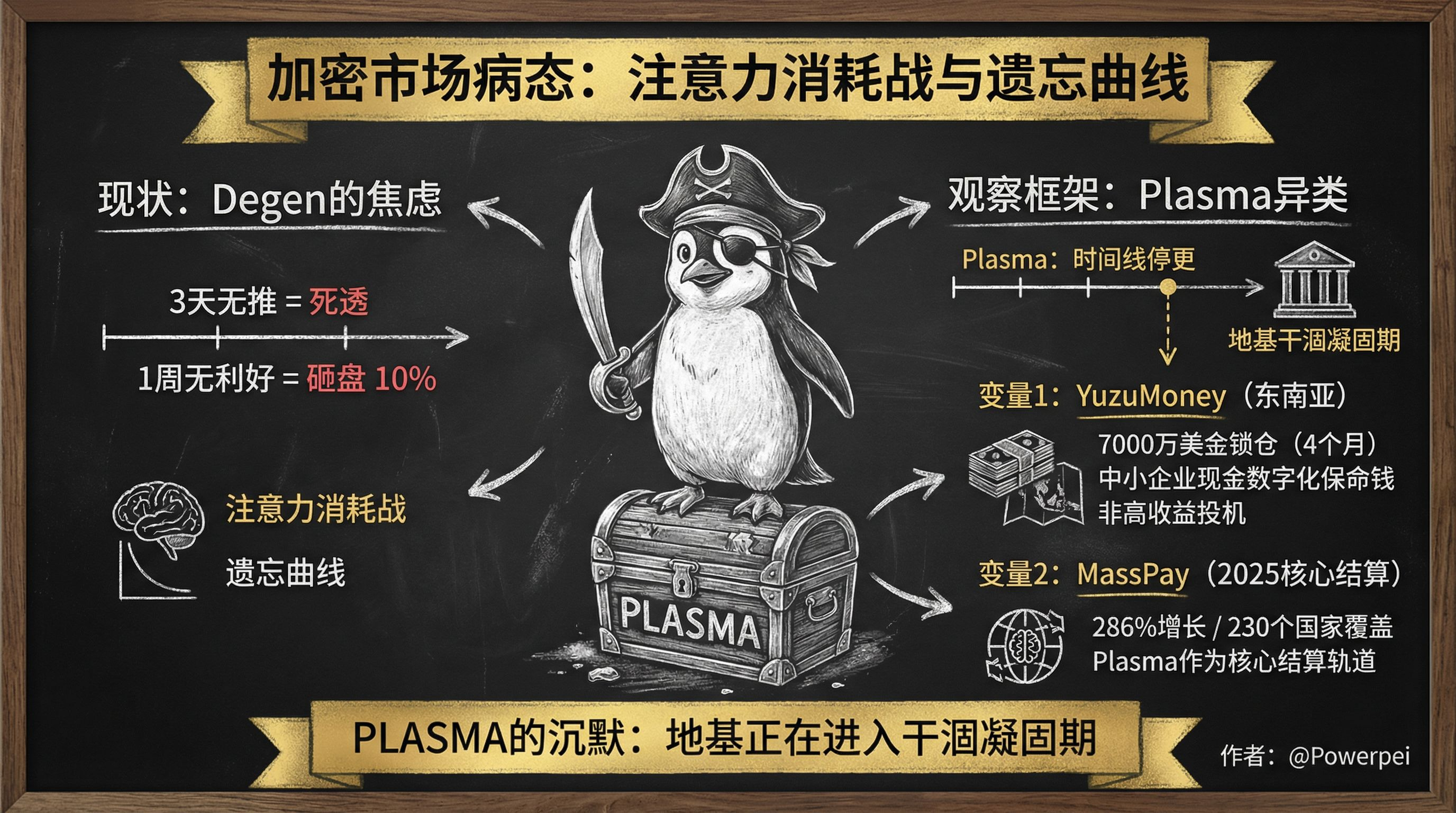
The current crypto market is very unhealthy. If a project's main account does not tweet for three days, everyone thinks it is completely dead.
If there are no new benefits for a week, the K-line has to drop by 10 points. Everyone is playing a very costly attention consumption battle, trying to counteract the human forgetting curve with high-frequency publicity.
But in this noise, Plasma seems like an anomaly, its timeline has almost stopped updating.
This silence, in the eyes of Degen, is 'cold', but in my observational framework, this is called the foundation entering a state of drying and solidification.
We need to clearly see the two real variables happening in the Plasma backend right now:
The first is YuzuMoney. It locked in 70 million US dollars in four months in the cash-dominated soil of Southeast Asia.
This is not speculative capital obtained through high returns; it is the lifeline money for local small and medium-sized enterprises completing their cash digitization transformation.
The second is MassPay. A payment brain that achieved 286% growth in 2025, covering 230 countries, placing Plasma as its core settlement track.
————————————————————————————————————————
What does this indicate?
This indicates that Plasma is playing a quiet infiltration battle where merchants are captured first, and consumers naturally follow.
It does not try to grab your phone's home screen; it directly takes the default options in the payment stack.
Just like the difficult-to-use cash register system in Wang's store, once an enterprise application like MassPay is integrated, the migration cost is no longer just a matter of money, but the risk assessment of overall financial security.
This kind of stickiness in ToB is much more stable than airdrops on the retail end.
The current $XPL price hovers around $0.09x, essentially the market is paying for its dullness.
Everyone is accustomed to exponential narratives but cannot bear the linear reality of adoption.
The market punishes it with standards that have no new stories.
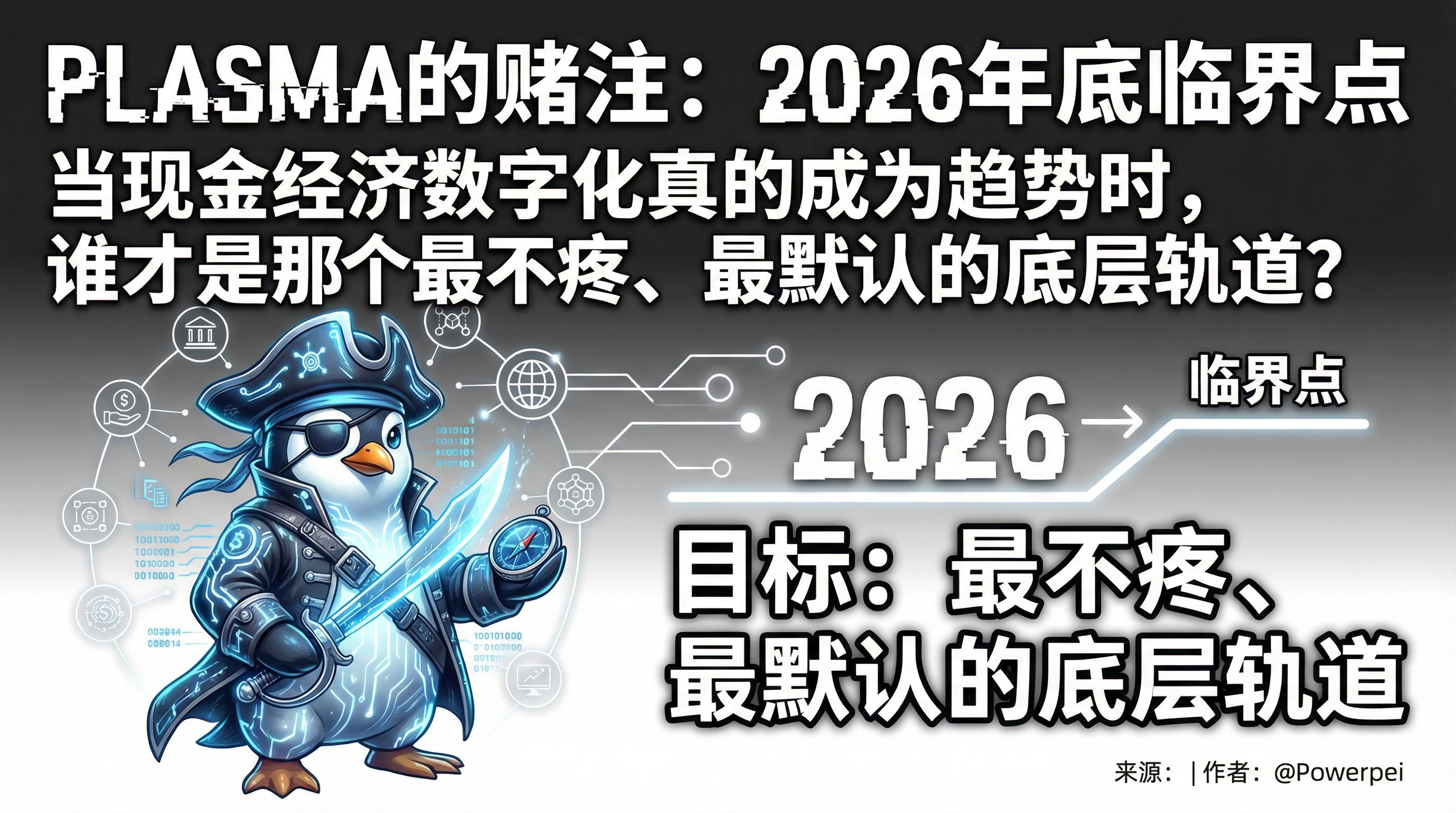
But Plasma is betting on a critical point at the end of 2026: when the digitization of cash economy truly becomes a trend, who will be the least painful and most defaulted underlying track?
————————————————————————————————————————
My personal stance is very clear:
I do not pursue that kind of flashy heat. I value the certainty that once the road is repaired, everyone can only follow along.
Although the accumulation of this path dependence is slow, it is irreversible.
Once scale is completed, the market will be forced to switch from forgetting to chasing pricing.
Don't always think about grabbing the loudest microphone.
Sometimes, the person quietly changing the global financial pipeline in the background is the one most worth accompanying through this period of silence.