
There is a moment every payments product eventually runs into: someone is trying to send a simple stablecoin transfer, and the only thing standing between them and done is the weird requirement to hold a second asset they do not care about, just to pay a fee. The user has the dollars. The app is asking for something else. The line grows. A tiny loading spinner turns into a small social failure.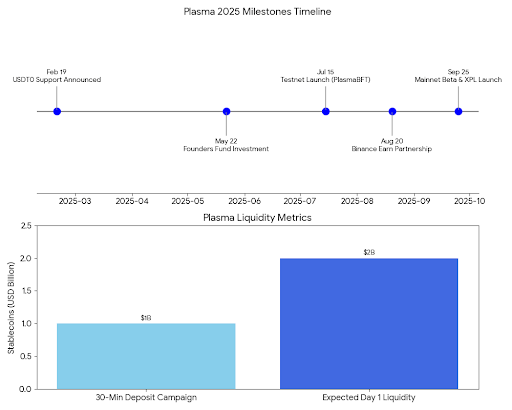
That friction is not philosophical. It is operational.
Plasma is basically an argument that stablecoins deserve their own rails, the same way card networks and bank transfer networks are not built as general-purpose computers. Stablecoin settlement has a particular shape: lots of small transfers, heavy repetition, unpredictable spikes, and an expectation that once a payment is accepted, it is accepted. Not probably. Not after a few blocks. Accepted.
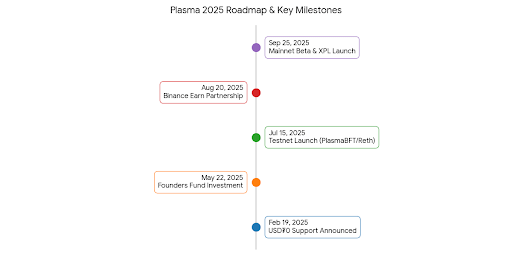 In 2025, Plasma’s public story stopped being abstract and started looking like engineering plus distribution. Testnet went live on July 15, 2025, with two core pieces already running: a pipelined BFT consensus called PlasmaBFT (built from Fast HotStuff ideas) and a Reth-based execution client for full EVM compatibility. The emphasis in that testnet announcement was not vibes, it was determinism: faster finality, consistent confirmation timing, and the ability to keep behaving under load. �
Plasma
This is where the design choice gets quietly important. Plasma did not pick an unfamiliar execution environment that forces every developer to relearn basics. It chose to be EVM-compatible, so existing Solidity code and tooling can show up without ceremony. That is not glamorous, but it is what builders actually do when they are trying to ship. The chain’s own docs and site are explicit about the execution layer being Reth-based, and about deploying Ethereum-style contracts with no code modifications. �
Plasma +1
Speed alone is not the point, though. Payment systems are judged by the absence of drama.
So Plasma pushes on a different lever: make stablecoins feel like the native thing, not a guest in someone else’s house. The most obvious place to do that is gas. If a user is holding USD₮, and the app makes them hunt for a gas token first, that app is not a payments app yet. It is a crypto obstacle course.
Plasma’s answer is stablecoin-first gas through protocol-managed paymasters. In their Custom Gas Tokens design, users can pay fees using whitelisted ERC-20 assets like USD₮ or BTC, while the protocol handles the conversion mechanics behind the scenes through a standard EIP-4337 paymaster flow. The docs are unusually clear about intent: no third-party paymaster markups, no fragmented reliability, and minimal extra work for developers. They also call the implementation under active development, which is honest and, in payments, necessary. �
Plasma
Then Plasma goes one step further for the most common action on a stablecoin chain: sending USD₮. The Zero-Fee USD₮ Transfers design is not described as a hacky wallet trick. It is a scoped, chain-native pathway using an API-managed relayer, limited to direct USD₮ transfers, with verification and rate limits meant to reduce abuse. The paymaster sponsorship is described as funded by the Plasma Foundation in the initial rollout, and the docs again flag that details may evolve as they validate performance and compatibility. That is what real infrastructure reads like: constraints first, marketing later. �
Plasma
A slightly blunt line, because it deserves one: if every $5 transfer requires a separate token purchase, you are not building payments, you are building friction.
The other lever Plasma leans on is neutrality. Stablecoin settlement is where real pressure shows up: compliance demands, policy risk, deplatforming risk, simple censorship risk. Plasma’s pitch is that anchoring parts of its security story to Bitcoin raises the cost of interference, and makes the chain harder to bend quietly over time.
There are two related threads here. One is Bitcoin anchoring, the idea of periodically checkpointing state so history is harder to rewrite without colliding with Bitcoin’s base-layer finality. The other is a native Bitcoin bridge, aimed at bringing BTC into the EVM environment in a more trust-minimized way than typical wrapped-asset setups. Plasma’s Bitcoin Bridge documentation lays out an architecture with a verifier network, onchain attestation, MPC-based withdrawal signing, and a pBTC asset designed to maintain a verifiable link back to Bitcoin. It also states plainly that this bridge and issuance system are under active development and not live at mainnet beta. �
Plasma
If that sounds like a lot, it is. Bridges are where chains get hurt, historically. So Plasma describing trust assumptions and staging the rollout is the right instinct, even if it frustrates people who want everything on day one.
Now, the 2025 updates that actually mattered were not only technical. Plasma’s distribution moves were loud enough to notice.
On February 19, 2025, Plasma announced that USD₮0 would be supported on Plasma from day 0, framing it as an interoperability backbone for expanding USD₮ across ecosystems and connecting Plasma into a much larger pool of existing USD₮ liquidity. �
Plasma
On May 22, 2025, Plasma announced a strategic investment from Founders Fund, explicitly tying the project’s ambitions to the payments lineage of fintech and money movement. �
Plasma
On August 20, 2025, Plasma announced a partnership with Binance Earn to launch what it described as a fully onchain USD₮ yield product distributed through Binance’s platform. Whether someone cares about yields or not, the distribution lesson is simple: payments infrastructure that cannot reach people stays a demo. �
Plasma
And then, in mid-September, Plasma published the mainnet beta plan: mainnet beta going live Thursday, September 25 at 8:00 AM ET alongside the launch of XPL, with $2B in stablecoins expected to be active from day one and capital deployed across 100+ DeFi partners. The post also mentions a deposit campaign that pulled in over $1B in stablecoin commitments in just over 30 minutes, plus details about bridging vault deposits to Plasma for USD₮0 withdrawals and enabling zero-fee USD₮ transfers through their dashboard. �
Plasma
Those are not the numbers of a niche experiment. Those are the numbers of a project trying to start with liquidity and utility instead of hoping it appears later.
But the more interesting part is who Plasma is really trying to serve. The target user is not a DeFi power user chasing an APR. It is the person who uses stablecoins the way people use cash balances: to preserve value, to pay, to receive, to move funds between family and business, to settle invoices, to top up a wallet and spend it without ceremony.
That user does not want to learn what finality means. They want to know if the payment is safe to accept. The BFT design direction matters because it prioritizes deterministic confirmation times instead of probabilistic comfort. Plasma’s own testnet messaging called out confirmations within seconds and irreversible commits, and the consensus documentation describes finality in seconds with pragmatic performance engineering such as pipelining. �
Plasma +1
There is an institutional version of the same need. Treasury flows, payroll runs, merchant settlement, cross-border netting: these are not impressed by cleverness, they are impressed by repeatability. Plasma’s docs also point toward privacy-preserving stablecoin transfers as a planned module, aiming to shield amounts and recipients while still allowing regulatory disclosures when needed, implemented in Solidity rather than a custom VM. That is a very specific signal about where they think real finance adoption gets stuck. �
Plasma
And here is the slightly imperfect sentence, on purpose: Payments are boring until they break, then everyone suddenly cares.
So the real question around Plasma is not whether it can process transactions quickly, or whether EVM compatibility is convenient. Those are table stakes. The question is whether stablecoin-native features at the protocol level can make everyday money movement feel ordinary, without sacrificing the neutrality and robustness that keep settlement credible when conditions get tense.
If Plasma succeeds, a user will send USD₮ the way they send a message: no thought, no prep, no extra tokens, no rituals. The best compliment it could earn is silence—because nobody had to stop at the counter to fix a gas problem again.

