
I noticed it at 11:42 PM while watching a transaction explorer tab refresh itself. The transaction had already shown as executed in the app UI. Balance updated. Action completed. But the explorer still said pending. I waited. Thirty seconds. Then a minute. I felt that familiar low level anxiety. Not panic. Just the quiet question of whether I should trust what I was seeing.
I opened another tab. Same transaction hash. Different view. Still pending. The app had moved on but the chain had not caught up yet. I remember leaning back and thinking this was the gap people never talk about. Not speed. Not cost. But certainty.
I was testing something simple. A routine interaction. No edge case. No load test. Just regular usage at a regular hour. The feeling was not frustration exactly. More like caution. The kind you get when systems disagree with each other.
That moment clarified the real friction for me. Throughput is visible. Finality is emotional. Builders and users live in that gap where an action feels done but is not done yet. Most teams underestimate how often people check twice. Refresh dashboards. Compare explorers. Ask support. Not because something broke. But because settlement timelines are fuzzy.
The industry likes to talk about transactions per second. What gets less attention is how long you mentally hold a transaction open. That cognitive overhead shows up everywhere. Support tickets. Manual reconciliations. Defensive UX patterns. People assume the chain will resolve it eventually. But eventually is not a great operating model.
That is where Plasma became relevant to me. Plasma works like a background settlement engine similar to how card networks authorize instantly but settle later. Your action completes quickly at the interface level. The system handles ordering and final confirmation without asking you to babysit it. Instead of exposing every consensus step to the user. It absorbs them.
What changed first was timing. Interactions returned results almost immediately. Not optimistic placeholders. Actual state changes that stayed consistent when I checked later. Finality happened fast enough that I stopped opening a second tab. That was the real shift.
Under the hood Plasma runs committees that agree on blocks before they are widely propagated. A committee here is a small rotating group responsible for ordering transactions. The rotation matters. It prevents long lived bottlenecks and spreads responsibility. When a block is agreed internally it moves outward. By the time most nodes see it the decision is already locked.
Block propagation felt quieter than on other networks I monitor. Fewer forks. Fewer reorders. I noticed blocks that were smaller than expected during low activity periods. That usually means the network is not forcing throughput for appearances. It is letting demand shape block content.
Consensus messages stayed tight. No long gaps. No sudden bursts. When a validator responded late the round continued without drama. That tells me the system prioritizes progress over perfection. Some chains stall waiting for everyone. Plasma does not seem to.
This matters because incentive alignment shifts. Operators are rewarded for keeping committees responsive not just for being online. That is where $PLASMA enters. It is used to pay network fees and to stake for committee participation. Validators earn $PLASMA by doing the boring work of staying synchronized and responsive. Over time this creates pressure toward reliability rather than headline speed.
Users indirectly benefit. Faster perceived finality reduces double checking behavior. Builders spend less time explaining edge cases. The token is not a narrative layer here. It is an enforcement tool that keeps the system punctual.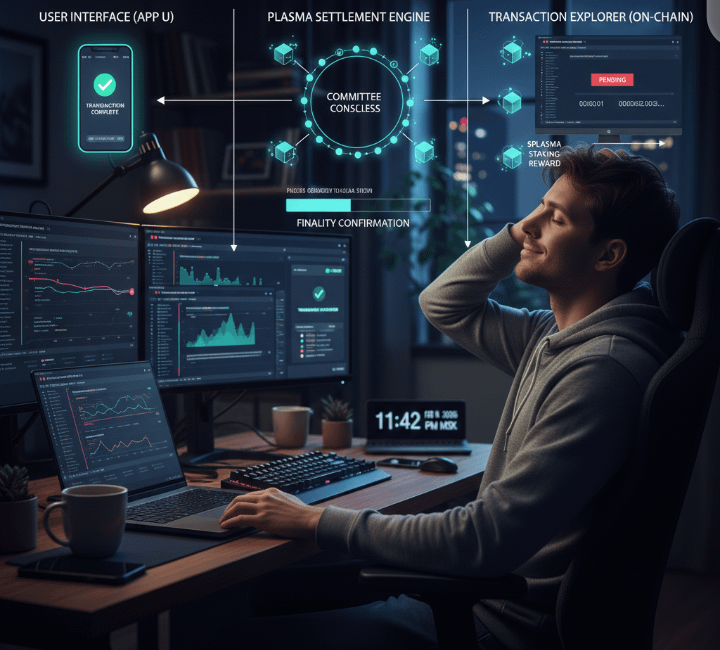
That said there is a real risk. Committees introduce coordination assumptions. If participation thins or rotations are poorly tuned finality guarantees could weaken. If that happens the same uncertainty creeps back in just with a different shape.
My stance is simple. I am watching Plasma because it reduced the number of times I felt the need to refresh. That is a small signal. But in distributed systems small signals usually matter. Personal observation only not investment advice.

