
When I think about Plasma, I don’t imagine a futuristic blockchain race or a leaderboard of technical achievements. I think about the awkward silence that happens when someone tries to send stablecoins for the first time and realizes it isn’t as simple as it sounded. I’ve felt that hesitation myself. You expect digital dollars to behave like money, but instead you’re double-checking gas, networks, and balances like you’re preparing for a small exam. That gap between expectation and reality is where a lot of trust quietly breaks. Plasma feels like it was designed by people who noticed that exact moment and decided it shouldn’t exist.
What keeps pulling me back to the idea is how Plasma treats stablecoin settlement as the center of the story, not a side feature. Stablecoins are already being used for rent, remittances, payroll, survival, and everyday trade in places where traditional finance doesn’t work smoothly. That’s not theory anymore. That’s lived reality. If people are already trusting digital dollars with real parts of their lives, the infrastructure around them shouldn’t feel experimental. Plasma reads like an attempt to make the rails match the seriousness of the use case. Not flashy. Not loud. Just dependable in a way people can lean on without thinking.
Sub-second finality sounds technical until you experience the emotional difference it creates. Waiting for a transfer to confirm always carries a tiny knot of anxiety. Even when you trust the system, there’s a moment where your money exists in a kind of limbo. I’ve noticed how that pause stretches in your head. Fast finality collapses that uncertainty. The transaction stops feeling like a gamble and starts feeling like an action that already happened. For businesses and institutions, that shift isn’t cosmetic. It’s the difference between something they can operationalize and something they always treat as a risk.
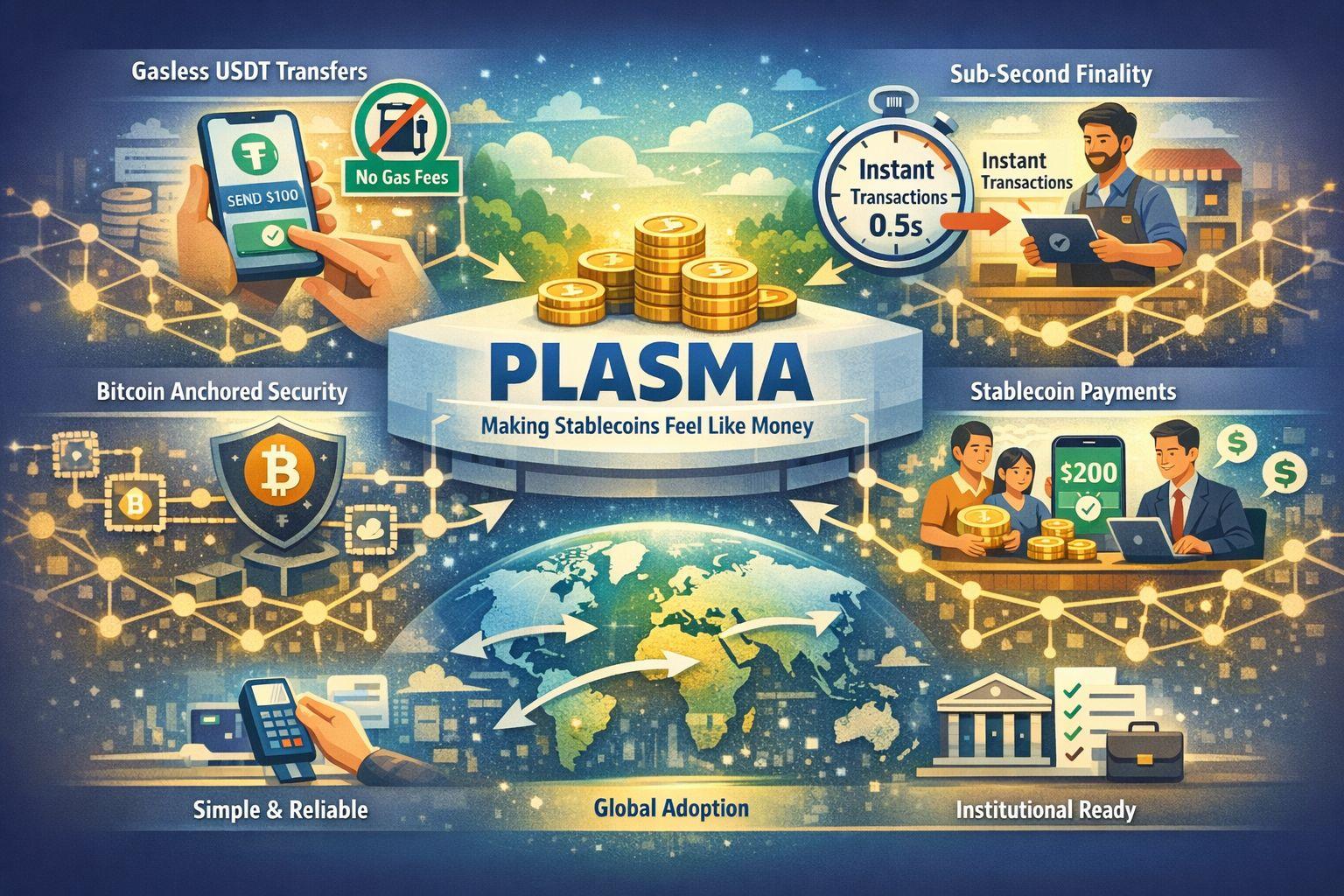
The gasless USDT transfers and stablecoin-first gas design feel deeply human to me. There’s something almost absurd about telling someone they can hold digital dollars but need a separate volatile asset just to move them. Most newcomers don’t see that as an interesting technical quirk. They see it as a contradiction. I’ve watched people lose confidence right there. Letting stablecoins function as self-contained money removes a layer of mental friction that most users never wanted to deal with in the first place. It respects how people already think about value instead of forcing them to adopt a new financial language.
The Bitcoin anchoring piece feels like a quiet promise about history. I don’t read it as Plasma trying to borrow Bitcoin’s reputation. I read it as Plasma acknowledging that payment systems eventually face pressure, disputes, and attempts to rewrite narratives. Anchoring state to Bitcoin is like asking a neutral witness to timestamp your story. It adds a layer of credibility that doesn’t depend on internal politics or temporary consensus. For a network that wants to handle serious money movement, credible history isn’t optional. It’s part of the psychological contract with users.
What makes the project feel grounded is the audience it’s aiming for. Retail users in high-adoption regions aren’t chasing ideology. They’re trying to send value quickly and safely because their daily life depends on it. Institutions aren’t chasing excitement either. They’re chasing reliability. Both groups want the same emotional outcome: they want to feel calm while money is moving. Plasma sits in that overlap. It’s not trying to impress people with novelty. It’s trying to reduce the number of things they have to worry about.
The token design is where the philosophy becomes delicate. A chain focused on stablecoins has to justify its native token without turning it into a tax on usability. The separation between user experience and network security feels intentional. Everyday users interact mostly with stable assets, while the token supports staking, governance, and long-term alignment in the background. That division matters because it keeps volatility away from moments where people are seeking stability. The infrastructure carries complexity so the user doesn’t have to.
What makes the story real instead of ideal is the risk that comes with building payment infrastructure. Stablecoins sit in a politically sensitive space. Networks that matter attract scrutiny by default. Gasless systems have to defend against abuse. Fast finality has to hold up during stress, not just in calm conditions. Bitcoin anchoring adds layers that must be explained clearly so expectations stay honest. None of this is dramatic failure talk. It’s the reality that money systems don’t get to be fragile. They’re tested by the worst days, not the best ones.
The biggest danger isn’t that Plasma fails technically. It’s that it never becomes the default path people see inside wallets and exchanges. I’ve watched strong technology fade simply because it didn’t embed itself where users already lived. Payment infrastructure wins when it becomes invisible plumbing. Adoption is less about persuasion and more about presence. If Plasma integrates deeply enough into everyday financial surfaces, its design advantages become habits instead of features.
What keeps the idea compelling is that Plasma seems to be chasing a strange goal: boring success. Not boring as in lifeless, but boring as in trustworthy. Electricity is boring. Card networks are boring. We trust them because they stopped demanding attention. If stablecoins ever reach a point where sending digital dollars feels uneventful, that’s when the underlying infrastructure has matured. Plasma reads like a project aiming for that quiet milestone.
The feeling I’m left with is simple. Plasma isn’t trying to make crypto louder. It’s trying to make money feel normal again inside a digital system. Every design choice looks like a response to a real human hesitation — fear of mistakes, fear of delays, fear of complexity. When a network starts from those emotions instead of hype, it tends to build something people can actually live with. And infrastructure that people can live with is the kind that lasts.

