
Recently, this wave of 'Six Major Sects Attacking Bright Summit' AI short drama competition has raised the prize pool, and the community's enthusiasm has skyrocketed. Everyone is talking about Seedance 2.0, and some even think that 'once the model is in hand, you can just lie down and win.' Let me pour a basin of cold water: Seedance is still in A/B testing, and ordinary people cannot obtain stable production capacity; more critically, AI video has never been about 'writing a prompt and producing a masterpiece'; that is called self-entertainment, not creation. What truly makes a difference is whether you have a workflow that can be repeatedly replicated, can control consistency, and can produce complete works.
The updated MyNeutron 1.4 in the Vanar ecosystem; I think the most valuable part is not 'just another feature', but that it finally solves a real problem: you no longer need to describe the shot with words; you can directly feed the shot to it. It supports uploading local files as Seed, which means you can 'copy homework'—steal the visual language of professional directors and let AI shoot according to this syntax.
You need to clarify a pain point: why do most AI short dramas look like PPT? Because they are uncontrollable. If today you want 'martial arts style, looking back, fierce gaze', the usual way is to wildly change words in various engines, generate 100 images, and pick a few that can be used. As a result, the character sometimes looks like He Yi, sometimes like Dong Mingzhu; the scene alternates between the Song Dynasty and cyberpunk; in one shot, you're on a mountaintop, and in the next shot, you suddenly enter an internet cafe. It's not that you aren't trying hard; it's that you don't have the tools and processes to 'control the footage,' nor do you have the basic knowledge of film production.
My advice is straightforward: use MyNeutron 1.4 and follow five steps; don't experiment randomly.
Step one, first find a benchmark, don't imagine things out of thin air. Go to Bilibili/Douyin/old version (The Legend of the Dragon Slayer) and pick a segment that you think has the 'most impressive camera work, harsh lighting, and strong momentum'—like a panoramic view from the mountaintop, a sect suppressing the area, or the wind blowing the clothes. What you need to feed is not the plot, but the visual language. Download it, and this will be your original reference.
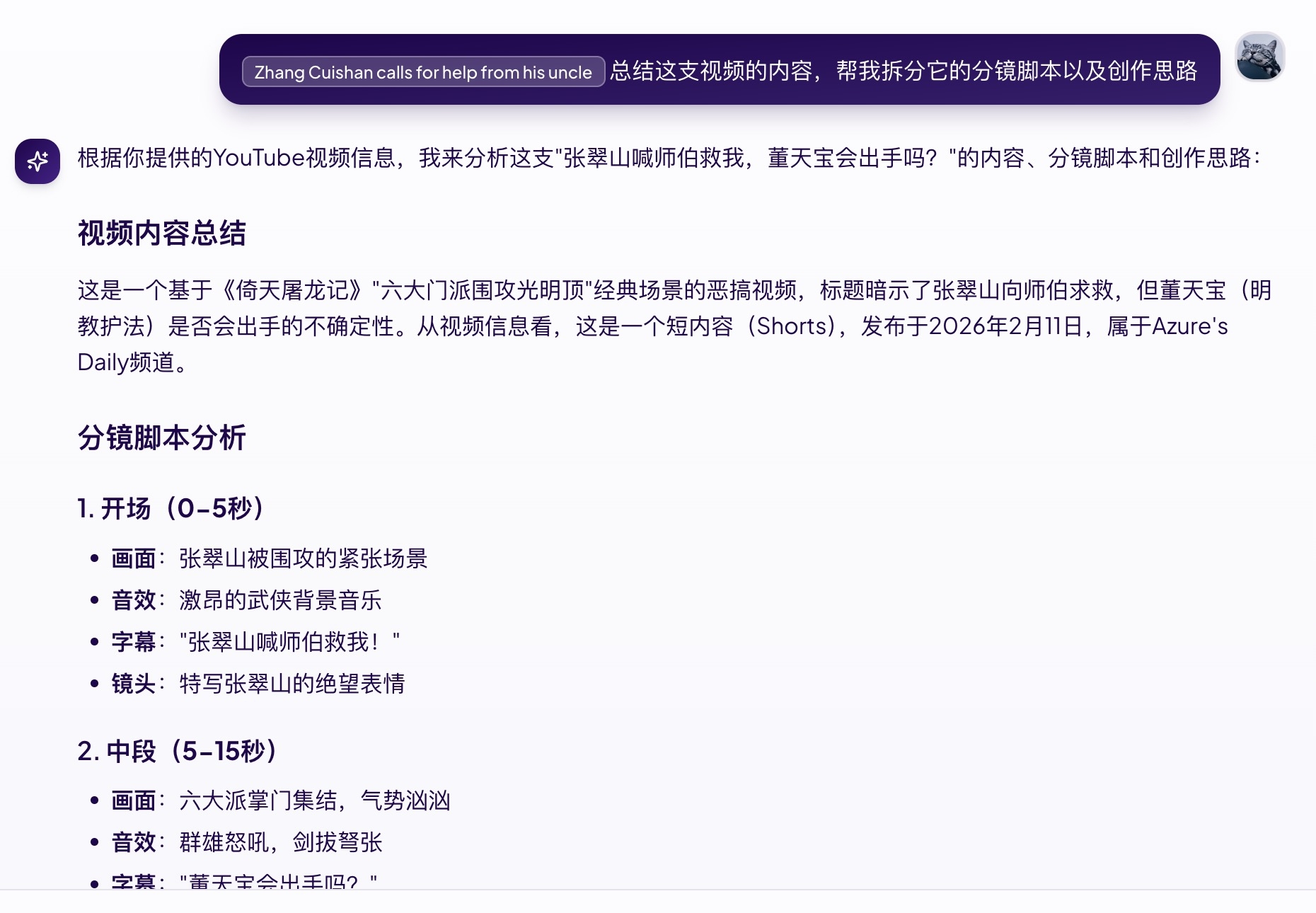
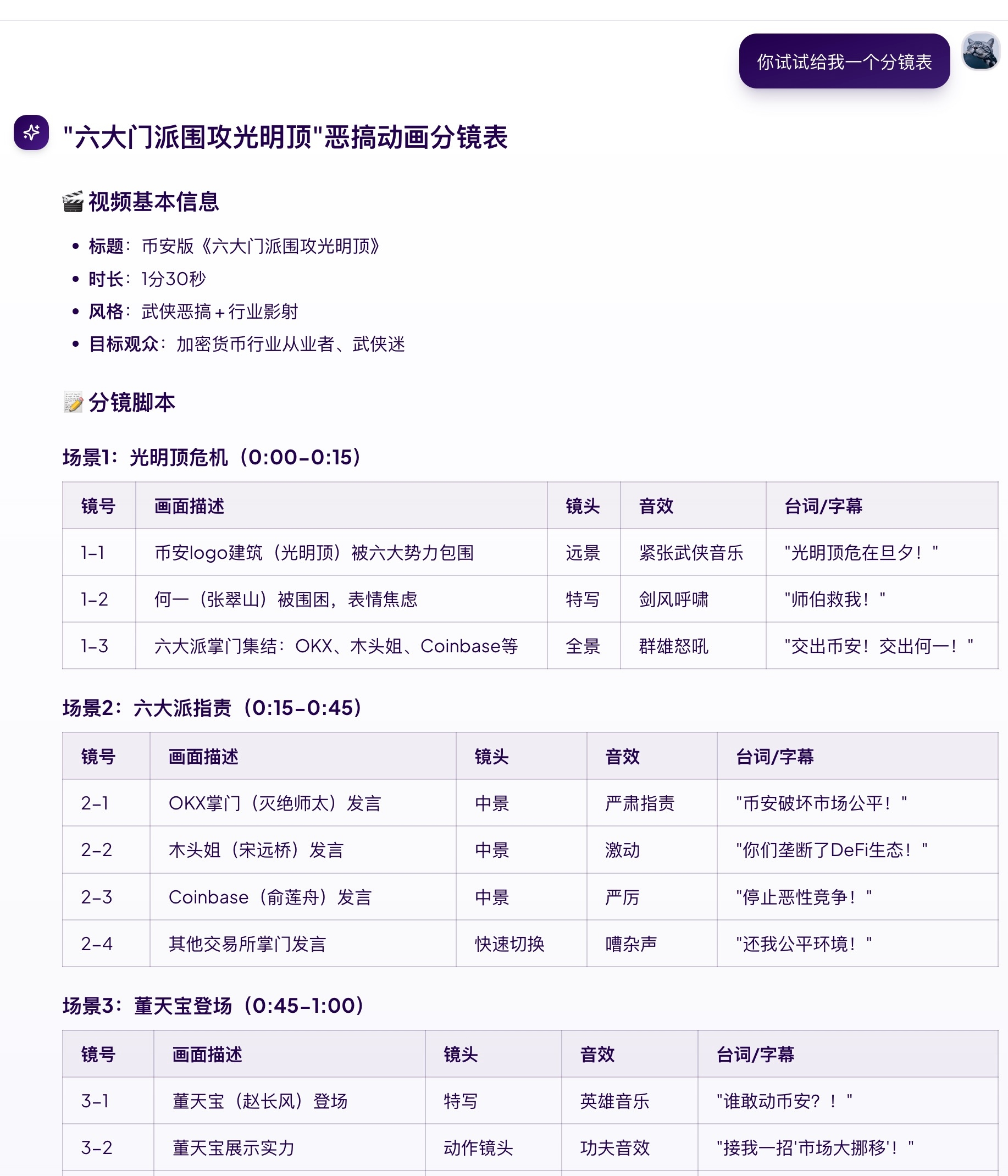
Step two, upload the Seed and let it break down the shots for you. Directly upload the benchmark video to MyNeutron as the Seed. The highlight of 1.4 is this: it will analyze your camera movements, composition, and lighting, then break it down into a set of storyboard scripts. You don't have to guess 'how to write pushes, pulls, shakes, and pans'; it directly translates the syntax in the director's mind into parameters you can use. At this point, you have already stolen half of the professionalism.
Step three, first build the character library, don't rush to create the video. Facial collapse is the biggest pitfall of AI short dramas; don't confront it head-on. In MyNeutron, first 'fix' the main character: make the front view, side view, and full-body view, and lock in the hairstyle, clothing, and temperament (like Binance's yellow battle robe and a stern gaze). In the future, all shots will reference the character library, otherwise you will inevitably encounter the disaster of 'the same person changing faces in every shot.'
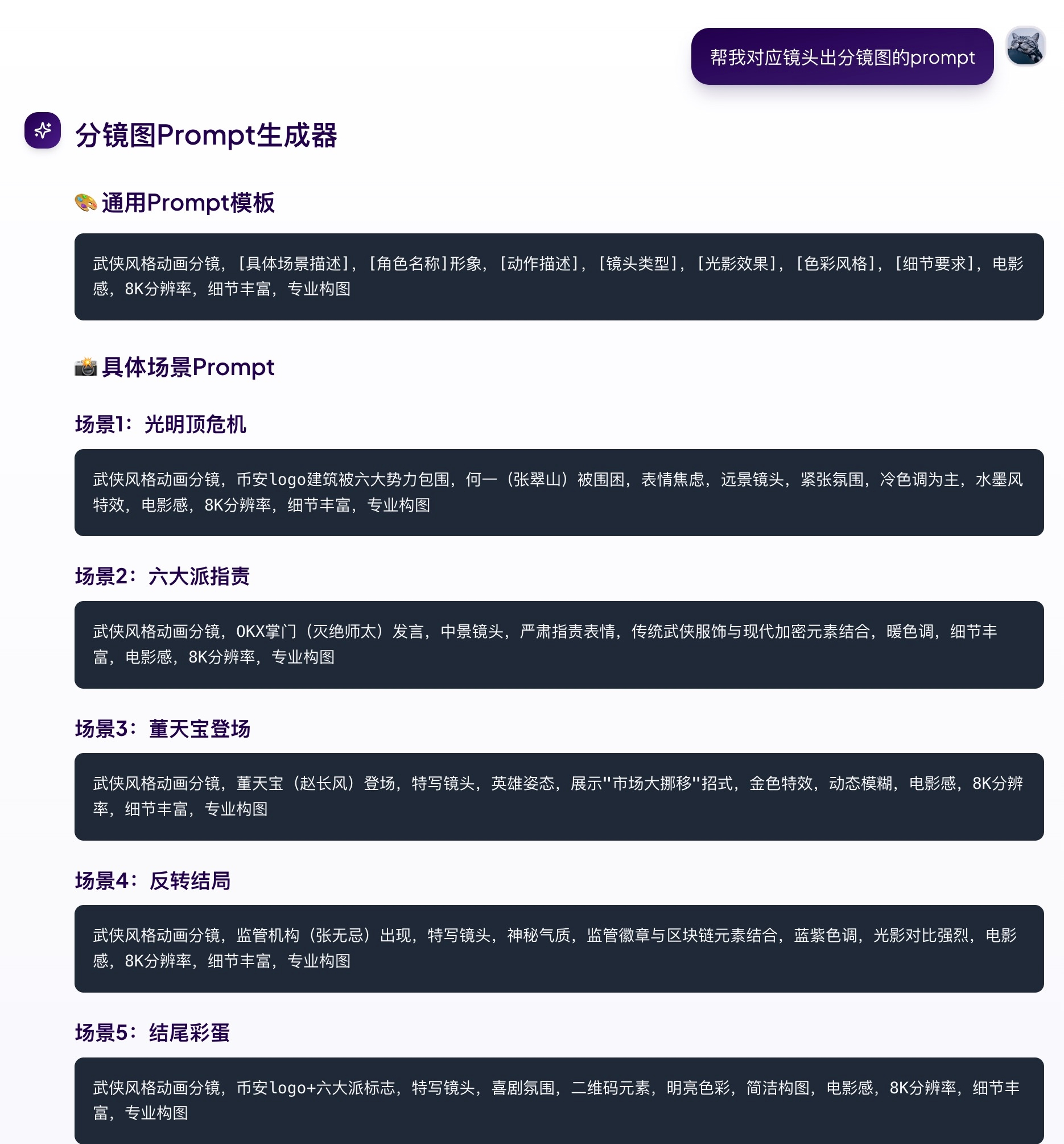
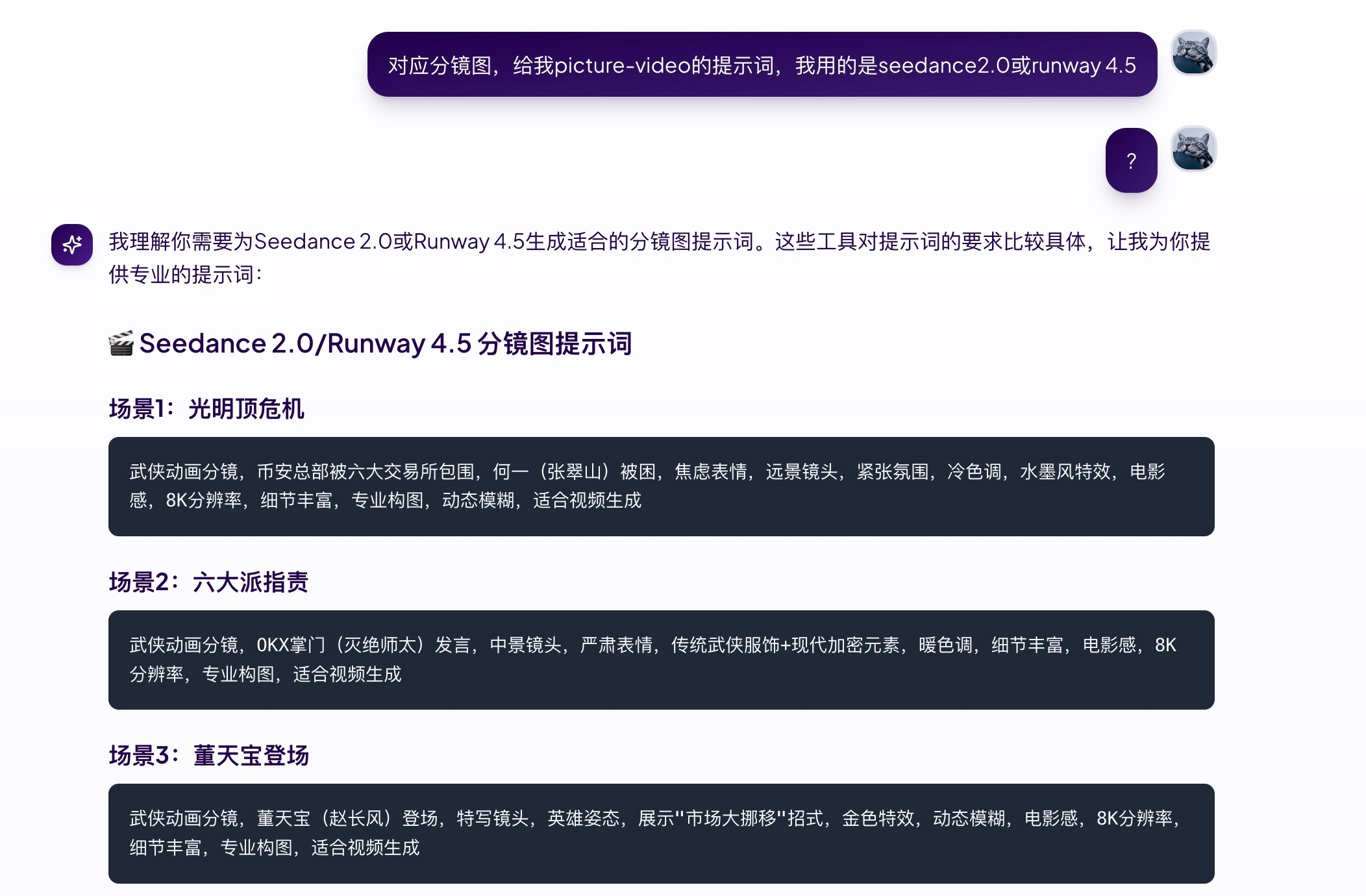
Step four, prioritize images over video. Use the storyboard script obtained from step two to generate keyframe images using the character library. Once the keyframes are fixed, feed them into an image-to-video generator (Kling/Runway works too). At this time, the camera movement parameters provided by the Seed will help elevate the 'sense of motion' to a more cinematic level—pushes, pulls, shakes, and pans have logic, not random movements.
Step five, the post-production is what makes it a finished piece. Those who tweet right after completing step four usually stop at 'trial versions.' Throw your generated 3-5 second clips into video editing software like Jianying/PR: cut out bad frames, edit the shots to the rhythm, layer BGM and sound effects like sword clashes/wind/crowd pressure (sound effects can really account for half the score), then unify subtitles and color grading to achieve a consistent color tone throughout the piece—after this step is done, the viewing experience will change from 'a patched GIF' to 'a short drama.'
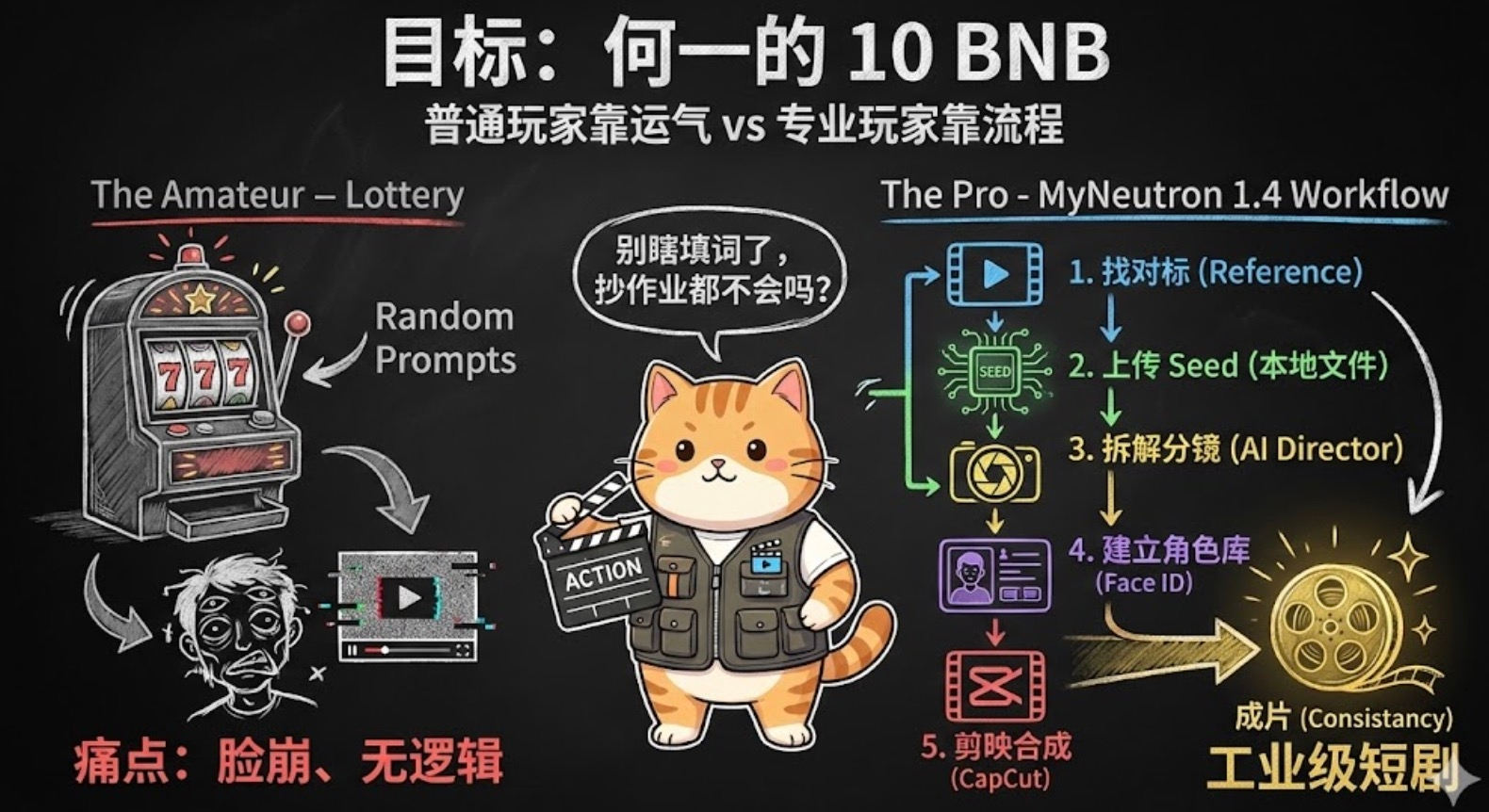
So what does this competition come down to? It's not about who can write the longest prompt; it's about who is more industrialized: who can produce steadily, maintain consistency, and replicate the visual language. Seedance 2.0 might be the future killer tool, but it hasn't become mainstream yet; the ability of MyNeutron 1.4 to 'deconstruct seeds and analyze' is an external tool you can use right now—it directly solves the two hardest problems for ordinary people: you can't describe shots, it breaks them down for you; you're afraid of facial collapse, you lock it with the character library.
I've laid out the methodology; it just depends on whose 'Bright Summit' is fiercer and more cinematic. Don't hesitate, get started—go for those 10 BNB. 🚀
