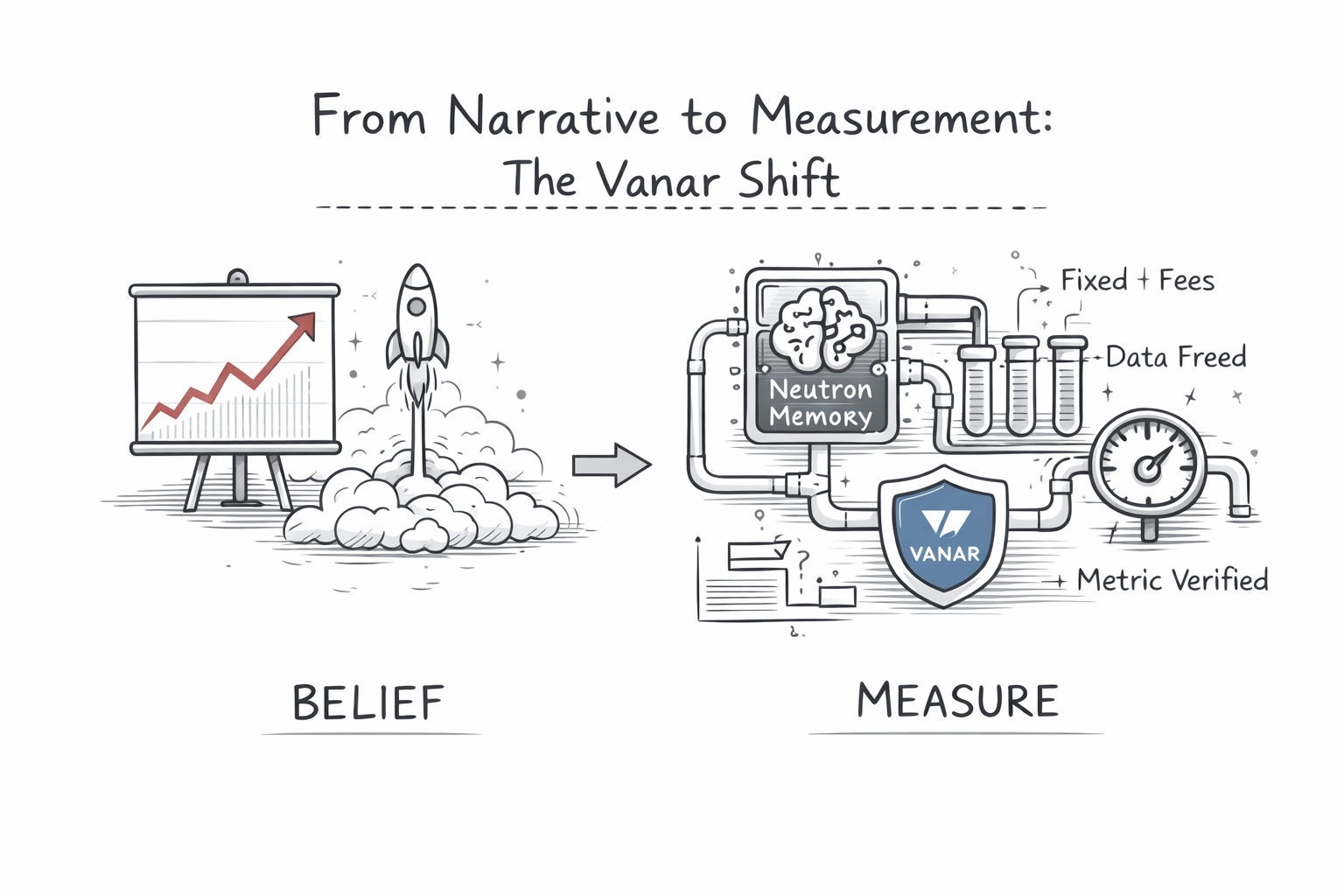
What Vanar’s current state isn’t about is re-igniting a narrative, or defending a chart. It’s not even about re-building trust for 2026 with vision decks anymore. What Vanar is trying to do here, it seems, is not even close to that kind of recovery marketing, but more like an audit of what blockchains are even useful for as a system of record that can be queried under pressure.
The least understood change, though, is the retreat of Vanar from "AI hype" to "AI persistence." It's no longer a business of intelligence; it's a business of continuity. Neutron flips the value proposition on its head: the capacity of agents, apps, and workflows to build context without depending on flimsy assumptions made outside the chain itself. That's a pretty radical shift. Most AI agents start over with each use case; context matters the most, not reasoning velocity.
All of which explains why Vanar’s recent statements are feeling a bit less warm, a bit more technical: they’re not trying to engage retail imagination anymore. They’re talking to the folks who care about all-in costs, data longevity, and deterministic behavior. While fixed fees, FIFO ordering, and predictable execution are boring, they’re at least quantifiable. And quantification is the only language remaining once narrative fails.
As far as token dynamics are concerned, Vanar is, ostensibly, staking its claim on the efficacy of utilization-based burn-offs and subscription pressure in outlasting unlock pressure. There is no illusion here, only a bet being made on time. Either the experiment works, or it does not.
The key takeaway isn't that VANRY recovers quickly. It's that Vanar manages to transform itself from a speculative object to a utility substrate that can be validated without belief. Trust will not come back with a bang; it will come back without a bang, block by block and metric by metric.
At this point, Vanar is not asking the market to believe in again. It is asking to watch.