
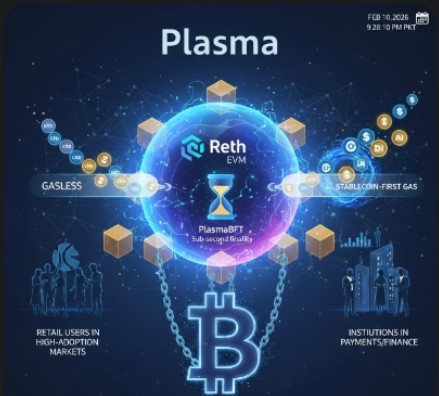
Plasma addresses a specific operational problem: stablecoin payments need to settle fast, cost predictably, and remain neutral and auditable. Most general-purpose blockchains were not designed around stablecoin settlement as a primary use case. Fees fluctuate, gas tokens are volatile, finality can be uncertain, and UX breaks under congestion. For retail users in high-adoption markets and for institutions handling payments or financial flows, these weaknesses translate directly into failed transactions, reconciliation delays, compliance friction, and loss of trust. If you are building payment infrastructure, merchant settlement systems, remittance corridors, or institutional treasury rails, you need a clear operational blueprint. Plasma, as a Layer 1 tailored for stablecoin settlement with full EVM compatibility through Reth, sub-second finality via PlasmaBFT, stablecoin-first gas, gasless USDT transfers, and Bitcoin-anchored security, provides the base layer. The value comes from how you implement it.

The core issue in existing systems is misalignment between infrastructure design and payment reality. Stablecoins are meant to be stable units of account, yet users often need volatile native tokens to pay gas. That creates friction and unpredictability. Many chains optimize for general smart contract flexibility, not deterministic settlement speed. Congestion spikes increase costs at the worst possible time. On the institutional side, compliance teams require auditable records and verifiable neutrality, but not all chains offer strong external anchoring that supports censorship resistance narratives. Additionally, most teams underestimate the operational load: running nodes, managing relayers, handling nonce management for meta-transactions, and aligning on-chain finality with off-chain banking systems. What goes wrong is rarely the blockchain itself; it is weak operational design around it.

To implement Plasma effectively, start by defining your settlement objective in measurable terms. Specify target finality time in seconds, acceptable transaction failure rate, maximum fee variance, and reconciliation window with banking partners. Without numeric targets, you cannot design infrastructure correctly. Once defined, build infrastructure that supports these metrics from day one rather than retrofitting later.

First, deploy resilient node infrastructure. Use multiple full nodes running the Plasma-compatible Reth client across separate cloud regions or providers. Place them behind a load balancer that distributes RPC traffic evenly. Enable health checks that automatically remove unhealthy nodes from rotation. Store validator or signing keys in hardware security modules or managed key services, never in plain configuration files. Automate deployment with infrastructure-as-code tools so that node replacement is fast and reproducible. Schedule regular snapshots and test restoration procedures to ensure you can recover quickly from corruption or failure.

Second, design and operate a relayer system for gasless stablecoin transfers. Gasless USDT transfers rely on meta-transactions where the user signs a message and a relayer submits it on-chain. Build a dedicated relayer cluster rather than a single server. Implement queue management so transactions are processed in order and retried safely if submission fails. Store nonces in a reliable database and confirm nonce synchronization with the on-chain contract before broadcasting. Add replay protection inside your smart contracts by validating signatures and nonces explicitly. Monitor relayer queue depth and processing latency; if queue time increases beyond threshold, automatically scale horizontally.

Third, implement stablecoin-first gas logic directly into your contract and backend design. If the protocol supports paying gas in stablecoins, configure your system so that users never need to hold a volatile native token. For retail flows, sponsor gas fees and charge a transparent service fee embedded into the transaction amount. For institutional flows, agree on a fixed per-transaction fee denominated in stablecoin and store that fee schedule in a contract variable accessible on-chain for auditability. This ensures predictability and avoids hidden fee drift.

Fourth, integrate Bitcoin anchoring verification into your accounting process. Plasma’s Bitcoin-anchored security strengthens neutrality and censorship resistance, but only if you operationalize it. Set up an automated service that monitors anchoring events and records corresponding Bitcoin block references. Store these references alongside your transaction logs. When generating settlement reports for partners, include both Plasma finality timestamps and associated Bitcoin anchor data. This creates an auditable chain of custody from transaction initiation to anchored state.

Fifth, align on-chain settlement with off-chain treasury operations. Sub-second finality is powerful, but fiat settlement still depends on banking rails. Build a reconciliation engine that listens for finalized Plasma events and triggers accounting entries in your internal ledger. Aggregate stablecoin inflows and define clear policies for when to convert to fiat. Work with multiple liquidity providers to reduce slippage and counterparty risk. Establish thresholds where conversions are automatic and thresholds where manual approval is required. Maintain daily reconciliation reports comparing on-chain balances, custody balances, and bank balances.
Sixth, implement rigorous observability. Measure end-to-end latency from user action to confirmed finality. Track success rate, average fee paid, relayer processing time, RPC response time, and consensus confirmation time. Define service-level objectives such as 99.9 percent of transfers finalized within two seconds. Connect alerts to an on-call rotation and maintain runbooks describing corrective steps. Observability must cover not only blockchain metrics but also application-layer metrics like API response time and database health.

Seventh, secure your contracts and infrastructure through staged testing. Begin with unit tests that validate signature logic, nonce increments, and fee calculations. Expand to integration tests on a Plasma testnet, simulating high transaction throughput. Conduct load tests to observe relayer and node behavior under stress. Commission an external security audit before mainnet deployment. If using upgradeable contracts, protect upgrade authority with multi-signature control and time-lock mechanisms. Document emergency pause procedures and test them in controlled environments.

Eighth, design compliance integration from the outset. Fast settlement does not remove regulatory obligations. Integrate KYC providers to verify user identities for regulated flows. Implement monitoring rules that flag suspicious transaction patterns. If required by jurisdiction, build on-chain controls allowing temporary freezing of specific addresses subject to legal review. Maintain secure storage of KYC data off-chain while linking reference IDs to on-chain addresses for audit consistency.

Ninth, build user experience around simplicity. Retail users should see instant, stable transfers without being exposed to nonce errors or gas mechanics. Provide clear confirmation messages once finality is achieved. Offer transaction history with readable details including timestamp and status. For institutional dashboards, expose more granular data such as transaction hash, relayer ID, fee paid, and anchoring reference. Good UX reduces support costs and increases trust.

Tenth, roll out in controlled phases. Begin with a small pilot involving one merchant or business unit. Monitor metrics closely and gather operational feedback. Adjust fee policy, scaling parameters, and relayer configuration based on real usage patterns. Expand gradually while ensuring infrastructure capacity scales ahead of demand. Document every operational lesson and incorporate it into standard procedures.

Avoid common mistakes that undermine stability. Do not rely on a single node or relayer; redundancy is mandatory. Do not ignore nonce management edge cases, as they are a frequent source of failed meta-transactions. Do not assume anchoring works automatically without monitoring; verify and log it. Do not delay security audits until after scaling. Do not treat compliance as an afterthought; retrofitting controls is far more difficult than designing them early. Finally, avoid overpromising instant fiat settlement simply because on-chain finality is fast.

For practical implementation, ensure the following conditions are met before declaring production readiness. Multiple RPC nodes are deployed with automated failover. Relayer clusters are load-tested and monitored. Smart contracts are audited and deployed with protected upgrade paths. Stablecoin gas logic is functioning and fee schedules are transparent. Bitcoin anchoring verification is automated and logged. Treasury reconciliation connects on-chain data to custody and banking systems. Monitoring dashboards display latency, success rate, and fee metrics in real time. Incident response runbooks are written and tested. Compliance workflows are integrated and documented.

