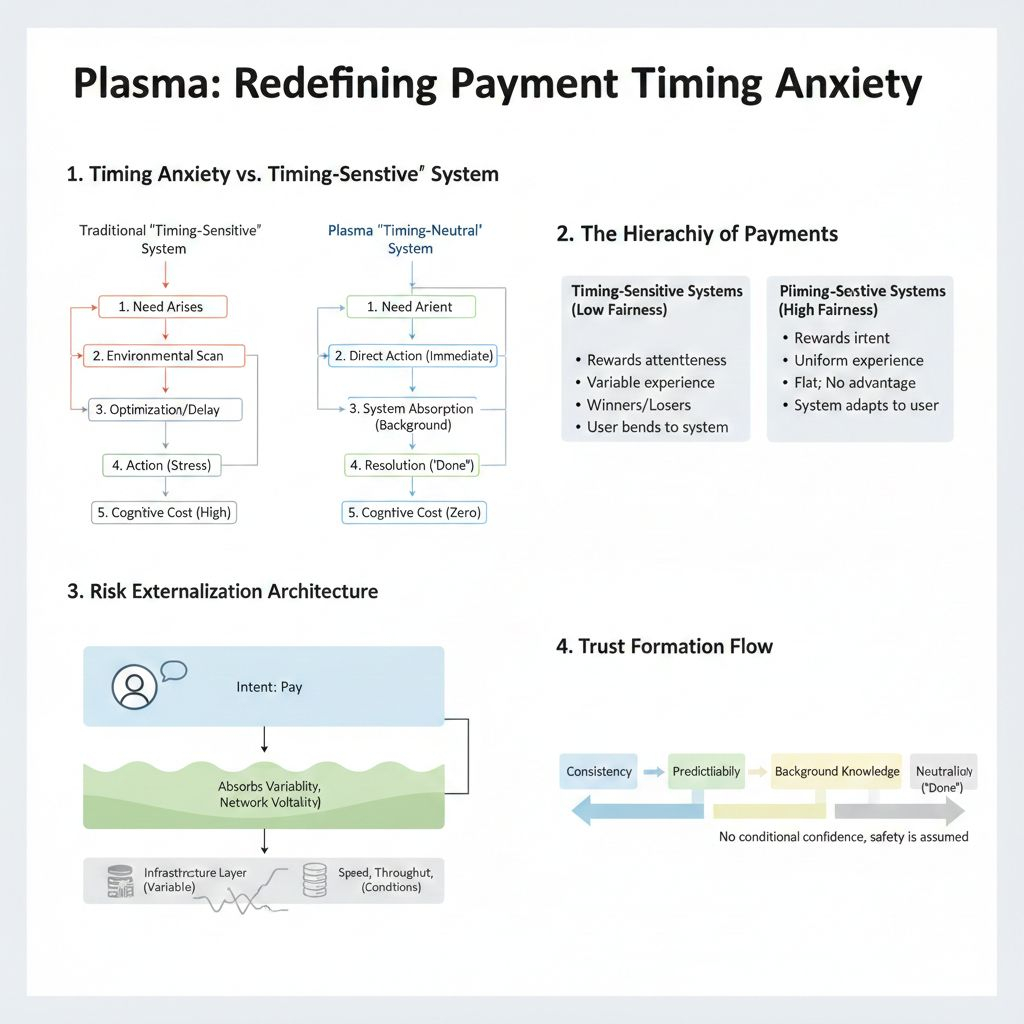
Timing anxiety is one of the least discussed frictions in payment systems.
Not latency. Not throughput. The fear that you’re acting at the wrong moment. Too early before things are ready. Too late after conditions have shifted. That fear quietly shapes how people move money, even when the system technically works.
What keeps standing out to me about Plasma is how intentionally it seems to dissolve that anxiety.
Most crypto payment rails teach users to develop timing instincts. You learn when fees are low. You learn when the network is calm. You learn which hours feel safer than others. Over time sending money becomes less about intent and more about reading the system’s mood.
That’s manageable for traders.
It’s corrosive for payments.
Payments don’t want intuition. They want indifference to timing. Rent doesn’t care if the network is busy. Payroll doesn’t wait for optimal conditions. When systems force users to think about when to act instead of simply acting they turn money movement into a scheduling problem.
Plasma feels like it’s built to eliminate that problem.
The system doesn’t appear to reward waiting or punish immediacy. You don’t gain an advantage by being early. You don’t incur a penalty by being late. The experience doesn’t change based on subtle timing choices. That sameness is not accidental it’s behavioral design.
When timing stops mattering, behavior simplifies.
Users stop planning around the system. They stop delaying payments to safer windows. They stop accelerating transfers out of fear. Money moves when the need arises, not when the conditions feel right.
That shift has real consequences.
In systems where timing matters, users internalize risk. They learn to hedge emotionally. They treat payments as something that requires situational awareness. Even if nothing goes wrong, the cognitive cost remains.
Plasma seems designed to externalize that risk instead. The system absorbs variability so the user doesn’t have to. That’s a heavy responsibility for infrastructure, but it’s the right place for it.
There’s also a fairness dimension here that’s easy to miss.
Timing-sensitive systems reward those who are watching closely. People with time tools or experience get better outcomes. Casual users pay more or wait longer. Over time that creates a quiet hierarchy in what should be a neutral activity.
Payments shouldn’t have winners and losers based on attentiveness.
Plasma’s consistency flattens that hierarchy. Acting at noon feels the same as acting at midnight. The system doesn’t favor those who are more engaged. It treats intent as sufficient.
That’s a strong signal about who the system is for.
What I find interesting is how this philosophy aligns with real world money habits. In everyday life we don’t think about whether it’s a good time to hand someone cash. We don’t optimize when to swipe a card. The expectation is that the system will handle timing on our behalf.
Crypto systems often violate that expectation then ask users to adapt. Plasma feels like it’s doing the opposite: adapting itself so users don’t have to.
This also affects trust formation.
When users believe that acting at the wrong time could hurt them they never fully relax. Even after dozens of successful transactions the anxiety remains latent. One bad experience reinforces it instantly.
When users learn that timing doesn’t matter, trust stabilizes faster. There’s no conditional confidence. No sense that safety depends on vigilance. The system behaves the same regardless of when it’s used.
That reliability becomes background knowledge.
Over time people stop thinking in terms of now or later. They just think in terms of done. The payment doesn’t carry a timestamp emotionally. It doesn’t feel rushed or delayed. It just feels resolved.
Plasma feels like it’s aiming for that emotional neutrality.
This isn’t about being fast. It’s about being unaffected. A system that behaves the same way regardless of moment teaches users that their schedule doesn’t need to bend around it.
That’s a subtle form of respect.
Of course designing away timing anxiety is difficult. It leaves little room for excuses. If the system behaves inconsistently even once the illusion breaks. Users immediately relearn the instinct to time their actions.
Plasma seems aware of that risk. Its restraint suggests a willingness to trade expressiveness for predictability flexibility for calm. Those are not popular trades in crypto culture but they’re sensible ones in payments.
As money systems mature the ability to act without thinking about timing becomes more valuable than raw speed. Speed impresses. Indifference to timing liberates.
Plasma doesn’t feel like it’s trying to convince users that now is the perfect moment.
It feels like it’s trying to make every moment equally unremarkable.
And in payments that unremarkableness is often what finally allows money to move on human schedules instead of system schedules.
When that happens, the system stops shaping behavior.
It starts serving it.@Plasma #plasma #Plasma $XPL