
Most crypto updates shout for attention.
Plasma didn’t.
While the market chased narratives, Plasma focused on something far less glamorous—and far more consequential: how stablecoins actually move at scale.
That design choice now defines every recent update around XPL.
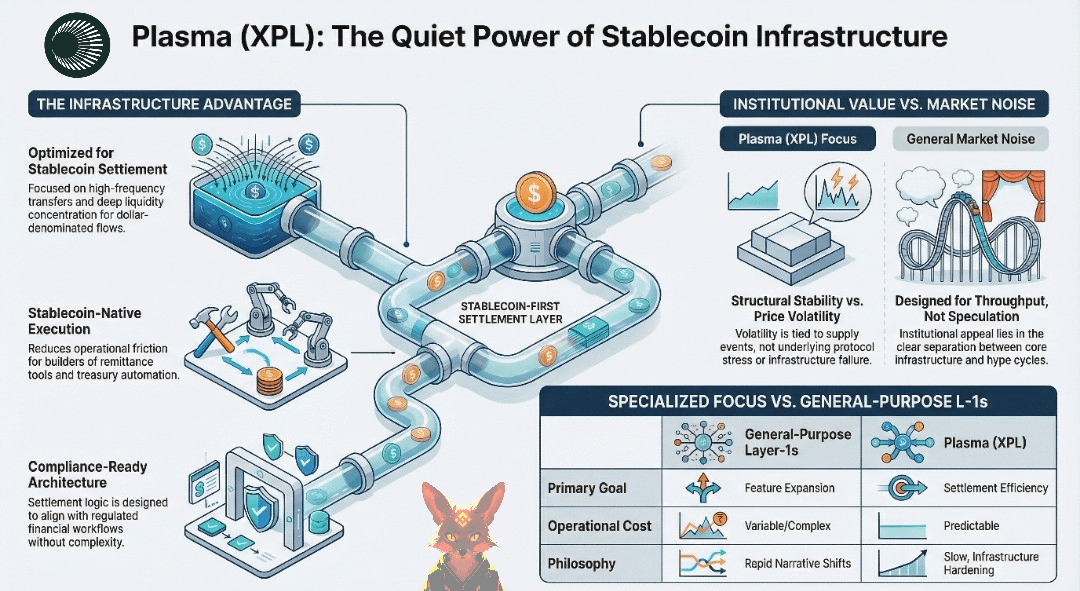
In the current digital asset landscape, "noise" has become the primary export. Between the relentless hype cycles and the performance art of narrative reinvention, it is easy to lose sight of actual market structure. While most projects are shouting for attention to mask a lack of utility, the most consequential shifts are occurring in the silence of foundational builds.
Plasma (XPL) is a case study in strategic narrowing. It has intentionally stepped away from the "innovation theater" that defines much of the sector to focus on a singular, unglamorous problem: the mechanics of how money actually moves. By ignoring the impulse to be everything to everyone, Plasma is positioning itself not as a speculative playground, but as the quiet, essential plumbing for global stablecoin settlement.
The most critical evolution within the Plasma ecosystem is its pivot from a general-purpose Layer-1 to a specialized "stablecoin-first settlement network." In a market crowded with a "sea of sameness"—where dozens of chains compete for the same fragmented liquidity—Plasma has chosen to double down vertically.
The network’s architecture is now strictly optimized around four pillars:
High-frequency transfers: Scaling specifically for the velocity of modern commerce.
Predictable costs: Eliminating the fee volatility that renders most chains unusable for real-world business.
Compliance-ready architecture: Designing settlement logic that aligns with, rather than fights, regulatory frameworks.
Deep liquidity concentration: Ensuring dollar-denominated flows have the depth required to prevent slippage.
Why Vertical Integration Wins the Long Game Horizontal expansion in crypto often leads to feature bloat and fragmented liquidity. By specializing in stablecoins—the highest-velocity segment of the digital asset market—Plasma is building a moat that general-purpose chains cannot easily replicate. While others chase every new trend, Plasma is capturing the specific utility required for global settlement, creating a "sticky" infrastructure that prioritizes the movement of value over the collection of "cool" features.
While retail speculators hunt for excitement, sophisticated builders hunt for efficiency. There is a growing movement of developers escaping the complexity of general-purpose chains in favor of environments that simply work. For teams building remittance tools, treasury automation, and payment rails, Plasma offers a "stablecoin-native" execution environment that removes the operational friction of legacy-style blockchains.
"This is not innovation theater. It’s boring infrastructure—and that’s the point."
The Competitive Advantage of Predictability In fintech, "boring" is a high-level feature, not a bug. For a treasury manager or a payment provider, a "sexy" or experimental feature is often just another point of failure. Plasma’s "boring" infrastructure provides the predictability and reliability required for real-world financial tools. By removing the "unnecessary complexity" typical of other protocols, Plasma allows developers to focus on the application layer rather than fighting the underlying settlement rails.
Institutions are fundamentally allergic to "innovation theater." They require infrastructure that prioritizes throughput and compliance over speculative narratives. Plasma’s design separates itself from the hype cycles of the retail market by focusing on structured, regulated workflows. This clear separation places XPL in a different category than the typical speculative L1; it is being built as a tool for professional financial entities that value stability and institutional-grade settlement over the next viral trend.
There is currently a significant gap between XPL’s market price and the protocol’s structural health. Recent price action has been characterized by volatility, primarily driven by supply events such as token unlocks. From a market-structure lens, it is vital to recognize that this volatility is a non-fundamental event. It is a product of supply-side pressure rather than any stress or failure within the protocol itself.
Navigating the Gap Between Reputation and Reality This decoupling creates a natural friction. Early participants who entered with expectations of rapid price expansion are often frustrated by a project that favors slow, deliberate execution over narrative-driven pumps. However, this friction also provides clarity. The protocol is undergoing a period of "infrastructure hardening," where technical reality is outpacing market perception. For the strategist, the value lies in realizing that supply-side events are temporary, while the utility of the "pipes" being laid is permanent.
Plasma’s current phase lacks the dramatic pivots that usually keep the crypto press engaged. There is no narrative reset, only a relentless focus on infrastructure hardening and liquidity positioning. In a world of a thousand chains, the network that controls the "stablecoin pipes" will ultimately control the flow of value.
As the market matures, the ability to generate noise will matter far less than the ability to settle value predictably. We are moving toward a reality where liquidity positioning matters more than short-term price cycles.
Are you a "tourist" chasing the latest round of innovation theater, or a "homesteader" looking for the pipes that will power the future of global settlement? Sometimes, the most important work is the quietest.

