
In the world of cryptocurrency, exchanges act as a bridge between buyers and sellers. The two most popular types of exchanges today are centralized exchanges (CEX) and decentralized exchanges (DEX).
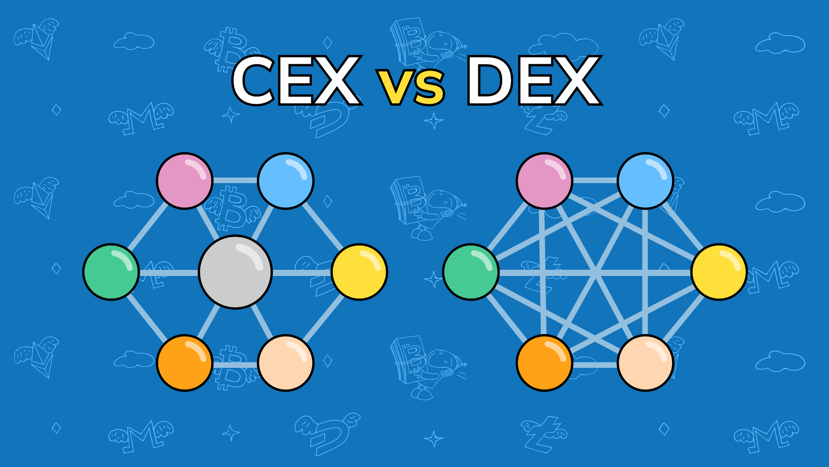
Both have their own advantages and disadvantages, serving different needs of users. This article will help you understand the differences between these two models and how they shape the future of digital finance.
What is a centralized exchange (CEX)?
Centralized exchanges (CEX) are trading platforms managed by an organization or company. Users need to register an account, complete KYC (Know Your Customer), and deposit assets into the exchange's wallet to trade.
Advantages of CEX
✅ Fast transaction speed: Transactions are executed instantly on the internal system, without waiting for confirmation on the blockchain.
✅ High liquidity: CEXs often have a large user base and professional market-making teams, ensuring liquidity.
✅ Easy to use: User-friendly interface, with customer support services.
✅ Margin trading and derivatives: Many CEXs support leverage, futures contracts, and other derivative products.
Disadvantages of CEX
❌ Concentrated control: Users do not actually hold their assets as they are held on the exchange.
❌ Risk of hacking: Being a centralized target, CEX is more susceptible to hacker attacks.
❌ Bankruptcy risk: If the exchange encounters financial problems (like FTX), users may lose all their assets.
❌ Must comply with legal regulations: CEX is controlled by financial regulatory authorities, which may restrict users' access in certain countries.
What is a decentralized exchange (DEX)?
A decentralized exchange (DEX) is a trading platform that operates on the blockchain and is not controlled by any organization. Trading on DEX is done through smart contracts, eliminating the need for intermediaries.

Advantages of DEX
✅ Users control their assets: No need to deposit money into the exchange, assets always remain in the users' personal wallets.
✅ High security: Due to the lack of a central point, DEX is harder to hack compared to CEX.
✅ No KYC required: Users can trade anonymously without providing personal information.
✅ Not controlled by regulatory authorities: DEX operates on the blockchain, making it difficult for governments or regulatory bodies to shut it down.
Disadvantages of DEX
❌ Slower transaction speed: Transactions need to be confirmed on the blockchain, which can take time if the network is congested.
❌ Lower liquidity than CEX: Due to fewer users and no professional market-making teams.
❌ Difficult to use: Requires users to have knowledge of crypto wallets, private keys, and how to interact with smart contracts.
❌ No customer support: If issues arise, users have to resolve them on their own as there is no support department like CEX.
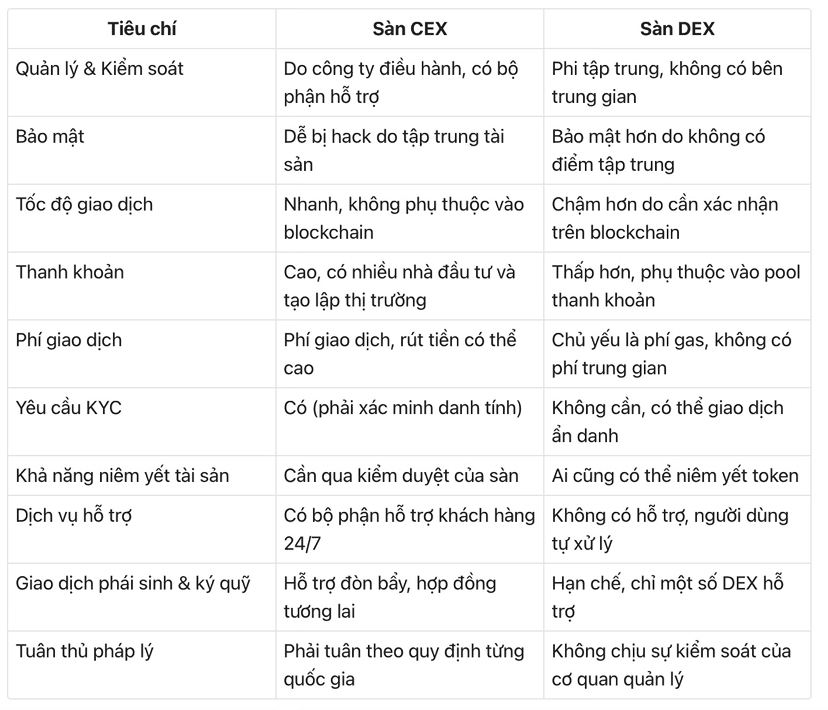
Detailed comparison between CEX and DEX
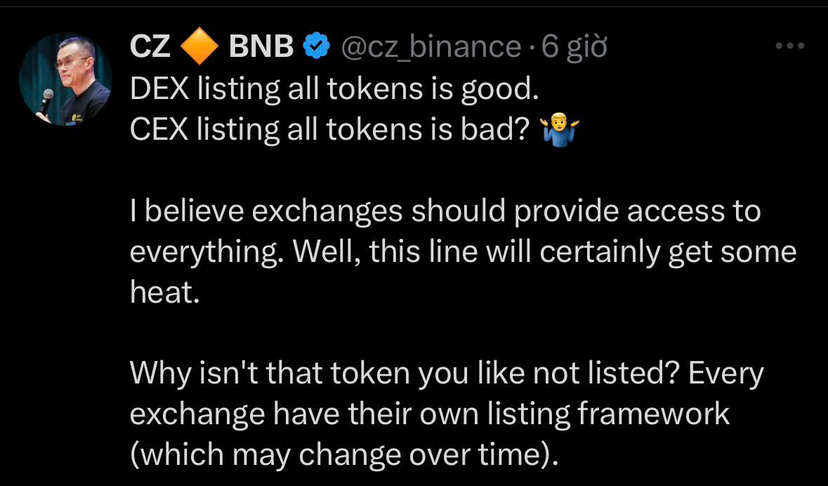
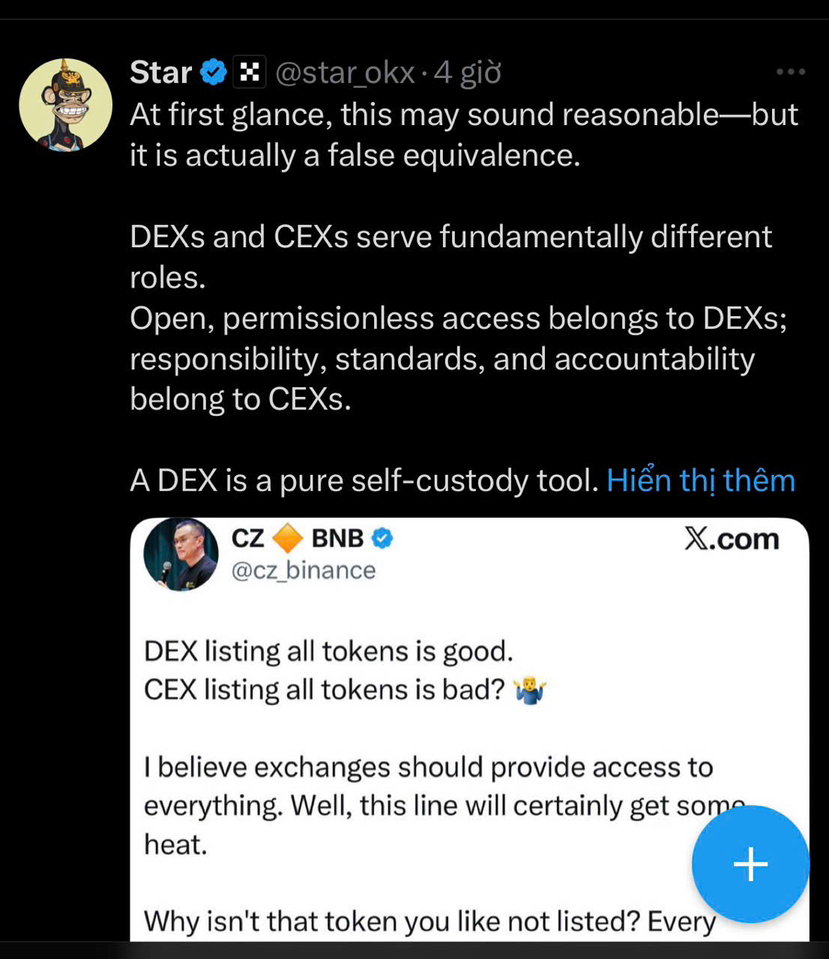
Quote from CZ's post on X about CEX and DEX
The fact that DEX lists all tokens is a good thing.
Is it bad that CEX lists all tokens? 🤷♂️
I believe exchanges should provide access to everything. Surely this statement will cause much controversy.
Why isn't your favorite token listed? Each exchange has its own listing framework (and this framework may change over time).
1. Why is it "good" that DEX lists everything?
The nature of DEX (like Uniswap, PancakeSwap) is permissionless.
The power of Code: Anyone can create liquidity for a token. This fosters innovation. Great projects often start from small "niches" that no large exchange cares about.
Responsibility lies with the user: On DEX, users are responsible for their own wallets. If you buy "junk", it’s because you didn’t research thoroughly (DYOR).
No filters: The absence of filters is a hallmark of decentralization.
2. Why is it "not good" that CEX lists everything?
Although it may seem unfair, there are practical reasons that make exchanges like Binance or Coinbase extremely stringent:
Reputation and Legal Responsibility: CEX operates as a business entity with legal personality. If they list a scam project or a Ponzi scheme, they will face lawsuits from users and pressure from regulatory authorities (SEC, etc.).
Liquidity and Systemic Risk: Listing too many "junk" tokens with low liquidity can easily lead to price manipulation (Pump & Dump). When users lose money en masse on a platform, they will abandon that exchange.
Operational resources: Each token listed requires a technical team to maintain wallets, deposits/withdrawals, and a customer support team. Listing "everything" is operationally impossible.
The coexistence of DEX and CEX is a complete ecosystem. DEX is a breeding ground and screening place, while CEX provides convenience and security for the majority.
Rebuttal to CZ's article, Star also has opinions
At first glance, this may sound reasonable—but in fact, it is a misleading comparison.
Decentralized exchanges (DEX) and centralized exchanges (CEX) play fundamentally different roles.
Open access, no permission belongs to DEX; responsibilities, standards, and obligations belong to CEX.
A decentralized exchange (DEX) is a fully self-managed tool. The service provider is not an intermediary and does not control the users' money. Users interacting with DEX understand—or should understand—that they are using a tool and are entirely responsible for their actions. As SEC Chairman Paul Atkins stated:
"The right to self-manage personal assets is a fundamental value of America; it should not disappear when people access the internet."
Conversely, centralized exchanges (CEX) hold users' money, similar to banks. Therefore, they have clear obligations related to anti-money laundering (AML), compliance with sanctions, fraud prevention, and consumer protection. CEXs are not neutral intermediaries. They play the role of intermediaries creating trust, are responsible for operations, and thus have an obligation to protect users, rather than merely listing everything that exists.
Equating DEX and CEX does not demonstrate openness.
This is an effort to evade responsibility.
This fundamental difference reflects the long-standing value differences between OK* and Binance.
DEX is a "Tool": Like a knife or open-source software. The creator does not control how it is used and does not hold users' assets. Therefore, imposing banking regulations (like AML/KYC) on an automated line of code is absurd.
CEX is a "Custodian": Operating like a traditional financial institution. When you hold other people's money, you must be responsible for protecting them from fraud and complying with the law.
So should you choose CEX or DEX?
- If you are new, want to trade easily, have customer support, and high liquidity → CEX is the suitable choice.
- If you are concerned about security, privacy, and do not want to rely on intermediaries → DEX is the better solution.
- If you want to leverage both models, you can combine using CEX for quick trading and DEX for securely storing assets.
In terms of pure profit, the choice between CEX and DEX depends on the needs of each individual when participating in trading. While CEX offers convenience and liquidity, DEX provides security and asset control. However, in terms of legal protection, licensed CEX will be safer. Of course, you need to clearly determine whether that CEX is licensed in your country? Because with unlicensed CEX in your country, you may have inadvertently violated the law if your country prohibits that exchange.
Regardless of which platform you choose, the most important thing is to clearly understand how they work, manage risks, and protect your assets in this volatile crypto world with unclear legal status.
