
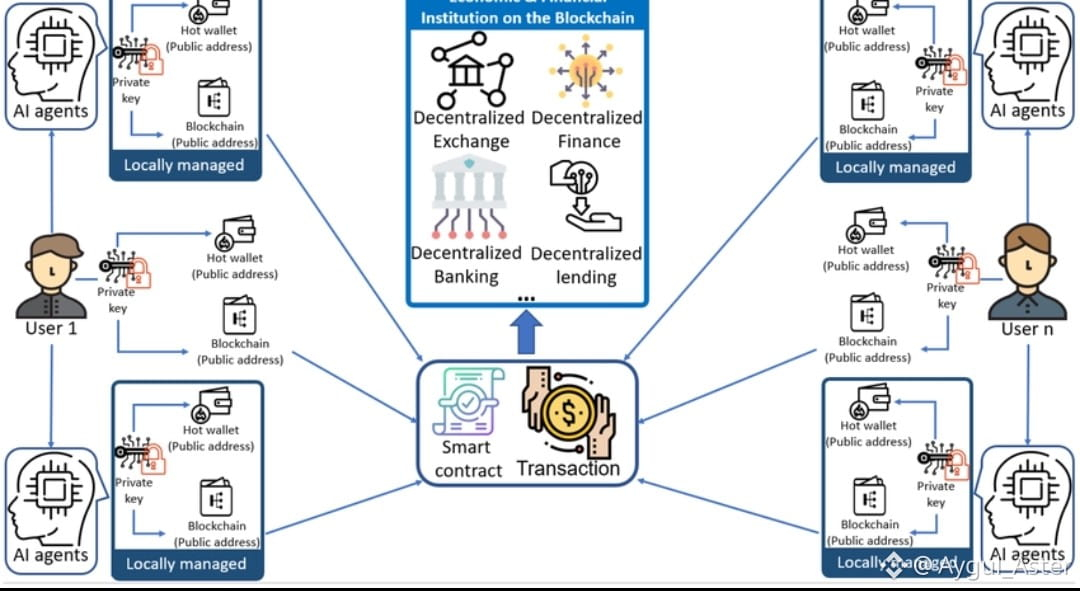
Modern digital systems still depend heavily on trust. Trust that users behave honestly, that operators do not abuse power, and that unseen processes run as promised. This model has survived because humans can negotiate, explain intent, and absorb ambiguity. Autonomous AI cannot. AI does not rely on belief or reputation—it relies on structure. As AI evolves into an independent economic and operational actor, trust-based systems become a liability rather than a strength.
This is where Vanar Chain positions itself differently. It is built on the idea that the future of AI requires infrastructure where trust is unnecessary because correctness is enforced by design.
AI-First Infrastructure Is About Certainty, Not Speed
Most platforms claim to be “AI-ready” by adding tooling on top of existing systems. AI-first infrastructure takes the opposite approach: it embeds certainty at the base layer. Every assumption that normally requires trust—data integrity, execution correctness, memory persistence—is handled structurally.
In a trustless design, AI does not need to assume honesty. The system itself guarantees consistency, auditability, and continuity. This becomes essential when AI is allowed to make decisions that carry real economic or operational consequences.
Native Semantic Memory: Context That Cannot Be Rewritten
A major weakness in current AI systems is memory. Context is often stored off-chain, in mutable databases, or across fragmented services. This makes AI reasoning fragile and vulnerable to manipulation.
Vanar Chain introduces native semantic memory at the infrastructure level. AI memory lives directly inside the network rather than on external layers. As a result:
Context persists across time without silent modification
Historical understanding remains verifiable
Any change leaves an immutable trail
AI no longer reasons on temporary snapshots. It builds knowledge on a stable, tamper-resistant foundation.
On-Chain Reasoning: From Black Boxes to Verifiable Logic
Autonomous AI must not only act—it must be explainable. When AI executes financially meaningful decisions, opaque outcomes are unacceptable.
By anchoring reasoning directly on-chain, every decision is broken into traceable logic steps. This allows:
Independent verification of AI decisions
Testing and auditing of reasoning paths
Accountability without relying on human explanation
Trust shifts away from operators and toward transparent architecture. Outcomes are no longer accepted because of authority, but because logic can be proven.
Secure Automation: Acting Without Human Permission
Decision-making alone is not enough. Autonomous AI must be able to act. Secure automation ensures that once logic is validated, execution follows predefined rules without manual intervention.
Risks are not ignored—they are bounded. The system limits failure impact, enforces constraints, and ensures that AI actions remain within defined parameters. This allows AI to operate continuously without depending on human trust or oversight for routine execution.
Economic Layer Driven by Real Usage
Within this ecosystem, economic value is not based on narrative or expectation. It emerges from measurable activity. Network usage, AI execution, and verified operations directly influence economic flow.
Rather than asking markets to believe in promises, the system exposes real demand through transparent usage. Value follows function, not speculation.
A Shift From Trust to Architecture
The age of autonomous AI requires a fundamental rethink of infrastructure. Systems designed for human trust do not scale to machine autonomy. Vanar Chain proposes a different model—one where:
Trust is replaced by verification
Assumptions are replaced by structure
AI autonomy is supported, not feared
In this model, trust is no longer requested. It becomes irrelevant—because the architecture itself enforces truth.
