
The Bitcoin market has recently experienced severe sell-offs, with prices dropping below the $70,000 mark, causing anxiety among many investors. However, market experts remain confident that this pullback is just a short-term emotional fluctuation and has not altered the fundamental long-term bullish outlook for Bitcoin. The Bernstein analyst team continues to uphold its target price of $150,000 for Bitcoin in 2026, believing that this decline is not a 'bear market reversal,' but rather triggered by liquidity tightening and macroeconomic pressures.
Short-term pullbacks do not change the long-term bullish outlook, with a target of $150,000 solid as a rock
Despite the recent significant pullback in Bitcoin prices, Bernstein analysts indicate that the reasons for this decline stem more from investor sentiment than from structural issues in the market. The report states: 'This is the weakest bearish rationale in Bitcoin's history' and emphasizes that there have been no major failures in the Bitcoin market's infrastructure. Even when Bitcoin's price briefly dropped by nearly 50%, the outflow of funds from spot Bitcoin ETFs was only about 7%, far below market expectations.
The analyst team led by Gautam Chhugani points out, 'The current price fluctuations are more driven by a crisis of market confidence and have not revealed any hidden risks. This volatility cannot change Bitcoin's core value.'
Macroeconomic pressures are increasing, limiting short-term upside potential.
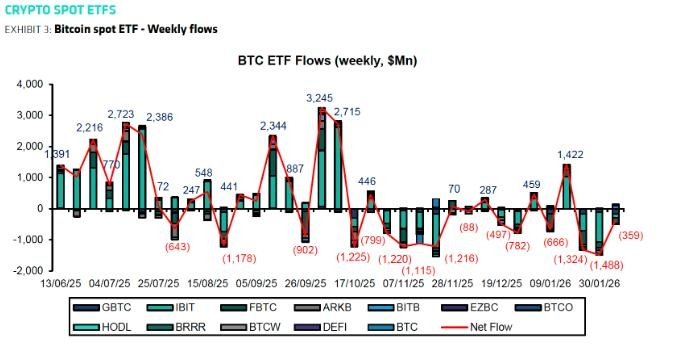
Although Bitcoin's long-term outlook remains strong, its short-term performance is constrained by the global macroeconomic environment. Current financial tightening policies and high-interest rate environments exert pressure on Bitcoin, causing it to perform worse than traditional safe-haven assets like gold. The report mentions that AI-related stocks and precious metals have gained more favor among investors in this environment, limiting Bitcoin's upside potential in the short term.
Additionally, analysts have rebutted several emerging risk expectations. For instance, there are concerns that artificial intelligence may divert funds away from cryptocurrencies, or that quantum computing will threaten Bitcoin's security. Bernstein emphasizes that quantum computing as Bitcoin's 'terminator' is unrealistic, as it overlooks the timeline of quantum technology applications, blockchain upgrade paths, and the global digital economy's collective response.
Leverage risks have been controlled, and institutional investors remain optimistic about Bitcoin.
Regarding the market's concerns about Bitcoin's leverage risks, especially with companies like MicroStrategy using leverage, Bernstein's analysis suggests that these companies rely on long-term sustainable preferred shares and have sufficient cash flow to cover dividends. Therefore, they do not face refinancing risks in the short term, and leverage usage does not pose a deadly threat to the market.
Miner capitulation sell-offs may exacerbate market downturns.
Nevertheless, analysts point out that once Bitcoin's price drops below miners' production costs, it could trigger a 'capitulation sell-off' from miners, further intensifying market selling pressure. However, the Bernstein team remains optimistic, predicting that as the liquidity environment improves, Bitcoin will return to an upward trajectory, ultimately breaking new highs. The company still believes in Bitcoin surpassing the target price of $150,000 in 2026.
Institutional investors are optimistic about the pullback, and market sentiment is turning positive.
Bitwise CEO Hunter Horsley states that the interpretation of Bitcoin falling below the $70,000 price range varies among different groups. Long-term holders are cautious, while institutional investors view this pullback as 'the best entry opportunity.' Horsley believes that Bitcoin's decline is mainly influenced by external macro pressures rather than structural issues within the cryptocurrency market. He adds that the synchronized decline of Bitcoin and other highly liquid assets reflects investors' risk aversion sentiment in global markets.
Technical analysis warns: Short-term downward risks still exist.
However, despite institutional investors and analysts holding an optimistic view of Bitcoin's medium to long-term prospects, short-term technical indicators still suggest Bitcoin may face further downward risks. Independent analysts Filbfilb and Tony Severino point out that current technical indicators suggest Bitcoin may continue to decline, with some traders even believing that the market can only see a 'true bottom' if Bitcoin falls below $50,000.
Summary: Opportunities in turbulence, the $150,000 target remains unchanged.
Despite facing a double blow from liquidity tightness and macroeconomic pressures in the short term, market experts generally believe that this pullback will not change Bitcoin's long-term upward trend. Institutional investors view this pullback as a new entry opportunity, while miner sell-offs may exacerbate market volatility. Overall, Bitcoin reaching a target of $150,000 by 2026 still has a considerable likelihood.
#美国科技基金净流 #易理华割肉清仓 #黄金白银反弹 #币安比特币SAFU基金 #比特币挖矿难度下降 $BTC $ETH $XRP


