
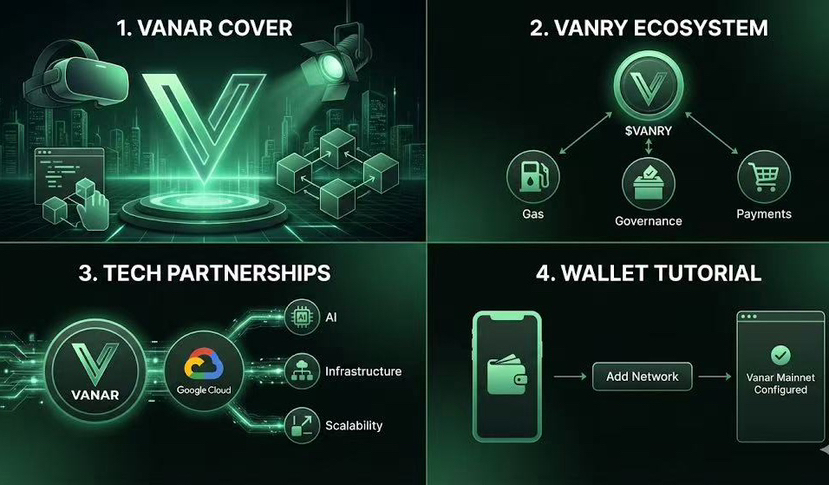
Vanry represents a purpose-built Layer-1 blockchain initiative developed in response to a structural challenge facing the digital asset industry: widespread attention without corresponding real-world adoption. Emerging from a strategic rebranding of a legacy digital ecosystem, Vanry positions itself not as a speculative experiment, but as an infrastructure-driven platform engineered for sustained, practical usage across consumer and enterprise environments.
Rather than competing for narrative dominance, the project emphasizes execution—high-performance blockchain engineering, predictable cost structures, and native intelligence embedded at the protocol level. This approach reflects a broader institutional shift within Web3: adoption is no longer driven by token velocity or marketing cycles, but by infrastructure capable of supporting stable, repeatable economic activity.
>>>>>>>>
Strategic Purpose and Market Positioning
At its core, Vanry is designed to lower structural barriers to blockchain participation. The platform targets sectors where reliability, cost efficiency, and user experience are non-negotiable—gaming, digital entertainment, digital assets, and brand engagement—domains that resemble payment and settlement networks more than speculative financial instruments.
By positioning itself between familiar Web2 user experiences and decentralized infrastructure, Vanry aims to onboard users without requiring deep technical literacy. This design philosophy mirrors the requirements for stablecoin adoption: users interact with applications, not protocols; performance must be consistent; costs must be predictable.
Unlike blockchains optimized primarily for financial speculation, Vanry’s strategic positioning prioritizes utility-driven adoption. This distinction is critical. Infrastructure capable of supporting real economic activity—whether microtransactions, digital goods, or stable value transfers—must be engineered for scale before it is marketed for attention.
Core Technology Architecture
Layer-1 Blockchain Foundation
Vanry operates as an independent, EVM-compatible Layer-1 blockchain. This compatibility enables developers to leverage established Ethereum tooling while benefiting from a standalone execution environment. Independence at the base layer allows Vanry to optimize transaction throughput, latency, and fee stability without inheriting congestion or cost volatility from external networks.
From an institutional perspective, this architectural choice is significant. Stablecoin payments, consumer applications, and enterprise integrations require deterministic performance. Vanry’s execution layer is structured to support these requirements rather than retrofitting them onto generalized, congested networks.
Consensus and Security Model
The network employs a hybrid consensus framework incorporating Delegated Proof of Stake and Proof of Reputation mechanisms. Validators participate in block production and network security through staking-based incentives, aligning economic participation with operational responsibility.
This model reflects an emphasis on balanced decentralization—sufficient validator distribution to preserve network integrity, while maintaining performance characteristics suitable for high-frequency transaction environments. Such trade-offs are increasingly common among infrastructure-first blockchains prioritizing usability over maximalist decentralization narratives.
AI-Native Capability and Data Innovation
A defining differentiator within Vanry’s architecture is the integration of AI capabilities directly into the blockchain stack. Rather than relying heavily on off-chain computation and oracle layers, the platform incorporates on-chain intelligence components such as data compression, semantic indexing, and embedded reasoning.
This design reduces external dependencies, simplifies application architecture, and improves efficiency for data-intensive decentralized applications. From an infrastructure standpoint, this approach strengthens reliability—an essential requirement for systems intended to process real economic activity rather than experimental logic.
Token Economics and Network Utility
The Vanry ecosystem is underpinned by its native token, which functions as the economic medium for network operation rather than a speculative instrument. Core utilities include transaction fee settlement, validator staking, and future governance participation.
The supply model is capped at 2.4 billion units, with distribution structured around validator incentives and ecosystem development. A notable characteristic of the model is the absence of founding team allocations, signaling an emphasis on long-term network sustainability and community-aligned incentives.
For infrastructure-focused evaluators, this structure aligns with a broader trend: tokens function as operational resources within the system, not merely as vehicles for early capital extraction.
Ecosystem Composition and Practical Applications
Vanry’s ecosystem is structured around deployment in environments where cost predictability and scalability are essential:
Gaming and Digital Entertainment
Ultra-low transaction costs enable microtransactions, tokenized in-game assets, and scalable digital goods economies. Integrated development tools and SDKs reduce friction for application deployment, reinforcing a focus on usability rather than experimentation.
Metaverse and Virtual Experiences
The platform supports interoperable digital assets, identity frameworks, and immersive environments aligned with emerging virtual interaction models. These systems require consistent performance and low latency—characteristics aligned with infrastructure-first blockchain design.
AI and Data-Driven Applications
On-chain data processing capabilities enable decentralized applications to manage and reason over datasets more efficiently. This reduces reliance on external computation layers and improves application reliability.
Brand and Enterprise Solutions
Beyond consumer applications, Vanry provides modular tools for tokenized loyalty systems, digital collectibles, and structured engagement mechanisms. These use cases mirror stablecoin and payment infrastructure requirements: predictability, scalability, and seamless integration.
Across all verticals, the unifying principle is practical deployment—not novelty.
Development Milestones and Market Integration
Vanry’s execution reflects a staged development strategy. Key milestones include the transition from a legacy ecosystem to an independent blockchain, expansion of infrastructure access through multiple exchanges, deployment of core protocol components, and continued ecosystem tooling development.
Rather than prioritizing rapid expansion, the roadmap emphasizes operational readiness and gradual integration—an approach consistent with infrastructure-centric systems designed for sustained usage.
Risk Considerations and Market Dynamics
As with any decentralized infrastructure project, Vanry operates within a volatile market environment shaped by regulatory scrutiny and evolving compliance standards. Documented market fluctuations and compliance attention reinforce the importance of governance transparency, security rigor, and disciplined execution.
Stakeholders should also remain vigilant regarding third-party misrepresentation and unauthorized use of project branding—a common risk in emerging ecosystems.
Conclusion: Infrastructure Over Narrative
Vanry represents a deliberate attempt to move blockchain development beyond hype-driven cycles toward systems capable of supporting real economic activity. By prioritizing predictable costs, scalable execution, and integrated intelligence, the platform aligns with the foundational requirements for stablecoin adoption, consumer applications, and enterprise deployment.
For institutional observers, Vanry serves as a case study in infrastructure-first blockchain design. Its long-term relevance will be determined not by market sentiment, but by measurable adoption, operational reliability, and disciplined growth within an increasingly regulated digital asset landscape.
