
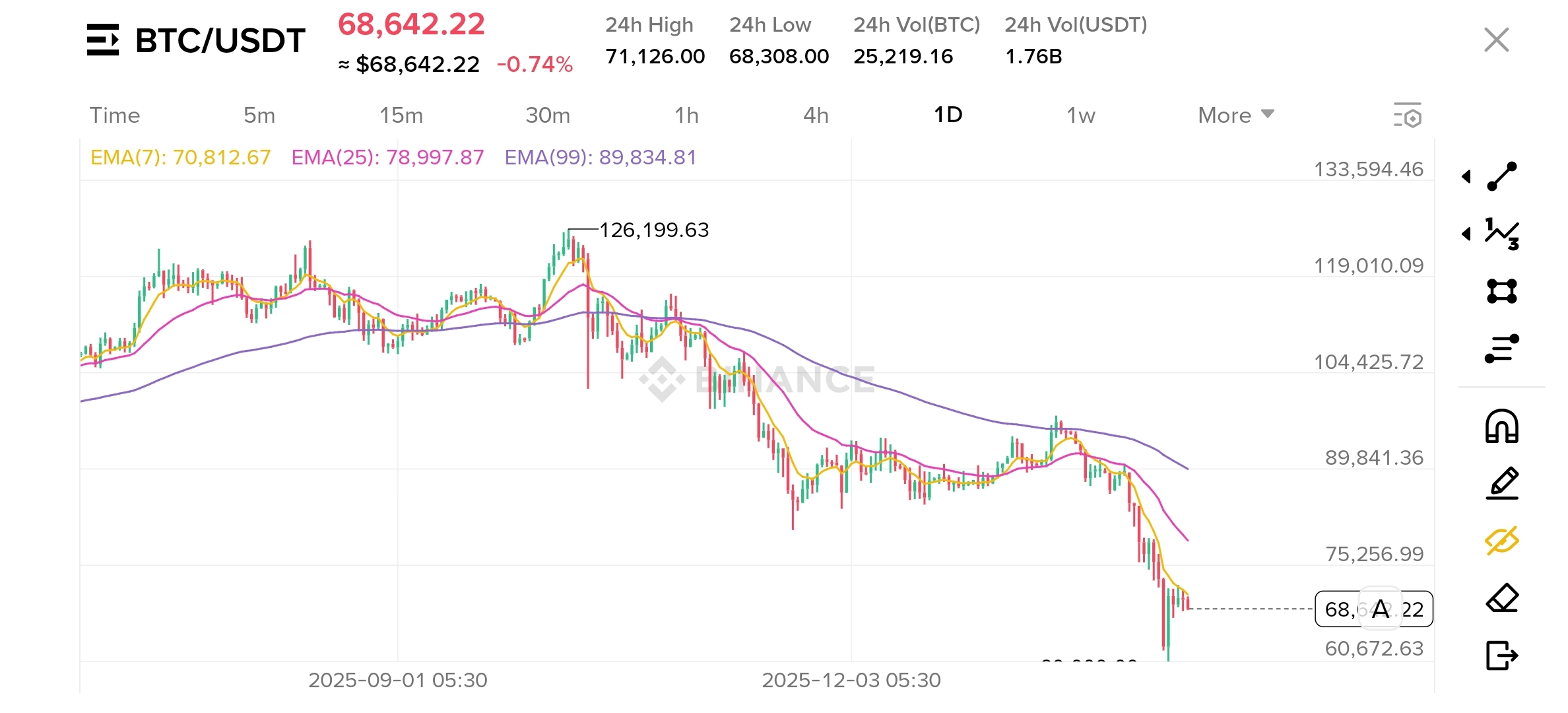
After reaching the 70,000 area, Bitcoin did not explode upwards, nor did it collapse downwards. Instead, the price slowed down, moved in a volatile manner, and began leaning toward sideways movement. This phase confuses many traders, but it is actually one of the most important phases of the market cycle.
When the price reaches a level like 70,000 after a strong surge, the market needs time. Not for rest, but to rebalance.
What does the 70,000 area represent on the chart?
70,000 is not just a psychological number. It is an area where multiple interests intersect:
Traders who bought from low levels start to take profits.
Late buyers hesitate to chase.
Short sellers are entering expecting rejection.
When buyers and sellers are active at the same time, the price doesn't trend. Instead, it compresses. This compression is consolidation.
Why hasn't BTC continued to rise or collapsed strongly?
Strong trends do not usually reverse immediately. Before any major decision, the market does three things:
Profit-taking occurs gradually and not violently.
New demand waits for clarity instead of chasing.
Sellers are testing weakness but without real conviction.
If sellers were fully in control, the drop would have accelerated. This does not happen.
If buyers were fully in control, the price wouldn't have stopped for so long.
So the price remains confined within a range.
What does this type of consolidation actually tell you?
Sideways movement at peaks is not weakness.
Weak markets break quickly.
Strong markets absorb pressure.
Bitcoin is currently absorbing:
Sell orders from profit-taking.
Forced exit from hasty buy positions.
Failed selling attempts to push the price down.
This behavior indicates balance, not collapse.
Why does this phase seem frustrating?
This is the phase where:
Breakouts fail here.
Stop-loss orders are being hunted.
Emotions dominate.
The price moves enough to attract entries, and enough to punish it. This is how leverage gets cleaned up and expectations reset. Most traders lose here because they overtrade.
What usually follows this structure?
From here, the market does only one of two things:
Builds acceptance above the range and then continues to rise after absorbing the supply.
Or breaks an important support with full momentum, not just candle tails.
Until one of these two scenarios occurs, volatility remains normal.
How do you read the market now?
Instead of trying to predict the direction, watch the behavior:
Are the sell-offs sharp or slow?
Is the dip being bought quickly or ignored?
Is the volatility expanding or contracting?
These answers are more important than any opinion.
