

Bright Future: AI and the Crypto Industry – The Digital Revolution is Approaching

In today's technological world, two "giants" are converging to create a storm of innovation: Artificial Intelligence (AI) and Cryptocurrency (Crypto). Imagine a future where your wallet automatically trades, predicting market trends with superior accuracy, and smart contracts act as tireless "smart assistants." By 2026, this combination will no longer be science fiction but is becoming a reality, reshaping the entire decentralized finance ecosystem. Based on the latest trends, this article will explore how AI is revolutionizing the crypto industry, bringing enormous opportunities but also not without challenges.
1. AI – The "Smart Brain" for Trading and Market Forecasting
The crypto industry is notoriously known for its unpredictable volatility, where Bitcoin prices can skyrocket or plummet within hours. But AI is changing that by transforming vast amounts of data into sharp insights. Advanced AI models, such as machine learning systems, can analyze millions of on-chain transactions, forecast price trends, and even optimize investment strategies. For example, platforms like Surf.ai are emerging as "personal companions" for investors, providing market insights four times faster than traditional tools, based on exclusive crypto data and multi-step AI models.
By 2026, we will witness the explosion of AI wallets – digital wallets that manage assets autonomously. They not only store but also automatically execute transactions, diversifying portfolios based on real-time data. According to a report from Silicon Valley Bank, venture capital investment in companies combining AI and crypto has surged, with 40 cents for every dollar invested flowing into this field just in 2025. This promises a smarter crypto market, where even newcomers can compete with "sharks" thanks to the power of AI.
2. On-Chain Security: AI as an "Impenetrable Shield"
One of the biggest barriers for crypto is the issue of security – from wallet hacks to DeFi fraud. AI is filling this gap by revolutionizing on-chain security. AI tools can detect anomalies in transactions at superhuman speed, using deep learning to predict and prevent attacks before they happen. Pantera Capital predicts that 2026 will witness a major shift towards "on-chain intelligence" with definable and verifiable rules, replacing traditional smart contract governance.
Moreover, the convergence between AI and blockchain is creating provenance verification systems and digital signatures. As Forbes predicts, 2026 will see many AI companies integrating blockchain to ensure transparency and authenticity, especially as AI agents autonomously take actions. The result? A safer crypto ecosystem, where trust is built on data rather than empty promises.
3. AI Agents and DePIN: Building the Future of Decentralization
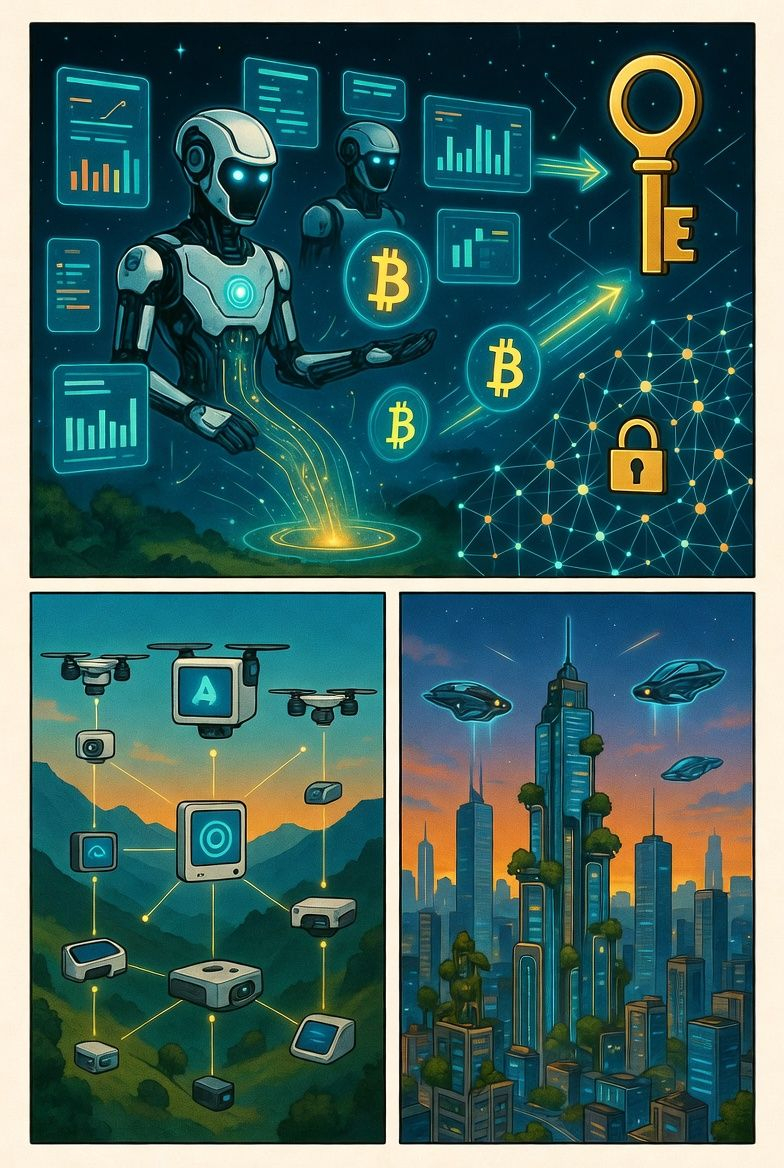
Think about AI agents – intelligent "robots" that can trade, verify, and coordinate economic activities without human intervention. This is the focal point of the AI-crypto convergence in 2026. According to Medium, crypto will become the financial layer for AI agents, allowing them to process payments, tokenize real-world assets (RWA), and even engage in automated digital commerce. At the same time, DePIN (Decentralized Physical Infrastructure Networks) – decentralized infrastructure networks – will explode thanks to AI, providing distributed computing power to support large AI models without relying on centralized data centers.
a16z crypto emphasizes that we will shift from "know your customer" (KYC) to "know your agent" (KYA), where AI agents are verified and closely monitored. This opens a new era for DeFi, NFTs, and even DAO (Decentralized Autonomous Organizations) driven by AI, where efficiency and speed reach unprecedented levels.
4. Challenges and Prospects: Not Always Smooth Sailing
While promising, the AI-crypto combination is not without risks. Data privacy issues, AI ethics (such as biases in predictions), and regulatory challenges are pressing "bottlenecks". For example, when AI agents trade autonomously, who is responsible in case of errors? Regulatory bodies like the SEC are pushing for a legal framework for digital assets, with bills like the CLARITY Act aiming to clarify regulations. Additionally, the enormous energy demands for AI may conflict with the sustainability goals of blockchain, requiring solutions like renewable energy.
However, experts are optimistic. Metatrends predicts that AI and blockchain are two of the five converging platforms, driving each other's development, leading to a value explosion where Bitcoin could reach 1.5 million USD by 2030.
Conclusion: Entering a New Era
The year 2026 will be a pivotal year for the convergence of AI and crypto, transforming this industry from a "risky playground" into a global economic foundation. From automated AI agents to superior on-chain security, we are witnessing the emergence of an intelligent, decentralized ecosystem full of potential. For investors, businesses, or everyday users, this is the time to prepare – because the future waits for no one. Imagine: A world where AI not only predicts but also shapes the destiny of crypto. This is not a dream, but a reality that is approaching. Are you ready?


