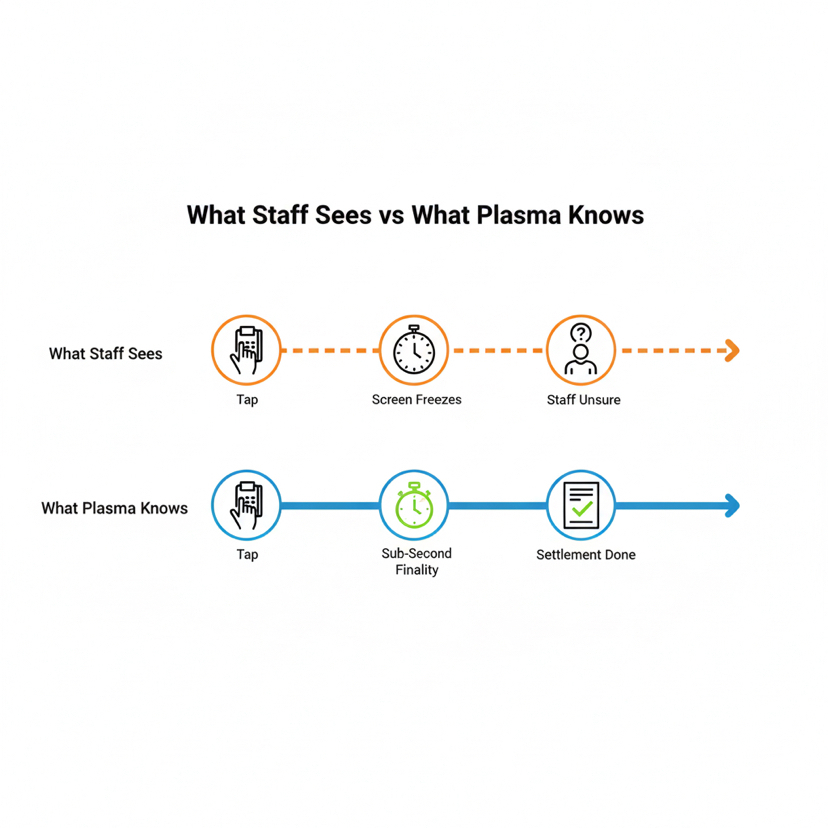
The café Wi-Fi drops at the worst possible time.
Not fully offline. Just slow enough to make everything feel unreliable.
A customer taps to pay with USDT. The cashier hears the small confirmation sound, the one that usually means “keep going.” Then the POS screen freezes halfway between screens, like it forgot what it was about to say.
No error.
No approval.
Just… stuck.
The line behind the customer shifts its weight.
On Plasma, the payment is already over.
PlasmaBFT closed the transaction in under a second. Gasless USDT moved without waiting for a fee token, without asking for another approval step. Settlement happened clean, fast, and somewhere the café’s Wi-Fi delay cannot reach.
But the room doesn’t know that yet.
“Did it work?” the customer asks.
The cashier does what training says: look at the screen.
The screen says nothing useful.
So now the human layer hesitates, even though the settlement layer doesn’t.
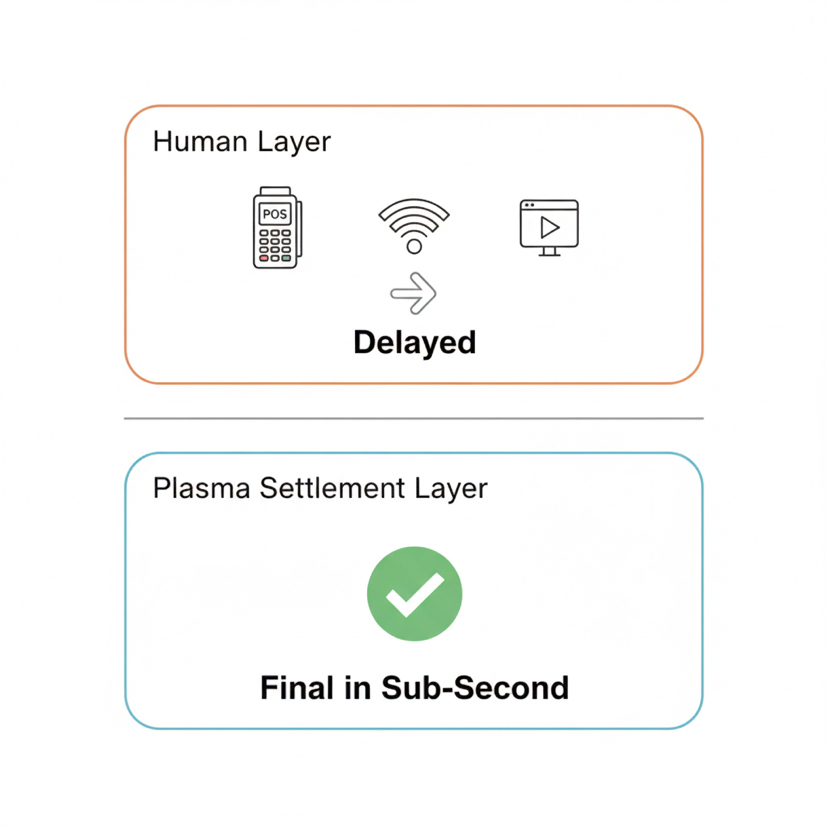
On older payment rails, this is where waiting helps. A delay can mean the transaction hasn’t really settled. Time gives space for uncertainty to resolve.
On Plasma, time is already irrelevant. Finality doesn’t slow down just because the café router did.
The supervisor walks over. Not rushing. Just cautious.
“Check the backend,” she says.
The cashier pulls up the transaction log on a separate device using mobile data. There it is. USDT received. Timestamped a few seconds ago. Already final.
The system of record is calm.
The system of interaction is confused.
That’s the shift Plasma introduces.
The risk isn’t that the payment might disappear. The risk is that the POS might try again because it thinks nothing happened. A retry, in this context, isn’t a correction. It’s a second, very real payment.
“Don’t tap again,” the supervisor tells the customer gently.
They mark the order as paid manually. The fix happens in procedure, not on-chain. A note gets added to the shift report: If Wi-Fi lags, verify by timestamp before retrying.
Nothing about this feels dramatic. No alarms. No red warnings. Just a small mismatch between how fast settlement moves and how fast store systems adapt.
Later that night, finance runs reconciliation.
Every USDT payment from the day sits in the export, neat and aligned. Fees show up inside the same stablecoin flow, thanks to stablecoin-first gas. No one had to stop a sale to top up a native token. No transaction stalled at checkout because of missing fuel.
From the customer side, nothing unusual happened.
From finance’s side, it looks like a clean day.
From ops, it’s a day where procedures got slightly rewritten.
Refunds now follow the same logic. They don’t reverse a payment. They create a new one in the opposite direction. Each refund carries its own finality, its own fee footprint, its own timestamp. The books reflect reality as a series of settled facts, not editable states.
Plasma’s EVM compatibility made integration easy. The payment module fit into existing systems without major rewrites. Reth felt familiar to the developers.
The hard part wasn’t technical.
It was cultural.
Staff had to unlearn the idea that settlement waits for the interface to feel ready. On Plasma, the chain doesn’t pause for Wi-Fi, slow tablets, or human doubt. It finishes first.
Bitcoin anchoring never comes up during a coffee sale, but it matters in the background. Especially for institutions and cross-border flows, where neutrality and resistance to interference aren’t theoretical concerns. The base layer staying steady lets higher layers move fast without second-guessing the ground beneath them.
A month later, the café staff don’t talk about blockchain. They talk about edge cases. Slow connections. Double taps. When to trust the receipt time over the screen animation.
The chain keeps doing the same thing every time: settling before the room finishes reacting.
That’s the real adjustment.
Payments stop being a live negotiation and start being recorded history almost immediately. The technology speeds up first. The workflow learns to breathe in that new timing after.