
To be honest, if you pulled the timeline back to a year or two ago, the idea of an 'API upgrade' hardly stirred any emotional response in me.
A faster, more stable interface with more fields—important for developers, but almost irrelevant to the lives of ordinary people.
But when I was looking at myNeutron v1.4, I felt something a little different for the first time.
It no longer feels like a 'tool layer for developers,' but rather like it is quietly answering a much bigger question:
When the digital world starts to have long-term memory, will our daily behaviors be redefined?
Starting from API, but the goal is not in API
Nominally, myNeutron v1.4 is still a technical upgrade.
More stable interfaces, finer-grained state synchronization, lower friction calling experiences—these things are certainly important for applications in the Vanar ecosystem.
But if you only understand it as 'making development easier,' you are actually underestimating its ambition.
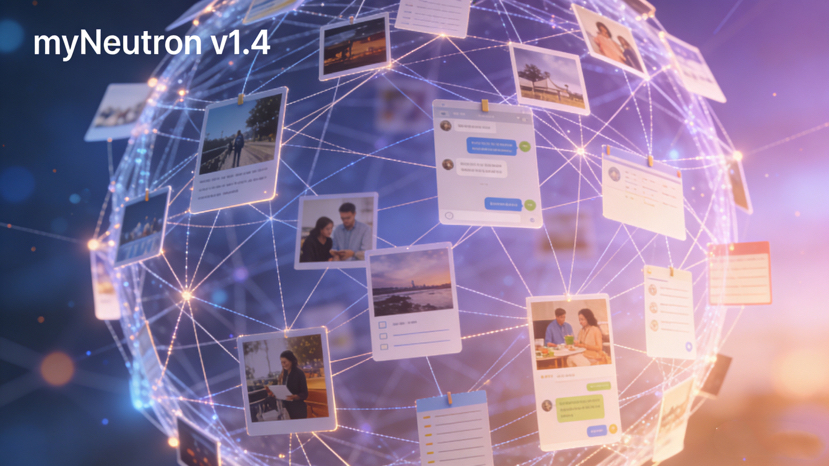
I prefer to think of myNeutron as a 'memory hub.' What it does is not just simply store data, but continuously link behavior, state, and identity together.
What you have done is no longer just a log; what you have participated in will become part of your digital identity.
This step is precisely the watershed from 'API' to 'lifestyle.'
⸻
Permanent memory begins to enter the daily layer
Many projects are talking about 'permanent storage' and 'on-chain memory,' but most stay at the conceptual level:
Either the cost is too high, only key events can be stored;
Either the experience is too poor, and ordinary users feel nothing.
The interesting thing about myNeutron v1.4 is that it does not package 'permanent memory' into a grand narrative, but directly incorporates it into daily behavior.
Your choices in one application, your role evolution in one world, and your identity continuity in multiple scenarios all begin to be recorded through a unified memory layer.
Not to show off skills, but for a very realistic goal: to make the digital world remember who you are, rather than starting over every time.
When memory is no longer a one-time snapshot but a continuous state, you will find that many experiences naturally change—
• Different applications begin to 'recognize' you
• Historical behavior begins to influence future permissions
• Identity is no longer just a login state, but an existence in the time dimension
This is no longer a tool upgrade, but a change in experiential logic.
From 'using products' to 'leaving traces'
I personally care about one thing: whether your behavior in the digital world really has consequences.
The traditional internet is actually highly 'forgetful.'
What you have posted and participated in can easily be drowned out by algorithms, reset by platforms, leaving only this moment.
What myNeutron v1.4 does is the opposite—
It assumes: behavior is worth remembering, even if it is not 'high value' at the moment.
This design will gradually change user mentality.
When you know your choices will be continuously recorded and may be referenced in the future, you will naturally participate more seriously, rather than just clicking through.
This is also why I feel it is transitioning from 'API' to 'lifestyle.'
Not because it is complicated, but because it begins to affect how you treat your own digital behavior.
⸻
VANRY plays a role here
In this structure, $VANRY becomes more concrete.
It is not just the cost of calls or network fuel, but a real anchor point for memory to be sustained.
Long-term states need maintenance, memories need consensus, and history needs verification—none of these are free.
When you pay for a long-term record, you are essentially saying:
This experience is worth preserving for me.
This mechanism of 'pricing memories with tokens' is actually very restrained and very realistic.
It avoids the garbage accumulation caused by infinite recording while allowing meaningful participation to naturally settle.
Sweet perspective
I do not believe myNeutron v1.4 will immediately break out due to a particular feature; it is not the kind of upgrade that is 'understood at a glance.'
But in the long run, it may be a very critical step in the Vanar system.
Because what truly determines whether an ecosystem can enter daily life is not TPS, nor TVL, but a simpler question:
Does it remember you?
When 'permanent memory' is no longer a slogan but woven into the daily user experience, blockchain has a chance to transition from a backend technology to a default existence.
For me, this is the most noteworthy aspect of myNeutron v1.4.
It does not tell you that the future must be grand, but quietly begins to turn 'being remembered' into a daily right.
And once you become accustomed to this experience, returning to a completely forgetful digital world will feel somewhat off.
