Order types play a critical role in how trades are executed on a crypto exchange. While market orders prioritize speed, limit orders and stop-limit orders give traders control — over price, timing, and risk. Understanding the difference between these two order types helps prevent unexpected executions and improves overall trade discipline.
Although they sound similar, limit orders and stop-limit orders serve very different purposes.
What Is a Limit Order?
A limit order is an instruction to buy or sell a specific amount of cryptocurrency at a defined price or better.
When placing a limit order:
A buy limit order sets the maximum price you are willing to pay
A sell limit order sets the minimum price you are willing to accept
Limit orders are commonly placed:
Below the current market price for buys
Above the current market price for sells
If the market reaches your specified price and there is sufficient liquidity, the order is filled. If not, it remains open in the order book.
Why Traders Use Limit Orders
Limit orders give traders price certainty. You know exactly the worst price you will accept, even if execution takes time.
They are often used for:
Planned entries and exits
Scaling into or out of positions
Avoiding slippage in volatile markets
If a limit order is placed at the current market price in a liquid market, it may fill almost instantly. In thin or volatile markets, execution can be delayed or partial.
What Is a Stop-Limit Order?
A stop-limit order adds a second layer of control. It consists of two prices:
Stop price – the trigger
Limit price – the execution price
Once the market reaches the stop price, a limit order is automatically placed at the limit price you specified.
For example:
A sell stop-limit might trigger below support to protect downside
A buy stop-limit might trigger above resistance to catch momentum
The order will only execute if the market can fill the limit price or better.
Why Stop-Limit Orders Are Used
Stop-limit orders are commonly used for:
Risk management and trade protection
Breakout strategies
Structured entries and exits
They allow traders to define both when a trade should activate and how it should be executed.
However, stop-limit orders do not guarantee execution. If the market moves too quickly past the limit price, the order may remain unfilled.
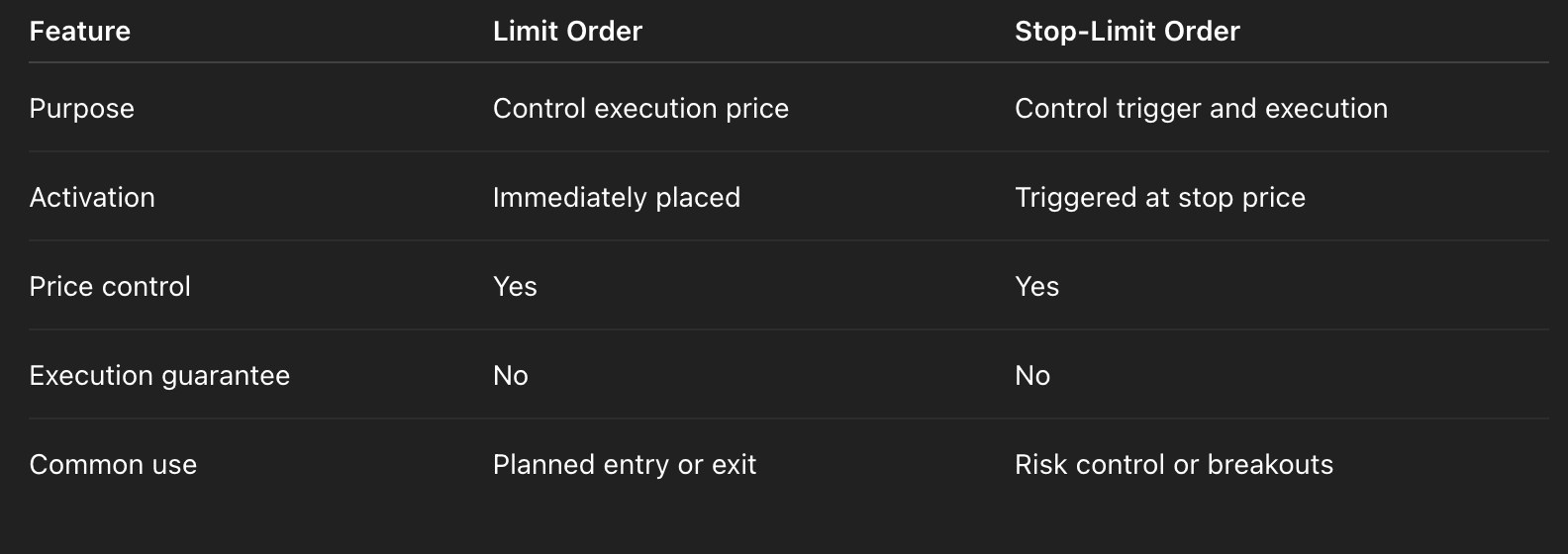
Key Differences Between Limit and Stop-Limit Orders
Choosing the Right Order Type
The choice depends on intent:
Use limit orders when price precision matters more than speed
Use stop-limit orders when you want a trade to activate only after a specific market condition is met
Both order types are tools for disciplined trading, not predictions of market direction.
Final Thoughts
Limit orders and stop-limit orders are essential for traders who value structure and control. A limit order defines what price you want. A stop-limit order defines when the market should care — and how far you are willing to go on execution.
Understanding this distinction helps traders manage risk more effectively and avoid surprises in fast-moving crypto markets.