

Bitcoin has never closed both January and February in the red. On the surface, that sounds like just another market stat, the kind people repeat during quiet weeks. But when you slow down and really think about it, this pattern is less about predicting price and more about understanding how Bitcoin behaves over time, how market psychology works, and why patience often beats reaction.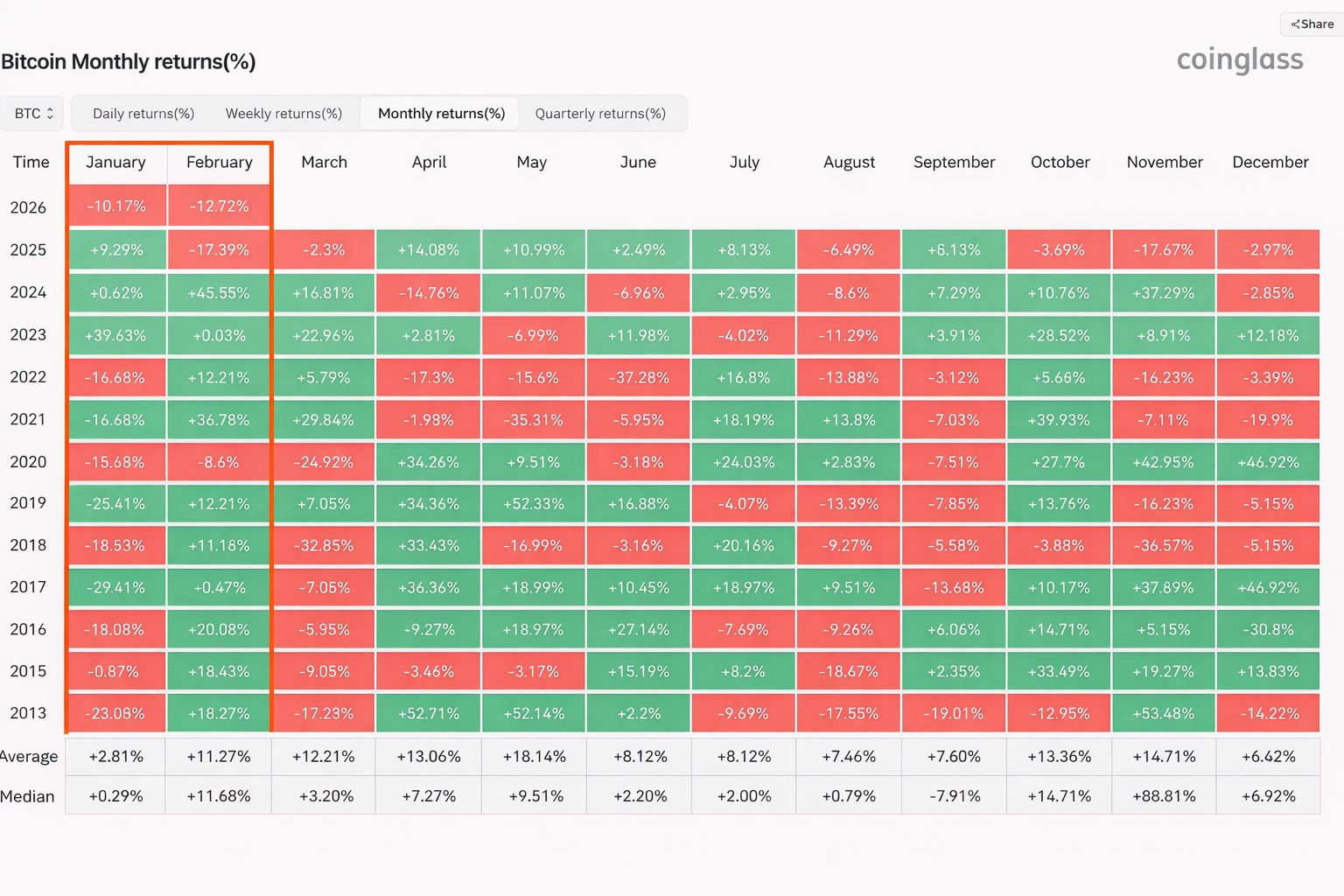
The start of the year is a unique moment for financial markets. Capital resets, portfolios are rebalanced, and risk is reassessed after the emotional swings of the previous year. January often brings hesitation, repositioning, and caution. February then becomes the month where that early positioning is either confirmed or abandoned. Bitcoin, which is driven more by liquidity and sentiment than by earnings or balance sheets, reacts strongly to this transition.
What matters is not that January is sometimes red. That happens. What matters is that historically, weakness at the very start of the year has not been allowed to compound. Bitcoin has always found enough support, stabilization, or recovery before February closes. Not always a rally. Sometimes just a pause. Sometimes a grind. But never a full confirmation of early-year collapse.
This tells us something important about the structure of the Bitcoin market. A large portion of Bitcoin’s supply is held by long-term participants who are not forced sellers. They are not rebalancing quarterly. They are not reacting to short-term volatility. When early-year fear appears, it often meets holders who are willing to absorb supply rather than dump it. That creates a natural resistance to sustained downside, especially in the first months of the year.
Seasonality in markets is not magic. It is human behavior repeating itself. At the beginning of a new year, pessimism often peaks because the previous year’s losses are still fresh. But at the same time, new capital begins to re-enter, and old narratives lose their emotional grip. Bitcoin, as a belief-driven asset, responds quickly to this shift. Even in difficult macro environments, the psychological reset of a new year has historically been enough to prevent consecutive early-month breakdowns.
It is also important to understand what this pattern does not mean. It does not guarantee gains. It does not mean Bitcoin cannot fall later in the year. It does not mean volatility disappears. Many years where this pattern held still experienced deep drawdowns later on. The lesson is not about certainty. It is about probabilities and structure.
Markets do not usually break because of one bad month. They break when weakness persists long enough to destroy confidence. Bitcoin’s history shows that early-year weakness has not been allowed to reach that point. Confidence may wobble, but it has not collapsed twice in a row at the very start of a year.
This is where the real educational value lies. Bitcoin teaches that time matters as much as price. Looking at isolated candles leads to emotional decisions. Looking at behavior across meaningful windows leads to better judgment. January and February together form one of those windows. They filter out impatience and reward those who can think beyond immediate fear.
The pattern also highlights why long-term participants tend to outperform reactive ones. Those who understand Bitcoin’s cycles do not need every month to be green. They need structure to remain intact. Historically, early-year structure has held, even when narratives were negative and headlines were loud.
Bitcoin refusal to close both January and February red is not a promise of upside. It is a reminder. A reminder that markets move in rhythms, that fear is often front-loaded, and that patience is a strategy, not a personality trait.
The deeper lesson is simple: understanding behavior is more powerful than predicting outcomes. Bitcoin’s history does not reward those who chase certainty. It rewards those who respect cycles, manage emotions, and give time a chance to do its work.
