

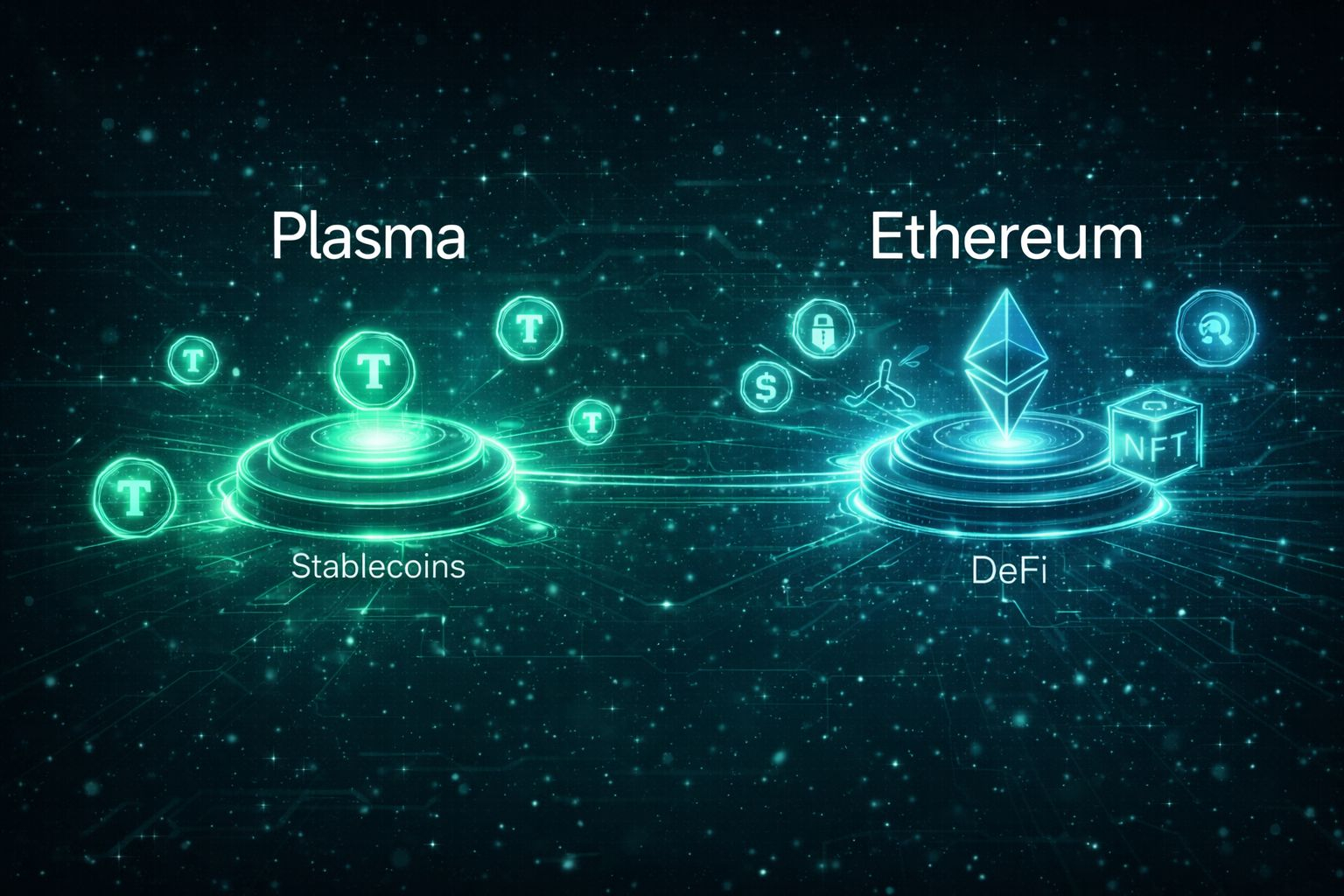
I think to talk about what @Plasma is addressing that Ethereum is still struggling with, we must start from a somewhat difficult truth: Ethereum is not failing to scale. It is simply being pulled too far away from what it was created to do.
Ethereum is designed as a 'general-purpose computer.' Everything can run on it, anyone can build, and no use case is favored. This is what makes Ethereum powerful, but it also makes it clumsy when handling very monotonous, repetitive value streams that are extremely sensitive to costs.
Stablecoins are the clearest example. And also where the contradictions are most evident.
Stablecoins do not need complex composability. They do not need permissionless innovation like DeFi. And they also do not need every transaction to be executed in a fully EVM environment.
What stablecoins need is very simple: low fees, stable latency, predictable costs, and not crashing when volumes surge suddenly.
On Ethereum, stablecoins have to compete for block space with everything else. NFT minting, airdrop farming, memes, short-term experiments. When the market is hot, rising fees are reasonable for speculators. But for stablecoins, those fees are just pure costs.
When you transfer USDC for payments, treasury management, or settlement between parties, there is no 'upside' to compensate for high fees.
Ethereum has L2, true. But the more L2s there are, the more fragmented the money flow becomes. Bridges, liquidity fragmentation, and more complex UX. With DeFi, it can still cope. With payments, it starts to become a burden.
Plasma looks directly at that pain point but does not try to fix Ethereum. They choose a different path.
Plasma does not try to become a general-purpose computer. It does not try to serve every use case. From the beginning, it accepts itself as a specialized infrastructure for payments and settlements, especially for stablecoins.
It sounds a bit 'boring.' In a market used to stories about world computers and financial layers for everything, this approach is not sexy at all.
But that lack of sexiness is actually the differentiator.
Plasma does not try to create new demand. It only tries to improve on an existing and growing demand: moving stablecoins with low costs, stable latency, and predictable behavior.
The problem that Ethereum is still struggling with is not 'how many TPS can it handle,' but 'how to efficiently serve non-speculative transactions.'
Ethereum thrives on market excitement. High fees are still accepted because the expected profits are even higher. But that logic does not apply to stablecoins.
Plasma is designed around the opposite logic. And because of that, it is willing to sacrifice many things that Ethereum considers core.
One of the biggest sacrifices is full on-chain execution and maximum data availability. Plasma pushes execution off-chain, minimizes the data that needs to be published, and focuses on safety in the exit mechanism.
For those who are used to the philosophy of 'everything must be on-chain,' this may seem like a step back. But for traditional payment systems, which have been accustomed to off-chain settlements for a long time, this is a reasonable trade-off.
Ethereum is having a headache because it has to bear too many roles at once. It is both a DeFi hub, a settlement layer, and must keep fees high enough for security while also keeping them low enough not to drive users away.
Plasma does not. It does not need to serve NFTs, does not need to attract thousands of dApps, does not need a broad narrative. This makes Plasma less attractive when viewed through familiar metrics like diverse TVL or the number of protocols.
The adoption of Plasma, if it happens, will go in a narrow but deep direction. A few large stablecoin flows will dominate the activity instead of thousands of small apps. For a market accustomed to measuring success by breadth, this is a clear disadvantage.
Ethereum, even though it's a headache, still wins absolutely in those metrics.
But in terms of timing, Plasma is addressing a problem that Ethereum has not been forced to prioritize.
When the market revolves around leverage, memes, and short-term narratives, stablecoin infrastructure is not the focal point. Ethereum still thrives thanks to speculative fees.
In that context, Plasma can easily be seen as 'not necessary.'
But if the market transitions to another phase, where stablecoin volume rises sharply, institutional money returns, and demands for costs, stability, and predictability become stricter, then Ethereum's limitations will truly emerge.
I do not think Plasma will replace Ethereum. And I also do not think Ethereum is wrong.
These two systems reflect two different perspectives on crypto. Ethereum bets on generality and adaptability. Plasma bets on some use cases being large enough to warrant a dedicated infrastructure, even if it has to forgo many attractive ideological aspects.
The question is not which one is more correct, but which approach the market will reward in the medium term.
And perhaps what catches my attention the most about Plasma is that they do not promise that this will happen quickly.
In crypto, not promising anything can sometimes be a signal worth observing.



