

When many people see '2 billion stablecoin liquidity,' their first reaction is scale:
Wow, that's a lot of money.
But if you shift your focus to institutions, the significance of this number lies not in 'more,' but in concentration, dispatchability, and predictability.
Wall Street never lacks money; what it lacks is a settlement layer that can be called upon at any time without issues. The true importance of a central bank lies not in its money, but in its ability to provide liquidity at the right time and place when the system needs it.
From this perspective, Plasma's recently emerging structure has begun to reveal a familiar outline—
It's not an exchange, nor a public chain ecosystem, but a stablecoin settlement hub.
In the past, institutions using stablecoins on-chain was actually very awkward.
Funds are scattered between different chains, different protocols, and different custody systems, leading to long settlement paths, many points of failure, and uncontrollable time. Each large transfer is an operational risk assessment, not just a simple 'transfer.'
This conflicts with the funding management logic of institutions.
Institutions do not pursue extreme yields; what they pursue is:
• Certainty
• Predictable liquidity
• Settlement capability that can still be called upon in times of stress
The uniqueness of Plasma lies in the fact that it does not start from 'trading scenarios', but directly from the most core and conservative scenario of stablecoin settlement.
2 billion stablecoin liquidity placed here does not mean that 2 billion is 'waiting to be used' on-chain, but rather signifies a fact:
Here, the conditions for becoming a liquidity scheduling node have begun to emerge.
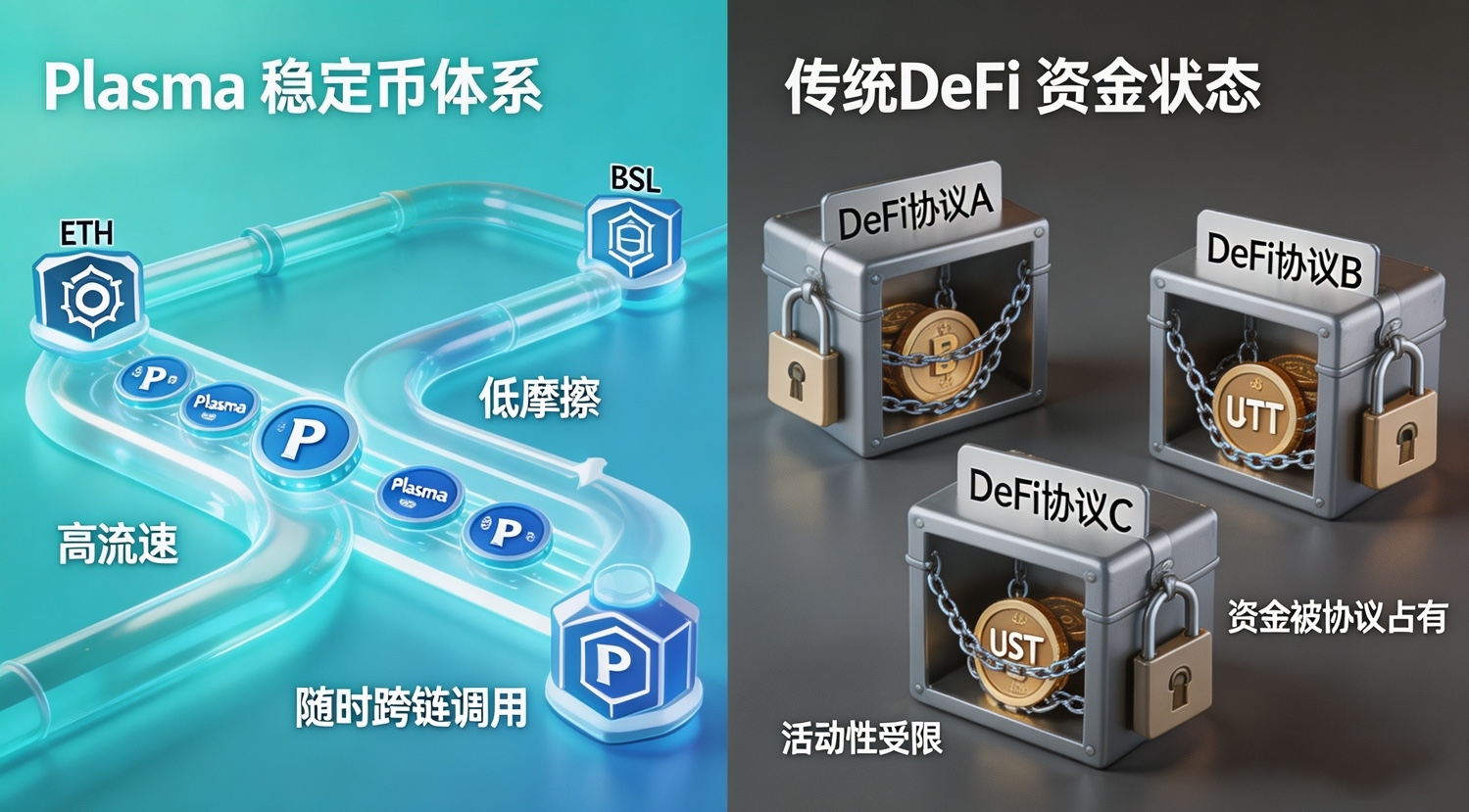
More critically, these stablecoins are not locked in yield farms, nor are they decorative items for stacking TVL, but are in a system with high flow rates, low friction, and can be called across chains at any time.
This is completely different from the logic of DeFi.
DeFi funds are 'occupied by protocols';
The funds of Plasma are more like 'managed by the system, but can be called at any time.'
This is where the temperament of a central bank begins to appear.
Looking further down, you will find that what Plasma is doing is increasingly unlike a traditional blockchain project.
It does not encourage users to lock up their money for a long time;
Not seeking to induce funds to stay with high yields;
It doesn't even emphasize 'ecological stickiness.'
What it cares more about is:
When a certain institution needs settlement, hedging, allocation, or cross-chain, whether this money can be completed immediately, stably, and imperceptibly.
This doesn't sound like a crypto narrative; instead, it feels very Wall Street.
And the characteristics of 'sub-second confirmation' and 'zero fees' that have been repeatedly mentioned suddenly seem no longer marketing points, but necessary conditions for the settlement system.
If settlement is slow, costs are uncertain, and failure probabilities are high, institutions will not place core funds here.
You can even understand it this way:
Plasma is not about 'attracting institutions to go on-chain', but about simulating a financial infrastructure that institutions are already familiar with, just placed on-chain.
When 2 billion stablecoins begin to circulate in such a system, what you get is not a larger fund pool, but a liquidity center closer to the logic of 'lender of last resort.'
Of course, Plasma is still not a central bank.
It does not have the power to issue currency, nor does it conduct macro-control.
But it has already begun to assume one of the key functions of a central bank:
Provide trustworthy, callable settlement liquidity between different entities.
Interestingly, with the introduction of intention chains and strategy settlements, this 'central bank prototype' has been further amplified.
Because once the settlement layer is not just executing commands but can understand 'I need liquidity', 'I need to finish quickly', 'I need the minimum risk path', then it starts to participate in resource allocation, rather than just transferring value.
In traditional finance, this is precisely the core source of power for central banks and clearing institutions.
So I don't think the phrase 'crypto central bank of Wall Street' is an exaggeration.
It's not about how high Plasma's status is, but about the extremely rare path it has chosen:
Not making financial products for retail investors;
No chasing yields, no storytelling;
But it focuses on making 'settlement' reliable enough, neutral enough, and imperceptible enough.
If one day, institutions allocate stablecoins on-chain,
No longer caring about which chain to take, how many bridges to cross, or which protocol to use,
But merely treating Plasma as a 'default existing backend system'—
Then it may not be far from the form of 'crypto central bank.'
Real financial power often does not come from the front desk, but from those backend systems that never make mistakes at critical moments.
Plasma is moving closer to that direction.

